
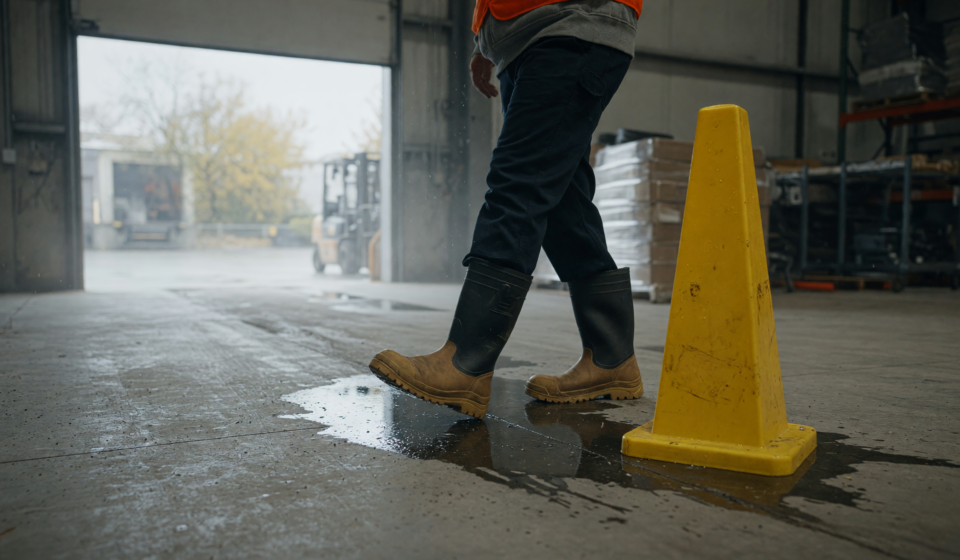
Warehouse Slip Prevention: Traction, Wet Floors and Fall Weather
It usually happens in the least dramatic way possible. A forklift tracks in rain from the dock, a pallet of cold product sweats onto the concrete, and someone rounding the end of an aisle with an armful of cartons puts a heel down on a film of water they never saw. There is no warning, just the sudden, sickening slide. Same-level falls like this are quietly one of the most common ways warehouse workers get hurt, and they spike exactly when the weather turns. That is why warehouse slip prevention deserves real attention before fall sets in, not after the first incident report lands on your desk.
This guide walks through what actually keeps people upright on a warehouse floor as the seasons change. We will cover floor traction and how it is measured, slip-resistant footwear and the standards behind it, wet floor control at docks and entrances, the role of entrance matting, and the housekeeping and hazard-marking habits that tie it all together. Along the way we will point to the US agencies and standards that set the baseline, so you can separate marketing claims from the requirements that genuinely matter for your crew.
Why Fall Weather Turns a Dry Floor Into a Hazard
Warehouses feel like sealed environments, but they breathe with the weather outside. Once autumn rain and the first cold snaps arrive, water and grit come in on wheels, boots, and pallets, and they collect in the exact places where people move fast and carry loads. The US Bureau of Labor Statistics consistently ranks falls, slips, and trips among the leading events behind nonfatal workplace injuries that cost workers days away from work, and a wet or contaminated walking surface is one of the most preventable triggers behind them.
The seasonal risk factors tend to cluster together:
- Tracked-in moisture: Rain and melting slush ride in on forklift tires and foot traffic, leaving thin, near-invisible films near doors and docks.
- Condensation: Cold products and cold outdoor air meeting warm interior air create sweating floors around refrigerated zones and loading bays.
- Reduced daylight: Shorter days mean more work under artificial light, where a wet patch is harder to spot at a glance.
- Grit and leaves: Debris blown in from outside acts like ball bearings underfoot on smooth sealed concrete.
Traction, Explained Without the Jargon
Traction is really just friction between the sole of a shoe and the floor. Safety professionals put a number on it called the coefficient of friction (COF), and a higher number means more grip. The number that matters most for warehouses is the wet COF, because a floor that grips fine when dry can turn treacherous the moment water gets between the sole and the surface.
In the United States, the National Floor Safety Institute (NFSI) and its ANSI-approved B101 standards give the industry a common yardstick. The ANSI/NFSI B101.1 method measures the wet static coefficient of friction of hard-surface walkways, while B101.0 lays out how to audit a walkway’s traction in the field. These standards sort surfaces into traction ranges, so you can objectively say a floor is high-traction rather than just hoping it feels grippy. If you are specifying new flooring, coatings, or anti-slip treatments, asking a supplier for results tested to the ANSI/NFSI B101 series is a fair, verifiable request.
Key point. Grip is a system, not a single product. The safest floor in the world still slips if it is wet and the crew is in worn-out soles, and the best boots slide on a surface that was never rated for traction. Match the footwear, the floor finish, and the housekeeping to each other.
Warehouse Slip Prevention Starts at the Sole
Footwear is the one piece of the traction system that moves with the worker, which makes it the backbone of any warehouse slip prevention program. Slip-resistant work shoes and boots use softer rubber compounds and tread patterns designed to channel liquid away from the contact patch, much like a tire in the rain. The tread cuts through the water film so the rubber can actually touch the floor instead of hydroplaning across it.
The relevant US test method here is ASTM F2913, the standard test method that uses a whole-shoe tester to measure the coefficient of friction of footwear against a surface. When a manufacturer marks a shoe as slip-resistant, ASTM F2913 is the kind of standardized, repeatable test that should be backing that claim rather than a vague in-house benchmark. When you evaluate footwear for your team, look for a few things:
- Tested slip resistance: Grip performance evaluated to a recognized method such as ASTM F2913, not just an “SR” sticker with no reference behind it.
- Tread that clears fluid: Open, siped patterns that give water somewhere to go, rather than a smooth or heavily worn sole.
- The right protective features: Where the job calls for it, safety-toe protection meeting ASTM F2413 alongside the slip resistance.
- A wear-out plan: Soles lose grip as the tread rounds off, so replace them on a schedule rather than waiting for a fall.
👉 Shop slip-resistant safety work boots and shoes on Amazon (Ad — as an Amazon Associate, we earn from qualifying purchases.)
Controlling Wet Floors at Docks and Entrances
The single most effective move is to stop water from spreading in the first place. OSHA’s walking-working surfaces rule, 29 CFR 1910.22, sets the expectation plainly: employers must keep floors clean, orderly, and as dry as practicable, and where wet processes are used, they must provide drainage and, where feasible, dry standing places such as false floors, platforms, or mats. The same rule requires walking surfaces to be kept free of hazards like spills, snow, and ice. In practical terms, that means building a routine around the wet spots you already know about.
- Target the entry points: Docks, personnel doors, and battery-charging or wash areas are where moisture concentrates, so put your controls there first.
- Give water a path out: Squeegees, floor drains, and wet-vacs get standing water off the surface before it spreads down an aisle.
- Dry, do not just cover: A cone parked over a puddle warns people but does nothing to fix the slip; clean it up and then mark what remains.
- Watch the shoulder seasons: On damp fall mornings, sweep and dry high-traffic thresholds at shift start before the crew is moving at full speed.
👉 Shop floor squeegees, wet-floor signs and spill cleanup kits on Amazon (Ad — as an Amazon Associate, we earn from qualifying purchases.)
Entrance Matting: The Cheapest Grip You Can Buy
Good matting is the unglamorous hero of fall slip prevention. A properly sized entrance mat system captures water and grit from wheels and boots before either reaches the sealed concrete, which shrinks the wet zone you have to manage everywhere else. The rule of thumb long promoted by floor-safety specialists is that it takes several strides on matting to dry a shoe, so short, token mats at a busy dock door do very little.
- Length beats logos: Run enough mat that a person takes multiple steps on it, so soles are meaningfully drier by the time they hit the floor.
- Lay it flat and secured: Curled edges and sliding mats become trip hazards, so use beveled edges and backing that stays put.
- Service it: A saturated mat just relocates the puddle; swap or clean mats on a schedule during wet weather.
- Match the zone: Scraper matting outside for grit, absorbent matting inside for moisture, and anti-fatigue matting at fixed workstations where feet stay planted.
👉 Shop commercial entrance and anti-fatigue floor matting on Amazon (Ad — as an Amazon Associate, we earn from qualifying purchases.)
Housekeeping, Lighting, and Marking the Hazard
Even with great footwear and matting, a warehouse floor stays safe only if people can see hazards and the aisles stay clear. OSHA’s general housekeeping expectation under 1910.22 is that walking-working surfaces are kept clean and orderly, and much of that comes down to daily discipline rather than equipment. The goal is simple: make the safe path obvious and the hazards visible.
- Keep aisles clear: Stray shrink wrap, banding, and stray cartons are classic trip hazards that pair badly with a slick floor.
- Light the walkways: Shorter fall days make adequate, well-maintained lighting essential for spotting spills and edges early.
- Mark spills fast: Wet-floor signs and floor tape make an unavoidable hazard visible until it is cleaned and dried.
- Close the loop: Give workers an easy way to report a slick spot, and act on it before the next shift walks through.
Building a Simple Seasonal Program
None of these pieces do much in isolation, so the real work is stitching them into a routine the crew actually follows when the weather turns. A light-touch seasonal program keeps everyone aligned without adding paperwork for its own sake.
- Audit before the weather turns: Walk the docks and entrances in early fall, note the recurring wet spots, and check that matting and drainage are ready.
- Set a footwear standard: Decide what slip-resistant footwear you require and how often worn soles get replaced, then communicate it.
- Assign the cleanups: Make it clear who dries the dock at shift start and who owns the squeegees and mats.
- Review incidents and near-misses: Every slide, even one without an injury, is a free lesson about a spot that needs attention.
The Bottom Line
Slips are rarely about one careless step; they are about a system that let water, worn soles, and a smooth floor line up at the wrong moment. Get ahead of fall weather by treating traction as a whole system: footwear tested to recognized methods like ASTM F2913, floors and coatings you can verify against the ANSI/NFSI B101 traction standards, aggressive wet-floor control and matting at the doors, and the plain housekeeping that OSHA’s 1910.22 expects. Do that before the first cold rain, and you turn one of the most common warehouse injuries into one of the most preventable. Your crew stays on their feet, and that is the whole point.
Disclaimer: This article is provided for general educational purposes only and does not constitute safety, legal, or compliance advice. Standards, test methods, and regulations are referenced in summary and may be updated over time. Always consult the current text of the applicable OSHA regulations and consensus standards, along with a qualified safety professional, before making decisions about your workplace, equipment, or personal protective equipment.
Sources: Occupational Safety and Health Administration (OSHA), 29 CFR 1910.22, Walking-Working Surfaces (Subpart D); ASTM International, ASTM F2913 Standard Test Method for Measuring the Coefficient of Friction for Evaluation of Slip Performance of Footwear; ASTM F2413 Standard Specification for Performance Requirements for Protective (Safety) Toe Cap Footwear; National Floor Safety Institute (NFSI) and ANSI/NFSI B101.0 and B101.1 walkway traction standards; U.S. Bureau of Labor Statistics (BLS), Injuries, Illnesses, and Fatalities program data on falls, slips, and trips.