
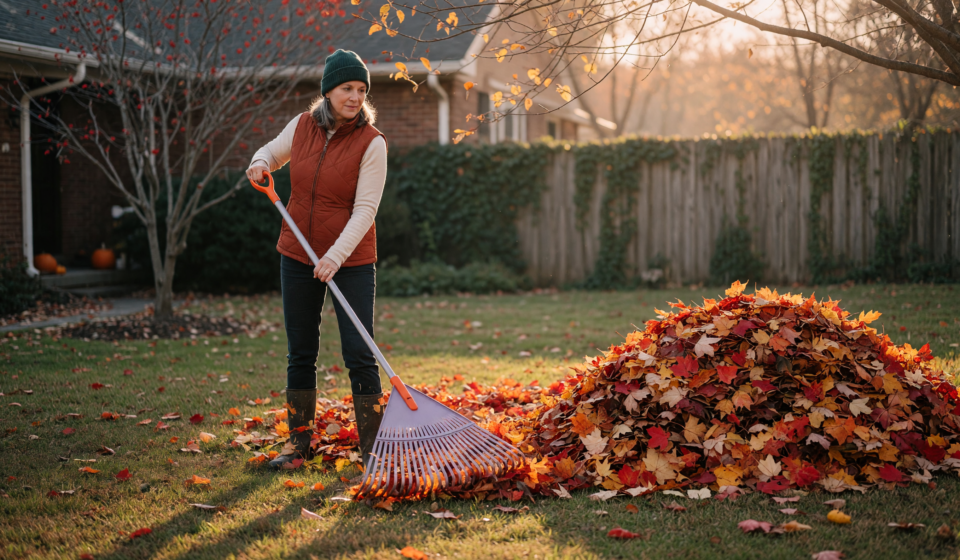
Raking Without Injury: Back-Safe Technique and Ergonomic Rakes
It usually happens on the second bag. You have been sweeping the same pile toward the curb for twenty minutes, twisting a little farther with each pull because moving your feet feels like a waste of time, and then something in your lower back locks up. Millions of Americans reach for a rake every autumn, and a surprising number of them finish the weekend on a heating pad. The good news is that most of that pain is preventable, and it comes down to raking ergonomics: how you stand, how you move, and what you hold in your hands.
This guide walks through the whole job the safe way. We will cover why raking is so hard on the lower back, how to warm up before you start, the back-safe stance and pulling motion that keeps your spine out of trouble, and how to choose an ergonomic rake that does more of the work for you. We will also talk about the gloves, footwear, and lifting technique that matter just as much as the rake itself. The principles come straight from occupational-safety and orthopedic guidance, translated into plain English for your own front yard.
Why Raking Is So Hard on Your Back
Raking looks gentle, but it hits nearly every risk factor that safety scientists warn about. The National Institute for Occupational Safety and Health (NIOSH), the research arm of the CDC, describes musculoskeletal disorders as injuries that build up from awkward postures, repetition, and forceful exertion over time. A raking session serves up all three at once: you bend and twist your spine into an awkward posture, you repeat the same pulling stroke hundreds of times, and you fight the resistance of wet, heavy leaves with every pull.
The trouble is that no single stroke feels dangerous. Injury creeps in through accumulation, which is exactly why people ignore the early warning signs and keep going. Understanding the mechanism helps you respect it:
- Awkward posture: Bending forward at the waist and rotating your spine puts uneven load on the discs and small muscles of the lower back.
- Repetition: The same motion performed hundreds of times fatigues the stabilizing muscles that normally protect your spine.
- Forceful exertion: Dragging damp leaves, especially after rain, dramatically increases the resistance your arms and back have to overcome.
- Static loading: Gripping a rake and holding your torso in one flexed position for long stretches starves muscles of the movement variety they need.
Warm Up Before You Reach for the Rake
Yard work is exercise, and no one sprints without stretching first. The American Academy of Orthopaedic Surgeons recommends warming your muscles before starting outdoor chores like raking, holding each stretch for roughly ten to thirty seconds, breathing into the stretch rather than bouncing through it. A cold, tight lower back is far more likely to strain on that first hard pull than one that has already been moved through its range.
A five-minute routine is enough. Gentle trunk rotations, hamstring and calf stretches, and a few shoulder rolls prepare the exact tissues you are about to load. When you finish raking, repeat the same stretches as a cool-down while your muscles are still warm. Treating the job like a workout, with a beginning and an end, is one of the simplest habits that separates a sore Sunday from a healthy one.
The Back-Safe Stance and Pulling Motion
How you stand determines whether your legs or your spine absorb the work. Johns Hopkins Medicine offers a clear template: stand up straight with your back straight and your knees slightly bent, and keep one foot just in front of the other so your weight is evenly distributed. From that staggered stance you can rock forward and back, letting your legs and hips power the stroke instead of hinging repeatedly at the waist.
The single most important rule is to avoid wrenching or twisting your spine to reach a distant pile. If the leaves are out of range, move your feet. It feels inefficient, but stepping is free and a strained back is not. A few more specifics keep the motion honest:
- Switch sides often: Alternate your lead arm and leg every few minutes so one side of your body is not doing all the work.
- Keep the rake close: Working with the rake near your body shortens the lever arm and reduces strain on your shoulders and lower back.
- Bend at the knees, not the waist: When you scoop or lift a pile, drop your hips and keep your spine aligned rather than folding forward.
- Do not overfill your strokes: Smaller, controlled pulls beat heroic drags of a massive wet mat of leaves.
Field note. If you catch yourself twisting to avoid taking a step, that is the exact moment injuries start. Reset your feet, square your hips to the pile, and let your legs do the pulling. Your future self will thank you.
Raking Ergonomics: Choosing the Right Rake
Good technique can be undone by the wrong tool. A rake that is too short forces you to hunch, and a heavy one multiplies the effort of every stroke. This is where raking ergonomics moves from your body to your equipment: the right rake fits your height, weighs little, and is designed to reduce the bending and reaching that grind on your back. Orthopedic and physical-therapy clinicians consistently point gardeners toward lightweight, well-fitted tools for exactly this reason.
When you shop, look past the price tag and evaluate the features that actually change how your spine loads:
- Correct length: The handle should let you stand reasonably upright; a rake that reaches roughly to your chin or nose height reduces forward bending.
- Light overall weight: Lighter aluminum or composite handles mean less force per stroke over hundreds of repetitions.
- Cushioned, ergonomic grips: A padded or contoured grip reduces hand fatigue and the tendency to clench, which travels up into your forearms and shoulders.
- Wide, springy tines: A broad head clears more leaves per pass, so you make fewer strokes; flexible tines glide instead of catching.
- An adjustable or no-clog design: Adjustable-width heads and clog-resistant tines cut down on the stop-and-start motions that add up.
👉 Shop ergonomic lightweight leaf rake with cushioned grip on Amazon (Ad — as an Amazon Associate, we earn from qualifying purchases.)
Gloves, Footwear, and the Gear That Protects You
The rake gets the attention, but two humble pieces of gear prevent a lot of grief. Footwear comes first. Johns Hopkins advises wearing sturdy, slip-resistant shoes and using caution on wet leaves, because a fall on a slick lawn can cause a far worse injury than any amount of raking. Wet leaves over damp grass are genuinely slippery, and a supportive shoe with real tread keeps you upright and gives your knees and back a stable base to work from.
Gloves are the other quiet hero. A well-fitted pair lets you hold the rake with a relaxed grip instead of a white-knuckle clench, which reduces fatigue in your hands and forearms and helps prevent blisters that make you change your grip in awkward ways. Look for a snug fit, a padded palm, and a breathable back so your hands stay comfortable through a long session.
👉 Shop slip-resistant yard shoes and padded gardening gloves on Amazon (Ad — as an Amazon Associate, we earn from qualifying purchases.)
Pace Yourself: Reps, Breaks, and Load Management
Occupational-safety guidance from OSHA and NIOSH boils down to a simple idea for repetitive physical work: manage the total dose. You would not ask an employee to perform the same forceful, bent-over motion for three unbroken hours, and your own spine deserves the same courtesy. Break a big yard into zones and rest between them. Rotating tasks, changing your posture, and taking short recovery breaks are among the core ways ergonomists reduce strain in physical jobs.
Practical pacing looks like this on a Saturday afternoon:
- Work in intervals: Rake for a set stretch, then stop, stand tall, and let your back extend the other way for a moment.
- Rotate your tasks: Alternate raking with bagging or hauling so no single motion is repeated for too long.
- Hydrate and rest: Fatigue degrades form, and sloppy form is where twists and overreaches sneak in.
- Split the job across days: There is no prize for finishing a huge lawn in one session; spreading it out is a legitimate injury-prevention strategy.
Bagging and Lifting Without Wrecking Your Back
Ironically, the raking is often not what hurts people. It is the moment they scoop up a soggy pile or hoist a stuffed bag and twist to toss it toward the curb. NIOSH literally publishes a lifting equation to help evaluate manual lifting risk, and its central themes translate perfectly to your yard: keep the load light, keep it close to your body, and never lift and twist at the same time.
When it is time to move leaves from ground to bag, protect yourself with a deliberate routine:
- Squat, do not stoop: Bend your knees and hips to get down to the pile, keeping your back straight rather than rounding over it.
- Lift with your legs: Drive up through your heels and let your powerful leg muscles do the work, not your lower back.
- Keep loads small: A half-full bag you can carry comfortably beats a bulging one that forces you to strain and shuffle.
- Turn with your feet: To change direction, step and pivot; do not rotate your spine while holding a load.
- Use leaf scoops or a tarp: Hand scoops let you grab bigger armfuls without gripping, and dragging a loaded tarp beats repeated bending and lifting.
👉 Shop leaf scoops and heavy-duty leaf collection tarp on Amazon (Ad — as an Amazon Associate, we earn from qualifying purchases.)
Know When to Stop
Even with perfect form, your body sends signals worth heeding. Sharp or sudden lower-back pain, pain that shoots down a leg, numbness, or tingling are not the ordinary soreness of honest work, and they are reasons to put the rake down. General muscle soreness the next day usually eases with rest and gentle movement, but symptoms that persist, worsen, or radiate deserve a conversation with a licensed medical professional rather than another weekend of pushing through.
Listening early is not weakness; it is the difference between a manageable tweak and a chronic problem. The whole point of good technique is to keep you in the yard for many autumns to come.
The Bottom Line
Raking will always be physical work, but it does not have to be an injury waiting to happen. Warm up like the chore is exercise, because it is. Plant your feet in a staggered stance, let your legs power the stroke, and move your feet instead of twisting your spine. Choose a light, well-fitted rake with a comfortable grip, protect yourself with slip-resistant shoes and good gloves, and pace the job so fatigue never dictates your form. Then lift the way the ergonomists teach: knees bent, load close, no twisting. Do those things and the season becomes what it should be, a satisfying afternoon in the crisp air, followed by a Monday with a back that feels just fine.
Disclaimer: This article is for general educational purposes only and is not medical advice. It does not replace guidance from a licensed physician, physical therapist, or other qualified health professional. If you have an existing back condition, experience pain, or are unsure whether an activity is safe for you, consult a professional before raking or performing similar yard work.
Sources: Johns Hopkins Medicine, “Take Care When Raking Leaves”; National Institute for Occupational Safety and Health (NIOSH/CDC), Ergonomics and Musculoskeletal Disorders, and the Revised NIOSH Lifting Equation; Occupational Safety and Health Administration (OSHA), Ergonomics guidance and solutions to control hazards; American Academy of Orthopaedic Surgeons (AAOS), warm-up and stretching recommendations; Cleveland Clinic, guidance on raking and back pain.

