
Halloween Trick-or-Treat Safety: Visibility and Street Crossing for Families
For one night a year, thousands of excited children pour into the streets at exactly the hour when drivers can see them the least. Researchers who studied decades of federal crash data found that childhood pedestrian deaths climbed sharply on Halloween evening compared with any other night, and child-safety groups report that more than twice as many young pedestrians are struck and killed between 4:00 p.m. and 10:00 p.m. on October 31 than during those same hours on an ordinary day. The costumes are dark, the sidewalks are crowded, and small trick-or-treaters dart between parked cars in the fading light. It is the deadliest night of the year to be a child on foot, and almost every one of those tragedies is preventable.
This guide is a plain-English, parent-tested playbook for halloween pedestrian safety. We will explain why the risk spikes after dark, how to make your trick-or-treater genuinely visible using reflective materials and active lighting, how to choose a costume that does not sabotage a child’s vision or footing, and the street-crossing habits that turn a chaotic evening into a safe one. Along the way we will point to the U.S. agencies and standards, including NHTSA, Safe Kids Worldwide, and the ANSI/ISEA 107 high-visibility apparel standard, that inform the recommendations you will read below.
Why Halloween Is the Riskiest Night for Young Pedestrians
Halloween concentrates every pedestrian risk factor into a few short hours. A landmark study published by the U.S. Centers for Disease Control and Prevention, which examined national fatality data across two decades, found that childhood pedestrian deaths rose several-fold on Halloween evenings relative to other nights. Understanding the reasons behind that spike is the foundation of good halloween pedestrian safety, because each cause points to a specific fix.
- Sheer exposure: Far more children are walking near roadways at once than on any normal evening, so the odds of a vehicle-pedestrian conflict rise dramatically.
- Low light: Peak trick-or-treating overlaps with dusk and early darkness, when a driver’s ability to detect a small figure at the roadside drops steeply.
- Dark costumes: Blacks, deep purples, and unlit fabrics blend into the background exactly when contrast matters most.
- Excited, unpredictable behavior: Kids cross mid-block, run between parked cars, and focus on candy rather than traffic.
- Distracted and impaired drivers: Party traffic and reduced attention behind the wheel add a hazard that families cannot control but can plan around.
Dusk Is the Real Enemy: Plan Around the Light
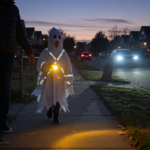
The single most useful thing to understand is that the danger is tied to light, not to the calendar. The most hazardous window lines up with twilight, when the sky still looks bright to the human eye but a driver’s contrast sensitivity is already fading. In that gray half-light, a child in a dark costume can be effectively invisible until a car is dangerously close.
- Go early: If your neighborhood allows it, start while there is still real daylight and finish before full dark to shrink your exposure during the worst window.
- Respect the transition: The shift from dusk to dark is when drivers are least adapted. Treat every crossing during that period as high-risk.
- Stick to lit routes: Favor streets with sidewalks and working streetlights over dim cut-throughs and unlit lanes.
The core idea. A driver cannot yield to a child they cannot see. Everything else in this guide exists to buy that driver a few extra seconds of warning, and those seconds are the difference between a near-miss and a tragedy.
Make Your Trick-or-Treater Impossible to Miss
Visibility comes in two flavors, and the best-protected child uses both. Passive visibility means retroreflective material that bounces a car’s headlights straight back to the driver, lighting the child up like a road sign. Fluorescent color boosts daytime and twilight conspicuity but does nothing in the dark, which is why reflective elements matter so much after sunset. This pairing of fluorescent background and retroreflective striping is the same principle behind the ANSI/ISEA 107 high-visibility safety apparel standard that governs the vests worn by U.S. road crews.
You do not need to dress a child as a construction worker, but you can borrow the science. Safe Kids Worldwide specifically recommends decorating costumes and treat bags with reflective tape or stickers and choosing light-colored fabrics. A few strips placed where they catch headlights transform a dark silhouette into something a driver picks up hundreds of feet sooner.
- Reflective tape and stickers: Run strips along the front and back, down the arms and legs, and around the treat bag so the child is visible from every angle.
- High-angle placement: Add reflective material near the shoulders and chest, roughly at headlight height, so it catches the beam and moves as the child walks.
- All-around coverage: Drivers approach from behind and from the sides, not just head-on, so avoid leaving the back of the costume dark.
- Light base colors: When the costume design allows, a lighter fabric extends the moment a driver has any chance of seeing your child at all.
👉 Shop reflective tape and reflective sticker kits for costumes and treat bags on Amazon (Ad — as an Amazon Associate, we earn from qualifying purchases.)
Light Them Up: Flashlights, Glow Sticks, and Lanterns
Reflective gear only works once headlights hit it, so pair it with something that glows on its own. Active lighting makes a child a moving light source that a driver notices even before the beams reach them, and it helps the child see the curb, the step, and the crack in the sidewalk. Safe Kids notes that many families skip this simple step, yet a flashlight or glow stick is one of the cheapest, highest-value pieces of gear on the whole outing.
- Give every child a light: A handheld flashlight or headlamp both signals the child and lets them watch their footing on uneven ground.
- Add glow sticks: Necklaces, bracelets, and wands provide continuous soft light that never depends on a driver’s headlights.
- Clip on a beacon: A small blinking LED on the bag or jacket adds motion and flash that the eye is wired to catch.
- Check the batteries: Test everything before you leave so nothing dies halfway through the route.
👉 Shop LED flashlights, clip-on blinking beacons, and glow sticks for trick-or-treaters on Amazon (Ad — as an Amazon Associate, we earn from qualifying purchases.)
Costumes That Don’t Compromise Safety
A costume can protect a child or quietly endanger them, and the difference usually comes down to vision, footing, and fit. Masks are the classic culprit: Safe Kids and other child-safety groups warn that they can slip and obstruct a child’s field of view precisely when the child needs to scan for traffic. Non-toxic face paint or well-fitted, low-profile makeup is the safer path because it leaves eyes and peripheral vision clear.
- Skip vision-blocking masks: Choose face paint over a mask, or lift the mask completely while walking and crossing.
- Hem it to size: Capes, gowns, and pant legs that drag are trip hazards on curbs and stairs, so shorten anything that pools at the feet.
- Wear real shoes: Comfortable, closed-toe, non-slip footwear beats costume slippers on wet leaves and uneven pavement.
- Mind the props: Swords, wands, and staffs should be soft and flexible so a fall does not turn the prop into an injury.
- Choose flame-resistant fabrics: Near jack-o’-lanterns and candles, look for costumes labeled flame-resistant and keep loose fabric away from open flames.
👉 Shop reflective safety vests, sashes, and slap-band wristbands to layer over costumes on Amazon (Ad — as an Amazon Associate, we earn from qualifying purchases.)
Street-Crossing Rules That Actually Stick
Most Halloween pedestrian crashes happen in the road, so the crossing itself deserves the most attention. NHTSA’s guidance for pedestrians is to follow the rules of the road, obey signs and signals, and cross at crosswalks or intersections while looking for cars in every direction, including vehicles turning left or right. Safe Kids adds a simple, teachable routine that even young children can master with practice.
- Cross at corners: Use crosswalks, intersections, and traffic signals instead of stepping out mid-block or from between parked cars.
- Look left, right, and left again: Then keep scanning while crossing, because a driver may be turning into the same crosswalk.
- Make eye contact: Teach kids to confirm a stopped driver actually sees them before stepping in front of the vehicle.
- Walk, never run: Crossing at a walk keeps footing steady and gives everyone time to react.
- Use sidewalks: Where sidewalks exist, use them; where they do not, walk facing traffic at the far edge of the road.
Supervision and the Buddy System
Gear and rules work best with an adult in the loop. Safe Kids Worldwide recommends that children under 12 trick-or-treat and cross streets with an adult, and NHTSA urges families to set up a buddy system so no one walks alone. Younger children in particular struggle to judge the speed and distance of approaching cars, so an adult is not a formality; it is an active safety layer.
- Adults lead the young ones: For children under about 12, an adult should manage every street crossing rather than trusting the child to judge traffic alone.
- Pair up the older kids: Tweens and teens going solo should travel in groups, agree on a lit route, and set a check-in time.
- Agree on the plan: Share the route, the return time, and a way to reach each other before anyone leaves the porch.
- Stay off the phone at crossings: A distracted supervising adult is as risky as a distracted child, so put the screen away at every curb.
The Bottom Line
Halloween does not have to be the most dangerous walking night of the year for your family. The spike in child pedestrian risk is driven by a handful of predictable factors: too many kids on the road, too little light, too much dark fabric, and crossings made in a hurry. Each of those has a direct answer. Go out while it is still light, layer reflective material with a flashlight or glow stick so drivers pick your child up early, choose a costume that keeps eyes and feet clear, and drill the cross-at-the-corner routine until it is automatic. Keep an adult with the youngest trick-or-treaters, and treat every crossing as the moment that matters most. Do those things, and you get the best of the night, the costumes and the candy and the joy, without the part nobody wants to remember.
Disclaimer: This article is provided for general educational purposes only and does not constitute safety, medical, or legal advice. Product standards, agency guidance, and local traffic laws change over time and vary by location. Always follow the instructions of local authorities, verify that any safety gear meets current requirements for your situation, and supervise children according to their age and abilities.
Sources: National Highway Traffic Safety Administration (NHTSA), Halloween Safety Tips; Safe Kids Worldwide, Halloween safety research and recommendations; U.S. Centers for Disease Control and Prevention (CDC/MMWR), “Childhood Pedestrian Deaths During Halloween, United States, 1975-1996”; International Safety Equipment Association (ISEA), ANSI/ISEA 107 American National Standard for High-Visibility Safety Apparel and Accessories.