
The Complete Guide to OSHA PPE Requirements: What Every Worker and Employer Needs to Know
Every year, hundreds of thousands of American workers are hurt on the job by hazards that the right piece of equipment could have stopped: a flying metal chip, a falling wrench, a chemical splash, a decibel level that quietly erodes their hearing over decades. Personal protective equipment — PPE — is the gear standing between a worker and those hazards. It is also one of the most misunderstood corners of workplace safety, tangled in acronyms, standards, and regulations that few people have time to decode.
This guide cuts through that. Whether you run a crew, manage a facility, or simply want to understand what your employer owes you, here is a clear, honest walkthrough of what OSHA actually requires, what the alphabet soup of standards means, and how to choose PPE that people will actually wear. We will keep it practical — and we will be straight with you about where PPE helps, where it falls short, and where it is only the last line of defense.
What PPE Is — and What It Isn’t
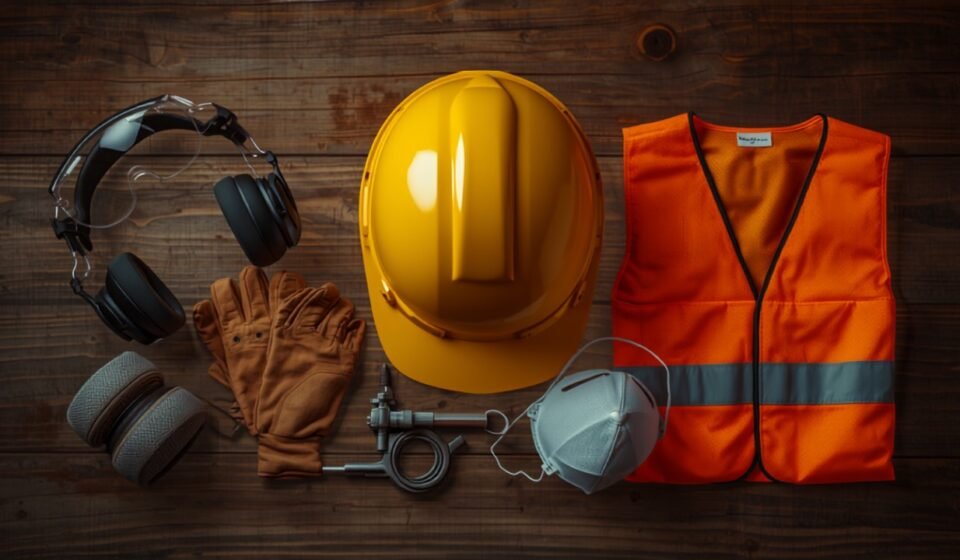
Personal protective equipment is any gear worn to minimize exposure to hazards that cause workplace injuries and illnesses. Think hard hats, safety glasses, gloves, respirators, earplugs, high-visibility vests, and safety-toe boots. It works by putting a physical barrier — or a filter, or a buffer — between you and a specific hazard.
Here is the part that safety professionals will not let you forget: PPE is the last line of defense, not the first. The National Institute for Occupational Safety and Health (NIOSH) ranks ways to control hazards in a “hierarchy of controls,” and PPE sits at the very bottom:
- Elimination — physically remove the hazard.
- Substitution — replace it with something less dangerous.
- Engineering controls — isolate people from the hazard (guards, ventilation, enclosures).
- Administrative controls — change the way people work (rotation, training, signage).
- PPE — protect the individual worker as a final safeguard.
Why does the order matter? Because PPE only works when it is present, correctly chosen, properly fitted, and actually worn — and any one of those can fail. A machine guard protects everyone near the machine, all the time, without anyone remembering to put it on. A pair of earplugs protects one person, only if they insert them correctly, every single time. Good safety programs use PPE to cover the risk that remains after they have engineered as much danger out of the job as possible.
The Legal Backbone: What OSHA Requires
In the United States, workplace PPE is governed by the Occupational Safety and Health Administration (OSHA). The core rules for general industry live in 29 CFR 1910, Subpart I (sections 1910.132 through 1910.140). Construction has a parallel set of rules in 29 CFR 1926, Subpart E. Layered on top is OSHA’s General Duty Clause, which requires every employer to provide a workplace “free from recognized hazards” even when no specific standard applies.
Boiled down, OSHA places a chain of duties on the employer:
- Assess the workplace for hazards that require PPE.
- Select appropriate PPE for each hazard.
- Provide that PPE to workers — and, in most cases, pay for it.
- Train workers on when, why, and how to use it.
- Maintain the program — replace damaged gear and keep records.
Who Pays for PPE?
This is the question that comes up on every job site, so let’s be clear. Under OSHA’s PPE payment rule (29 CFR 1910.132(h)), the employer must pay for required PPE, with a few narrow exceptions. The employer generally does not have to pay for non-specialty safety-toe footwear and non-specialty prescription safety eyewear if the employer allows the worker to wear them off the job site, everyday clothing, ordinary cold-weather gear, or items like an ordinary hat or sunscreen. But when a hazard on the job requires specific protective equipment, the cost is the employer’s — not something to be quietly deducted from a paycheck.
Step One: The Hazard Assessment
You cannot choose the right PPE until you know exactly what you are protecting against. OSHA requires employers to perform and document a hazard assessment of the workplace (29 CFR 1910.132(d)). This is a walk-through where you look at each task and ask what could hurt someone: impact, penetration, compression, chemicals, heat, harmful dust, light radiation, noise, or falls.
The assessment must be certified in writing — identifying the workplace evaluated, the person certifying it, and the date. It is not a one-time formality: it should be revisited whenever a new process, machine, or material is introduced. A thoughtful hazard assessment is the difference between handing everyone identical gloves and matching the right glove to the right task.
PPE by Body Area: The Practical Guide
Most PPE decisions come down to protecting a specific part of the body against a specific hazard. Here is what to look for, area by area — including the standards and markings that tell you whether a product is the real thing.
Head Protection — Hard Hats
Hard hats are tested to the ANSI/ISEA Z89.1 standard, and they are sorted two ways. By type: Type I protects against blows to the top of the head; Type II adds protection against lateral (side) impacts — increasingly the choice on sites where struck-by and slip-and-fall head injuries are a concern. By electrical class: Class G (General) is tested to 2,200 volts, Class E (Electrical) to 20,000 volts, and Class C (Conductive) offers no electrical protection at all — it prioritizes ventilation.
Two practical notes. First, hard hats have an expiration horizon: manufacturers typically recommend replacing the shell every few years and the suspension more often, and replacing any hat immediately after a significant impact — even if it looks fine. Second, the growing shift toward safety helmets with chin straps (borrowed from climbing design) reflects a simple truth: a traditional hard hat that falls off during a trip does nothing.
Eye and Face Protection
Eye injuries are among the most common — and most preventable — workplace injuries in America, and the overwhelming majority happen to workers who either wore no eye protection or the wrong kind. The governing standard is ANSI/ISEA Z87.1. Look for the marking on the frame or lens: Z87 indicates basic impact protection, while Z87+ denotes high-impact rated protection. Additional letters flag protection against droplets and splash (D3), dust (D4), fine dust (D5), and specific optical filters.
Match the eyewear to the hazard: safety glasses with side shields for flying particles, goggles for chemical splash or fine dust, and a face shield (worn over primary eye protection, never instead of it) for grinding, or full-face protection for high-splash tasks. For welding, the filter shade number must match the process and amperage — too light a shade is a slow, invisible injury to the eyes.
👉 Shop Safety glasses (ANSI Z87.1) on Amazon (Ad — as an Amazon Associate, we earn from qualifying purchases.)A well-fitting pair of Z87+ safety glasses is the single cheapest, highest-return piece of PPE most people can own — for the workshop, the yard, or the job site.
Hearing Protection
Noise-induced hearing loss is permanent, painless, and gradual — which is exactly why it is so often ignored until it is too late. OSHA’s noise standard (29 CFR 1910.95) sets a permissible exposure limit (PEL) of 90 dBA averaged over an 8-hour shift, and an action level of 85 dBA at which the employer must implement a hearing conservation program with monitoring, testing, and protection.
Every hearing protector carries a Noise Reduction Rating (NRR) on its packaging — a number in decibels measured in a laboratory. Here is the honest caveat: real-world protection is almost always lower than the label, because few people insert earplugs perfectly. NIOSH recommends “derating” the NRR — roughly by 25% for earmuffs, 50% for formable foam plugs, and 70% for other earplugs — to estimate real protection. The lesson is not that hearing protection fails; it is that correct fit and consistent use matter more than a big number on the box. For high-noise environments, combining earplugs and earmuffs (dual protection) is the reliable move.
Respiratory Protection
Respirators are the most heavily regulated PPE because getting them wrong can be deadly. OSHA’s respiratory protection standard (29 CFR 1910.134) requires a written program, and before an employee wears a required respirator, three things must happen: a medical evaluation (breathing through a respirator is work for the lungs and heart), fit testing to confirm the seal, and training.
Filtering facepiece respirators are certified by NIOSH and labeled by their filter series and efficiency. The letter indicates oil resistance — N (not oil-resistant), R (somewhat resistant), P (oil-proof) — and the number indicates filtration efficiency: 95, 99, or 100 (99.97%). An N95 filters at least 95% of airborne particles; a P100 is the top tier for particulates. Crucially, a respirator only protects when it seals to the face — which is why facial hair along the seal line and a proper fit test are not optional details but the whole ballgame.
Hand Protection — and the ANSI Cut Levels
Hands are the body part most often injured on the job, and gloves are the most misused PPE — because “a glove” is not one thing. Cut-resistant gloves are rated under ANSI/ISEA 105, which grades cut resistance on a nine-level scale from A1 (light cut hazard) to A9 (extreme), measured by the weight in grams required to cut through the material on a standardized test machine. A worker handling glass or sheet metal needs a very different glove than someone assembling cardboard boxes.
Cut resistance is only one dimension. Depending on the task you may also need chemical resistance (rated by breakthrough and permeation for specific chemicals), heat resistance, impact protection on the back of the hand, or grip in oily conditions. The right approach is to map the glove to the actual hazard — and to accept that a shop may need several types on the shelf, not one universal pair.
👉 Shop Cut-resistant work gloves (ANSI A-level) on Amazon (Ad — as an Amazon Associate, we earn from qualifying purchases.)When in doubt, choose the cut level that matches your worst routine task, and prioritize a glove dexterous enough that workers will keep it on — a cut-proof glove in a pocket protects no one.
Foot Protection
Safety footwear is tested to ASTM F2413 (which replaced the older ANSI Z41 standard). The markings inside the boot tell the story. Impact and compression resistance are shown as I/75 and C/75 (protection to 75 foot-pounds of impact and 2,500 pounds of compression). Additional codes flag EH (electrical hazard protection), Mt (metatarsal protection for the top of the foot), PR (puncture resistance for stepping on nails), CD (conductive, for static-sensitive environments), and SD (static dissipative).
Modern composite and alloy toe caps offer the same protection as steel at lighter weight and without conducting cold or setting off metal detectors — a real advantage for all-day comfort, which in turn drives compliance. Fit matters here more than almost anywhere: a protective boot that hurts is a boot that gets swapped for sneakers.
High-Visibility Apparel
For anyone working near moving vehicles or equipment — road crews, warehouse staff, airport ground workers — being seen is a life-or-death matter. High-visibility clothing is standardized under ANSI/ISEA 107, which sorts garments by type (off-road, roadway, public safety) and by Performance Class 1, 2, or 3, based on how much background and retroreflective material the garment carries. Class 3 offers the most conspicuity — full sleeves and more material — and is the standard for high-speed traffic and low-light conditions.
Fall Protection
Falls are the leading cause of death in construction, and fall protection is required in construction at heights of 6 feet (29 CFR 1926.501) and in general industry generally at 4 feet. A personal fall arrest system is built on the “ABCD” of fall protection: Anchorage (a secure point rated for the load), Body wear (a full-body harness — never a body belt for fall arrest), Connectors (lanyards and self-retracting lifelines), and a plan for prompt Descent and rescue. Fall protection is a deep topic that deserves its own guide — but the headline is simple: at height, a harness that is unworn, unanchored, or unfitted is not protection at all.
Training: The Step Everyone Skips
OSHA requires that workers be trained on their PPE (29 CFR 1910.132(f)): when it is necessary, what to use, how to put it on and take it off, its limitations, and how to care for it. Workers must demonstrate that they understand the training before doing work requiring PPE, and retraining is required when the workplace or the equipment changes, or when a worker’s use shows the training did not stick.
This is not box-checking. The most common reason PPE fails is not that it was absent, but that it was worn wrong — earplugs half-inserted, a respirator broken by a beard, safety glasses pushed up on a forehead. Training is what turns equipment into protection.
Why Workers Skip PPE — and How to Fix It
Let’s be honest about the human side. Workers skip PPE for predictable reasons: it is uncomfortable, it fogs up, it does not fit, it makes the job slower, or “I’ve done this a thousand times.” Blaming workers rarely fixes any of this. What does:
- Fit and comfort first. Offer sizes and styles. Anti-fog lenses, lighter toe caps, and low-profile earmuffs dramatically increase the odds that gear stays on.
- Involve workers in selection. People wear what they helped choose.
- Lead from the top. When supervisors wear their PPE without exception, the crew follows.
- Make it easy. Stock replacements where the work happens, not in a locked cabinet across the plant.
Inspection, Maintenance, and Replacement
PPE degrades. Harness webbing frays, respirator straps lose tension, safety glasses scratch until you cannot see through them, and glove coatings wear thin. Build a simple habit: inspect gear before each use, clean and store it properly, and replace it on a schedule or immediately after any damage or significant impact. A cracked hard hat, a cut in a harness lanyard, or a chemical glove that has reached its breakthrough time is not “still good” — it is a false sense of security, which is more dangerous than no protection at all.
Common PPE Myths
- “PPE makes the job safe.” No — it reduces the harm if something goes wrong. Engineering the hazard out comes first.
- “A higher rating is always better.” Over-specified PPE can be so bulky or hot that workers abandon it. Match the gear to the hazard.
- “One glove/boot/mask fits every task.” Different hazards need different gear. There is rarely a universal answer.
- “If it looks fine, it’s fine.” Impact damage, UV degradation, and chemical exposure are often invisible. Follow replacement schedules.
For Small Businesses and Home Workshops
You do not need a compliance department to get PPE right. If you run a small shop or work on projects at home, apply the same logic in miniature: look honestly at what could hurt you, buy standard-rated gear (Z87+ eyewear, well-fitted gloves matched to the task, hearing protection for power tools, a NIOSH-rated respirator for dust and finishing), keep it where you work, and replace it when it wears out. The hazards in a home garage — spinning blades, flying debris, loud tools, fine dust — are the same ones the standards were written for.
Frequently Asked Questions
Does my employer have to pay for my PPE?
In most cases, yes. OSHA requires employers to pay for required PPE, with limited exceptions such as non-specialty safety-toe footwear and non-specialty prescription safety glasses that can be worn off the job, ordinary weather gear, and everyday clothing.
What does “ANSI Z87+” mean on my safety glasses?
It means the eyewear meets the ANSI/ISEA Z87.1 standard for high-impact protection. Plain “Z87” indicates basic impact protection; the plus sign signals the higher impact rating.
Is the NRR on my earplugs the protection I actually get?
Not exactly. The Noise Reduction Rating is a laboratory figure; real-world protection is typically lower because of imperfect fit. NIOSH recommends derating the NRR to estimate real protection, and stresses that correct, consistent insertion matters more than the printed number.
Can I just wear an N95 without a fit test at work?
If a respirator is required for your job, OSHA mandates a medical evaluation, fit testing, and training first. Voluntary use of a dust mask when not required has lighter requirements, but any required respiratory protection follows the full 1910.134 program.
The Bottom Line
PPE is not complicated once you strip away the acronyms. Identify the hazard, choose gear that is rated for it, make sure it fits, train people to use it, and replace it before it fails. Do those five things and you have covered the vast majority of what OSHA asks — and, far more importantly, you have given the people doing the work a real chance to go home the way they came in. Just remember the order of operations: the best PPE is the hazard you engineered away before anyone had to put anything on. Everything else is the last line of defense — so make it a good one.
This article is general safety information, not professional or legal advice. OSHA standards and consensus standards (ANSI/ISEA, ASTM, NIOSH) are updated periodically and requirements vary by industry and state-plan jurisdiction. Always consult the current standard and a qualified safety professional for your specific workplace. Sources: U.S. Occupational Safety and Health Administration (OSHA, 29 CFR 1910 Subpart I & 1926 Subpart E); National Institute for Occupational Safety and Health (NIOSH); International Safety Equipment Association (ANSI/ISEA Z89.1, Z87.1, 105, 107); ASTM F2413.