Hi-Vis Apparel and ANSI/ISEA 107: Class 1, 2 and 3 Explained
Being seen is the whole job. For road crews, warehouse workers, first responders, tow operators, and anyone who works near moving vehicles or equipment, high-visibility clothing is often the difference between a driver noticing them in time and a tragedy. Struck-by incidents are among the leading causes of workplace fatalities in the United States, and the sobering truth is that many happen in daylight, to workers who assumed they were visible enough.
Not all “safety vests” deliver the same protection, though. A mesh vest from a hardware store and a full jacket worn by a highway crew are engineered to entirely different standards. The system that separates them is ANSI/ISEA 107, the American National Standard for high-visibility safety apparel. This guide explains how it grades garments into Class 1, 2, and 3, what the fluorescent background and reflective tape each do, and how to match the class to your work.
How high-visibility clothing actually works
Hi-vis apparel protects you two different ways, and understanding the difference is key:
- Fluorescent background material — the bright lime-yellow, orange, or red fabric — works in daylight. It takes invisible ultraviolet light and re-emits it as visible light, making the garment appear to glow far more intensely than ordinary colored fabric. This is what makes a worker “pop” against a dull road or industrial background during the day.
- Retroreflective material — the silver or prismatic tape — works in the dark. It bounces a vehicle’s headlight beam directly back toward the driver’s eyes, so the worker lights up brilliantly in low light. Retroreflective tape does little in daylight, and fluorescent fabric does nothing at night — which is why serious hi-vis garments combine both.
ANSI/ISEA 107 sets minimum amounts of both materials for each class, along with rules for how the reflective tape must be arranged so the human form is recognizable from a distance.
The three classes
Class 1 — lowest visibility
Class 1 garments contain the least background and reflective material. They’re intended for environments that are well separated from traffic, where vehicles move slowly (roughly under 25 mph) and the worker has the full attention of any drivers. Think parking-lot attendants, warehouse workers operating away from public roads, or sidewalk maintenance. A simple economy mesh vest is typically Class 1. It is not adequate for roadway work.
👉 Shop ANSI Class 1 safety vest on Amazon (Ad — as an Amazon Associate, we earn from qualifying purchases.)
Class 2 — the roadway standard
Class 2 requires substantially more fluorescent background and reflective tape, and it’s the minimum for workers exposed to traffic on public roads or in higher-risk environments. Under the Federal Highway Administration’s rules, anyone working within the right-of-way of a federal-aid highway must wear at least Class 2. This is the everyday choice for road construction, utility work, survey crews, airport ground staff, and school crossing guards. If your work puts you anywhere near vehicles traveling faster than about 25 mph, Class 2 is the floor.
👉 Shop ANSI Class 2 hi-vis vest on Amazon (Ad — as an Amazon Associate, we earn from qualifying purchases.)
Class 3 — highest visibility
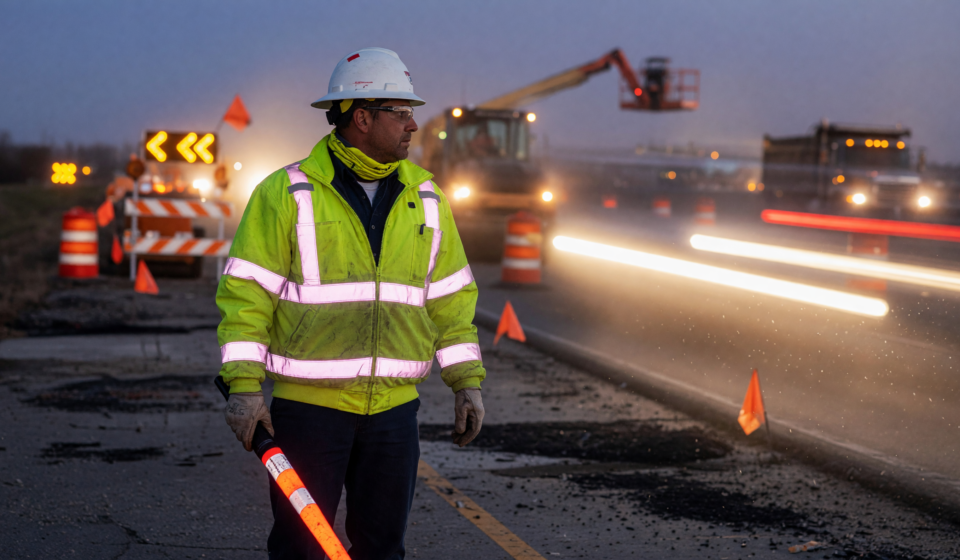
Class 3 provides the greatest visibility and defines the human form most completely, because the reflective and background material must cover the torso plus the arms and/or legs — meaning a Class 3 garment is a sleeved jacket or a vest-plus-hi-vis-pants combination, never a plain sleeveless vest alone. It’s required for high-speed roadways, poor visibility, night work, and any situation where workers face serious struck-by risk and need to be seen at the greatest possible distance. Highway crews on interstates, emergency responders on active roads, and flaggers in low light all belong in Class 3.
👉 Shop ANSI Class 3 hi-vis jacket on Amazon (Ad — as an Amazon Associate, we earn from qualifying purchases.)
A note on “Type”: O, R and P
Beyond class, ANSI/ISEA 107 also assigns a Type that describes the intended use environment:
- Type O (Off-Road): for occupational environments that don’t involve public roadways — think oil and gas, warehouses, or mining. Available in Class 1.
- Type R (Roadway): for workers exposed to public vehicular traffic or roadway construction. Available in Class 2 and Class 3.
- Type P (Public Safety): for emergency responders and law enforcement, with design allowances for equipment access. Available in Class 2 and Class 3.
So a highway flagger’s garment might be labeled “Type R, Class 3,” which tells you at a glance it’s built for roadway traffic at the highest visibility level. Always read the label sewn inside the garment — it states the standard, type, and class.
Fit, care, and when to replace
A hi-vis garment only performs if it’s worn correctly and still intact:
- Wear it closed and sized right. An open jacket or an oversized vest flapping loose reduces the visible background area and distorts the reflective pattern.
- Keep it clean. Dirt, grease, and road grime dramatically cut both fluorescence and reflectivity. A filthy vest can drop below its rated performance. Follow the garment’s care label — most specify a maximum number of wash cycles.
- Retire faded or damaged garments. Fluorescent fabric degrades with UV exposure over time; once the color has visibly faded, the daytime protection is gone. Torn or peeling reflective tape means it’s done. Many employers replace hi-vis apparel every 6 months of heavy field use.
Quick selection guide
- Away from traffic, slow vehicles → Class 1 (Type O).
- Near public roads, speeds above ~25 mph, daytime → Class 2 (Type R) minimum.
- High-speed roads, night work, poor visibility, flagging → Class 3 (Type R).
- Emergency response with gear access needs → Type P, Class 2 or 3.
- When in doubt, go up a class — over-protection costs a little more; under-protection can cost everything.
The bottom line
High-visibility apparel is engineered protection, not just a bright shirt. ANSI/ISEA 107 grades it into three classes based on how much fluorescent and reflective material it carries and how completely it defines the human form. Match the class and type to your traffic exposure — Class 2 as the roadway floor, Class 3 for high-speed and night work — wear it clean and closed, and replace it before it fades. Being seen is the job, and the right garment makes sure you are.
Disclaimer: This article is for general educational purposes and does not replace a formal workplace hazard assessment. Employers should consult ANSI/ISEA 107, the MUTCD/FHWA worker visibility rules, and a qualified safety professional to determine the correct apparel for their specific hazards.
Sources: ANSI/ISEA 107 American National Standard for High-Visibility Safety Apparel; FHWA Worker Visibility Rule (23 CFR 634); OSHA guidance on struck-by hazards and high-visibility garments.