Fall Protection Basics: Harnesses, Anchors and the OSHA ABCDs
Every year, falls kill more construction workers in the United States than any other hazard. They are consistently the number one cause of death in the industry, and year after year, fall protection tops OSHA’s list of most-cited violations. What makes these numbers especially tragic is that nearly all of these deaths are preventable. The physics of a fall are unforgiving — a body accelerates at 32 feet per second squared, and even a fall of a few feet onto the wrong surface, or an arrested fall with the wrong equipment, can be fatal — but the engineering to stop it safely is well understood, affordable, and required by law.
The problem is that “wearing a harness” is not the same as being protected. A harness clipped to the wrong anchor, a lanyard that lets you fall too far, or a system with no plan to rescue you afterward can all fail catastrophically. Real fall protection is a system of components that must work together, and OSHA organizes that system into a memorable framework: the ABCDs. This guide walks through each letter — Anchorage, Body support, Connectors, and Deceleration/Descent — explains when fall protection is required, and shows how the pieces combine into protection you can trust with your life.
When is fall protection required?
OSHA sets trigger heights that determine when fall protection must be in place. These differ by industry, which trips up a lot of people:
- Construction (29 CFR 1926.501): generally 6 feet or more above a lower level.
- General industry (29 CFR 1910.28): generally 4 feet.
- Shipyards: 5 feet.
- Scaffolds: 10 feet.
Regardless of height, fall protection is always required when working above dangerous equipment or an opening — you can drown in a few feet of water or be killed falling into machinery from any height. It’s also worth knowing that the hierarchy of controls applies here: OSHA prefers you eliminate the hazard (do the work at ground level), then use guardrails or covers (passive protection that needs no worker action), and only then rely on personal fall arrest systems (PFAS). The harness-and-lanyard system most people picture is actually the last line of defense, not the first.
Fall arrest vs. fall restraint vs. positioning
Before the ABCDs, understand the three ways a system can be used, because they demand different setups:
- Fall restraint keeps you from reaching the edge at all — the lanyard is short enough that a fall can’t happen. The safest approach when practical.
- Fall arrest lets a fall begin but stops it safely before you hit a lower level. This is the classic PFAS and the focus of the ABCDs.
- Work positioning holds you in place at a work location (like a utility pole) so you can work hands-free. A positioning system alone is not fall arrest and must be backed by one.
A — Anchorage
The anchorage is the secure point to which your system connects — the foundation everything else hangs from. It is also the component most often gotten wrong, because an anchor that looks solid may not be. OSHA requires that anchors used for personal fall arrest be capable of supporting 5,000 pounds per attached worker, or be designed by a qualified person with a safety factor of at least two. That’s the weight of a small pickup truck, and it exists because arresting a fall generates enormous forces in an instant.
The “anchorage connector” is the hardware that attaches to the structure — a beam anchor, a cross-arm strap, a roof anchor, or an engineered anchor point. A few rules that save lives:
- Anchor high. The higher the anchor point, the shorter your potential fall. An overhead anchor is far safer than one at foot level.
- Never use a random pipe, conduit, or piece of rebar. If it wasn’t engineered or verified for 5,000 pounds, it isn’t an anchor.
- Watch for the swing. An anchor far off to the side lets you swing like a pendulum in a fall and slam into an obstruction — the “swing fall” hazard. Position anchors as directly overhead as possible.
👉 Shop beam anchor / roof anchor connector on Amazon (Ad — as an Amazon Associate, we earn from qualifying purchases.)
B — Body support (the full-body harness)
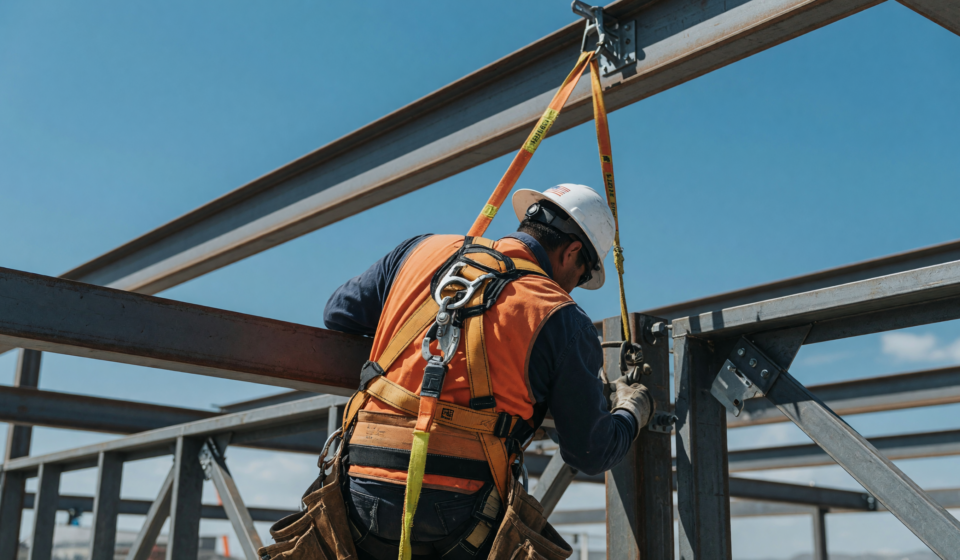
The harness is your connection to the system, and in modern fall arrest it must be a full-body harness — never a body belt, which OSHA banned for fall arrest in 1998 because it concentrates deadly forces on the abdomen and can cause a worker to slip out or suffer severe internal injury. A full-body harness distributes the force of an arrested fall across the strong areas of your body: the thighs, pelvis, chest, and shoulders.
Fit and inspection are everything:
- The dorsal D-ring (the attachment point on your back) should sit between your shoulder blades. If it rides low, a fall can leave you hanging head-down.
- Snug all straps. Leg straps should be tight enough that you can slide a flat hand under but no more; chest strap across the mid-chest. A loose harness lets you fall farther inside it and can cause injury on arrest.
- Inspect before every use. Look for cut or frayed webbing, chemical burns, distorted or cracked D-rings, and missing or damaged buckles. A single deployed impact indicator means the harness is done — retire it immediately.
👉 Shop full-body safety harness on Amazon (Ad — as an Amazon Associate, we earn from qualifying purchases.)
C — Connectors
Connectors are the components that link your harness to the anchorage — the lanyards, self-retracting lifelines, snap hooks, and carabiners. They’re where a lot of dangerous shortcuts happen.
- Shock-absorbing lanyard: a fixed-length lanyard (usually 6 feet) with a built-in energy absorber that tears open progressively to soften the arrest. Remember that a 6-foot lanyard plus the ~3.5 feet of absorber deployment plus your body height means you can fall well over 12 feet before stopping — which is why fall clearance matters (below).
- Self-retracting lifeline (SRL): works like a seatbelt, paying out slowly and locking instantly when it senses a rapid pull. SRLs sharply reduce free-fall distance and are often the safer choice, especially at lower heights.
- Snap hooks and carabiners must be the self-locking type with a double action to open. Never “roll out” — connect two snap hooks to each other, or clip to a point smaller than the throat — because that can cause the gate to be forced open under load.
- Never tie a knot in a lanyard or connect it back to itself around an anchor unless it’s rated for that; a knot can cut the rated strength by more than half.
👉 Shop self-retracting lifeline or shock-absorbing lanyard on Amazon (Ad — as an Amazon Associate, we earn from qualifying purchases.)
D — Deceleration and Descent (and the plan)
The final D covers two ideas that often get overlooked. The first is deceleration: the energy-absorbing element (built into the lanyard or SRL) that limits the arresting force on your body to a safe level — OSHA caps it at 1,800 pounds for a body harness. Without deceleration, an abrupt stop can injure your spine even if the fall itself is short.
The second, and most neglected, is descent and rescue. Arresting a fall is not the end of the emergency — it’s the start of one. A worker left hanging in a harness can develop suspension trauma (orthostatic intolerance) within minutes: blood pools in the legs, and the worker can lose consciousness or die even though the fall was successfully stopped. OSHA requires employers to provide “prompt rescue.” That means before anyone goes up, there must be a rescue plan: how will you get them down quickly? Self-rescue devices, suspension-trauma relief straps, and a trained rescue team or aerial lift on standby are all part of a complete system.
Calculate your fall clearance. Add it up before you clip in: free-fall distance + deceleration distance (up to 3.5 ft) + harness stretch (~1 ft) + the height of the worker below the D-ring (~5 ft) + a safety margin (~2–3 ft). With a 6-foot lanyard you often need 18+ feet of clearance below the work surface. If you don’t have it, a lanyard will let you hit the ground before it stops you — use an SRL or a higher anchor instead.
Putting the system together
A compliant personal fall arrest system is only as strong as its weakest link, and every link must be present:
- A — a verified anchor rated for 5,000 lb, positioned as high and as directly overhead as possible.
- B — a properly fitted, inspected full-body harness with the dorsal D-ring between the shoulder blades.
- C — the right connector for the clearance available, with self-locking hooks and no rollout.
- D — energy absorption that keeps arrest force under 1,800 lb, plus a written, practiced rescue plan.
Add to that a competent person to oversee the setup, training for every worker who uses the equipment, and inspection before every single use. Skip any one of these and the system can give you a false sense of safety that’s more dangerous than no protection at all — because a worker who feels protected takes the risk in the first place.
Common fatal mistakes to avoid
- Anchoring to an unverified point that can’t hold 5,000 pounds.
- Using a 6-foot lanyard where there isn’t enough clearance below to arrest the fall.
- Anchoring off to the side and getting hurt in a swing fall.
- Wearing the harness loose or with the D-ring too low.
- Having no rescue plan and leaving a worker in suspension.
- Reusing a harness or lanyard after it has arrested a fall.
The bottom line
Falls are the leading killer in construction, and almost every fatality traces back to a missing or broken link in a system that should have been complete. The ABCDs give you the whole picture: a real anchor, a well-fitted full-body harness, the right connectors, and deceleration plus a rescue plan. Master those four letters, calculate your clearance, inspect before every use, and never treat the harness as the finish line — treat the safe landing, and the prompt rescue, as the goal. Height is only dangerous when the system isn’t complete.
Disclaimer: This article is for general educational purposes and is not a substitute for hands-on training by a competent person or a formal fall protection program. Employers and workers must follow OSHA 29 CFR 1926 Subpart M (construction) or 1910 Subpart D/I (general industry) and consult a qualified safety professional before working at height.
Sources: OSHA Fall Protection standards (29 CFR 1926.500–503 and 29 CFR 1910.28–30); OSHA/NIOSH guidance on personal fall arrest systems and suspension trauma; ANSI/ASSP Z359 Fall Protection Code.