Smoke and Carbon Monoxide Alarms: Placement and NFPA Guidance
A smoke alarm buys you the one thing a house fire steals fastest: time. Modern homes, built with synthetic materials and open floor plans, can go from a small flame to a deadly, room-engulfing flashover in as little as three to five minutes — a fraction of the time it took decades ago. In that window, a working smoke alarm is often the only thing standing between a sleeping family and tragedy. The statistics are blunt: the majority of home fire deaths happen in homes with no smoke alarms or with alarms that didn’t work, usually because of a missing or dead battery.
Carbon monoxide is the quieter danger. It’s colorless, odorless, and tasteless — you cannot detect it with your senses — and it kills hundreds of Americans a year while sending thousands more to emergency rooms. A CO alarm is the only way to know it’s present before symptoms hit. This guide covers both: how many alarms you need, exactly where to place them according to NFPA guidance, the difference between detection technologies, and the simple maintenance that keeps them alive.
How many smoke alarms, and where
The National Fire Protection Association’s NFPA 72 is the standard that governs alarm placement, and its core requirements are clear. For comprehensive protection, you need smoke alarms:
- Inside every bedroom. Fires that start in a bedroom, or that occur while someone sleeps with the door closed, need an alarm in that room.
- Outside each sleeping area, in the hallway or space that serves the bedrooms.
- On every level of the home, including the basement. A basement alarm should be on the ceiling near the stairs to the floor above.
The single most important upgrade you can make is interconnection: when alarms are interconnected, one triggering alarm sounds them all, so a fire in the basement wakes people upstairs instantly. Newer homes are hardwired for this; for existing homes, wireless interconnected alarms accomplish the same thing without running wire.
👉 Shop interconnected smoke alarms on Amazon (Ad — as an Amazon Associate, we earn from qualifying purchases.)
Placement details that matter
Because smoke rises, mounting position affects how fast an alarm responds:
- Ceiling-mounted is best. Place the alarm in the center of the ceiling where possible. If wall-mounted, keep the top of the alarm 4 to 12 inches below the ceiling.
- Keep away from corners. Air is “dead” in the tight corner where wall meets ceiling; keep alarms at least 4 inches out from that corner.
- Stay clear of vents, ceiling fans, and windows, which can blow smoke away from the sensor.
- Mind the kitchen and bathroom. Keep alarms at least 10 feet from cooking appliances to reduce nuisance alarms, and avoid steamy bathrooms. If you must be closer to the kitchen, use a photoelectric alarm, which resists cooking nuisance trips better.
- Sloped ceilings: mount within 3 feet of the peak, measured horizontally, but not in the apex itself.
Ionization vs. photoelectric
Smoke alarms use one of two sensing technologies, and they respond to different fires:
- Ionization alarms respond faster to flaming, fast-moving fires (like a grease flare-up or burning paper).
- Photoelectric alarms respond faster to smoldering fires (like a cigarette in a couch or an overheating wire) — the slow, smoky fires that most often kill people in their sleep. They also produce fewer cooking nuisance alarms.
Because real fires can be either type, fire-safety experts recommend protection against both — either dual-sensor alarms that combine the technologies, or a mix of both types throughout the home. If you’re buying new, dual-sensor alarms are the simplest way to cover every scenario.
Carbon monoxide alarms
CO is produced by anything that burns fuel — furnaces, gas water heaters, stoves, fireplaces, generators, and car engines. When these malfunction or are used improperly (a generator run in a garage, a blocked chimney), CO builds up and displaces oxygen in your blood. Early symptoms mimic the flu: headache, dizziness, nausea, confusion. A CO alarm is your only reliable warning. Place them:
- On every level of the home and in or near each sleeping area, so an alarm will wake you.
- Near, but not right on top of, fuel-burning appliances (roughly 5–20 feet away) — too close and normal start-up emissions cause nuisance alarms.
- Follow the manufacturer’s height instructions. Because CO mixes with air rather than strictly rising, many models can be placed at any height; some combination units go on the ceiling with the smoke sensor.
Do not install CO alarms in dead air spaces, near vents or windows, or in humid bathrooms. And never ignore a CO alarm as a “false alarm” — get everyone outside to fresh air and call 911 or the fire department. It is genuinely a life-or-death signal.
👉 Shop carbon monoxide alarms / combination smoke-CO alarms on Amazon (Ad — as an Amazon Associate, we earn from qualifying purchases.)
Maintenance: the part everyone forgets
An alarm is only protection if it works. A simple routine keeps them alive:
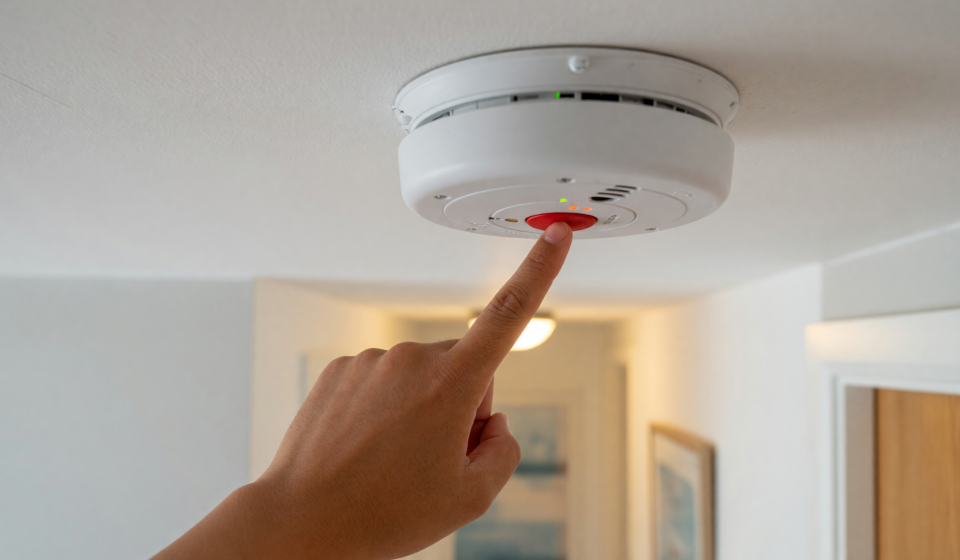
- Test every alarm monthly by pressing the test button.
- Replace batteries in battery-powered units at least once a year — the classic tip is to do it when the clocks change. If an alarm chirps intermittently, the battery is dying; replace it, don’t remove it.
- Vacuum the alarms a couple of times a year to clear dust that can cause false or missed alarms.
- Replace the whole alarm on schedule. Smoke alarms expire after 10 years; CO alarms typically after 5–7 years (check the date printed on the back). The sensors degrade even if the unit still powers on.
Consider 10-year sealed-battery alarms for a maintenance-free option — the lithium battery lasts the life of the alarm, so there’s nothing to replace and no tempting battery to “borrow” for a toy.
Don’t forget the escape plan
Alarms buy you time, but only a plan turns that time into survival. Every household should have a fire escape plan with two ways out of every room, a designated meeting place outside, and practice — twice a year is the recommendation. Teach children what the alarm sounds like and what to do. In a real fire, you may have less than two minutes to get out; the family that has practiced doesn’t have to think, they just move.
Quick checklist
- Smoke alarms in every bedroom, outside each sleeping area, and on every level.
- Interconnect them so one triggers all.
- Use dual-sensor (ionization + photoelectric) protection.
- CO alarms on every level and near sleeping areas.
- Test monthly, batteries yearly, replace smoke alarms at 10 years and CO alarms at 5–7.
- Have and practice a two-exit escape plan.
The bottom line
Smoke and carbon monoxide alarms are the cheapest, most effective life-safety devices you can own — but only if you have enough of them, place them where NFPA guidance says, and keep them working. Cover every bedroom and level, interconnect them, pair smoke alarms with CO protection near sleeping areas, and never silence a chirp by pulling a battery. Test them tonight. It takes two minutes, and it’s the two minutes a fire won’t give you later.
Disclaimer: This article is for general educational purposes. Always follow your alarm manufacturer’s instructions and local building and fire codes, which may exceed these guidelines. When in doubt, consult your local fire department, which often provides free home safety checks.
Sources: NFPA 72 National Fire Alarm and Signaling Code; NFPA and U.S. Fire Administration home smoke and CO alarm guidance; CPSC carbon monoxide safety recommendations.