
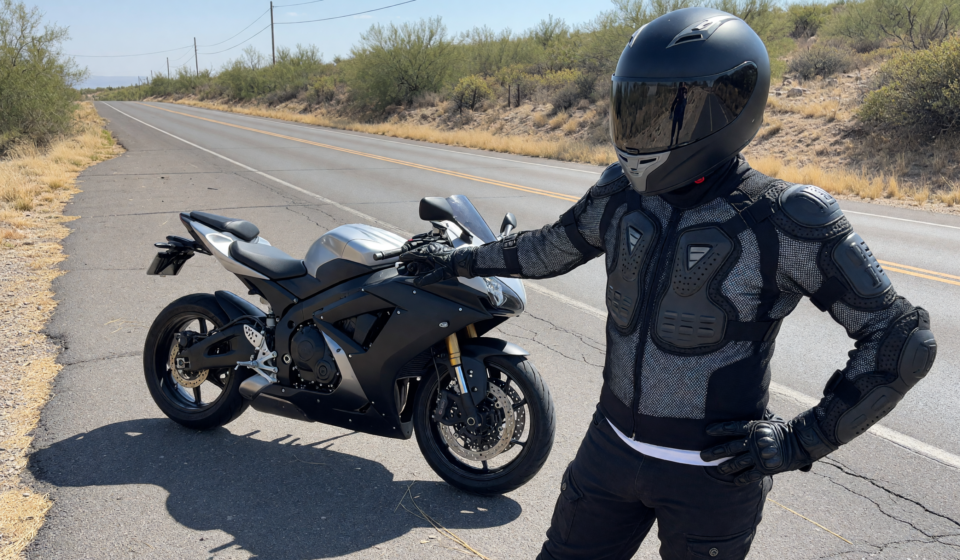
Summer Motorcycle Gear: Ventilated Jackets, Mesh Armor and Hydration
There is a moment every rider knows on a July afternoon: you roll up to a stoplight, the engine heat rolls back over your legs, the asphalt shimmers, and the leather jacket that felt heroic in April now feels like a wearable sauna. The temptation to unzip, or to ride in a t-shirt, is real. But heat itself is a safety problem on two wheels, and so is the road rash waiting under that t-shirt. The good news is that you do not have to choose between staying cool and staying protected.
This guide covers summer motorcycle gear the way a working rider actually thinks about it: how ventilated jackets and mesh armor move air across your body, what the CE armor ratings and abrasion standards really mean, how helmets and gloves change in the heat, and why hydration deserves a spot on your pre-ride checklist. We will lean on U.S. agencies and the standards you will actually see printed on hangtags, and we will keep the numbers honest. The goal is simple: help you build a hot-weather kit that keeps you comfortable enough to ride well and protected enough to walk away.
Why Heat Is a Safety Issue, Not Just a Comfort One
Riding is a physical, attention-heavy task, and heat quietly chips away at both. As your core temperature climbs, your body diverts blood to the skin to shed heat, your heart rate rises, and you start losing fluid and electrolytes through sweat that evaporates almost instantly in the wind. The rider often does not notice, because the airflow feels cool even while dehydration is setting in. Left unchecked, that path leads to heat exhaustion and, in severe cases, heat stroke.
The reason this matters for gear is that the early symptoms of heat stress are exactly the abilities you need to ride safely:
- Slower reaction time: Overheating dulls the split-second reflexes you rely on in traffic.
- Poorer judgment: Heat fatigue makes riders more likely to take small risks they would normally skip.
- Reduced focus: Fatigue and dehydration make it harder to scan, anticipate, and stay smooth.
- Physical weakness: Cramping hands or heavy arms undermine control precisely when you need it.
Groups like the Motorcycle Safety Foundation (MSF) and the National Highway Traffic Safety Administration (NHTSA) consistently emphasize all-the-gear-all-the-time riding. The trick in summer is choosing gear engineered to shed heat, so that “all the gear” does not become the reason you overheat.
Ventilated and Mesh Jackets: Airflow Without Giving Up Protection
The core idea behind good summer motorcycle gear is direct airflow across your skin while impact and abrasion protection stay in place. Two broad approaches dominate the market, and they solve the problem differently.
- Mesh jackets: Built largely from tightly woven, abrasion-resistant textile mesh so air passes straight through the panels. They cool aggressively at speed and are the go-to for stop-and-go summer heat, at the cost of less wind and rain protection.
- Ventilated (perforated or vented) jackets: A more solid textile or leather shell with strategically placed zippered intake and exhaust vents. They breathe less than full mesh but offer more coverage and versatility across a wider temperature range.
Whichever style you choose, the protection lives in three places: the abrasion resistance of the shell fabric, the impact armor at the shoulders and elbows, and the fit. A jacket that flaps loose in the wind will not hold its armor over the right spots in a slide, so a snug-but-mobile fit is part of the safety equation, not just comfort.
👉 Shop mesh and ventilated summer motorcycle jackets on Amazon (Ad — as an Amazon Associate, we earn from qualifying purchases.)
Understanding CE Armor: Level 1 vs. Level 2
The soft or hard pads tucked into your jacket’s shoulders, elbows, and back are impact protectors, and most quality gear sold in the U.S. is certified to European CE standards, because those are the widely recognized benchmark the industry has adopted. The relevant standards are worth knowing by name:
- EN 1621-1: The standard for limb impact protectors (shoulders, elbows, hips, knees).
- EN 1621-2: The standard specifically for back protectors.
- CE Level 1 vs. Level 2: Both must limit the force transmitted through the armor in a standardized impact test; Level 2 must keep that transmitted force substantially lower than Level 1, meaning it absorbs more energy.
Level 2 armor is generally thicker or denser, which can trap a little more heat, but modern designs use perforated and ventilated foams to fight that. A common summer misstep is buying a breezy mesh jacket that ships with only minimal foam inserts. Check whether the jacket includes certified armor, whether it is Level 1 or Level 2, and whether it has a pocket for a back protector, which many jackets leave empty from the factory.
Check the back. Many jackets ship with armor at the shoulders and elbows but only a thin foam pad where a real back protector should go. If yours has an empty back pocket, adding a CE-certified EN 1621-2 back protector is one of the cheapest, highest-value upgrades you can make.
Abrasion Resistance and the EN 17092 Classes
Armor handles impact, but in a slide it is the fabric that saves your skin. The current European garment standard, EN 17092, sorts complete riding garments into protection classes based on abrasion resistance and construction, and you will increasingly see these letter ratings on gear sold in the States:
- Class AAA: The highest protection level, built for the most demanding abrasion and impact exposure. Typically the heaviest and least ventilated.
- Class AA: A strong middle ground that many well-built mesh and touring jackets target, balancing airflow with real abrasion resistance.
- Class A: Lighter garments prioritizing comfort and mobility with a lower abrasion threshold; common for warm-weather riding shirts and light overlays.
For summer, many riders land on quality AA-rated mesh as a sensible compromise: enough abrasion resistance for street and highway speeds, with airflow that keeps you functional in the heat. The important thing is to make the trade-off consciously rather than assuming a cool-looking mesh jacket is automatically protective.
Helmets in the Heat: DOT, Snell, and Ventilation
Your helmet is the one piece of gear governed by a mandatory federal standard in the United States. NHTSA’s Federal Motor Vehicle Safety Standard No. 218 (FMVSS 218) sets the minimum performance requirements a helmet must meet to be sold as motorcycle headgear, and a compliant helmet carries the DOT certification mark. Two other marks you will see are voluntary: the Snell Memorial Foundation’s private certification and the European ECE standard.
In hot weather, ventilation and coverage pull in opposite directions, so choose deliberately:
- Vents matter: Look for a full-face helmet with functional brow and chin intake vents plus rear exhaust vents that channel air across your scalp.
- Coverage still counts: A full-face helmet offers the most face and chin protection; open-face and half helmets breathe more but leave more exposed.
- Beware the “novelty” trap: Very light helmets that skip the DOT mark are often decorative shells that do not meet FMVSS 218. Cooler is not worth uncertified.
- A moisture-wicking liner helps: A breathable balaclava or skull cap manages sweat and keeps the fit clean over long summer days.
Gloves, Pants, and Boots You Will Actually Wear
Hot weather is where riders are most tempted to skip the extremities, and it is exactly where hands and ankles are so vulnerable. The instinct in a fall is to put a hand down, and pavement does not care about the temperature. Summer versions of each piece exist for a reason:
- Vented gloves: Perforated leather or mesh-backed gloves with knuckle armor and reinforced palms keep your hands cool without sacrificing the parts that hit the ground first.
- Riding pants: Mesh or perforated overpants and abrasion-resistant riding jeans with knee and hip armor beat shorts every time; look for the same CE armor and class ratings you check on a jacket.
- Over-the-ankle boots: Ventilated riding boots protect the ankle joint and resist crushing far better than sneakers, while still breathing on a hot day.
The unifying principle is that summer-specific gear removes the excuse. When the protective option is also the comfortable one, you are far more likely to wear it on the ride where it counts.
👉 Shop vented summer gloves and over-the-ankle riding boots on Amazon (Ad — as an Amazon Associate, we earn from qualifying purchases.)
Hydration: The Gear You Drink
Hydration is the most overlooked piece of summer motorcycle gear, precisely because the wind hides how much fluid you are losing. Constant evaporation off your skin can dry you out fast without the usual sweaty-shirt warning, so you cannot rely on thirst alone. Treat fluids as part of your kit, planned before you throw a leg over the bike.
- Pre-hydrate: Drink water before you ride, not just when you already feel parched. By the time you are thirsty, you are behind.
- Carry water on you: A hydration pack or reservoir lets you sip at stoplights and on the move so you actually keep up, instead of waiting for the next gas stop.
- Replace electrolytes: On long, hot days, water alone is not enough; an electrolyte mix helps replace what heavy sweating strips out.
- Use evaporative cooling wisely: A soaked cooling vest or neck wrap under a mesh jacket uses airflow to pull heat away, extending how long you can ride comfortably.
- Take real breaks: Pull into shade, get airflow off the engine, and let your core temperature reset before it becomes a problem.
👉 Shop hydration packs and evaporative cooling vests on Amazon (Ad — as an Amazon Associate, we earn from qualifying purchases.)
Base Layers and Smart Layering for Hot Rides
It sounds counterintuitive to add a layer when you are trying to stay cool, but the right base layer does real work. A snug, moisture-wicking synthetic or merino shirt moves sweat off your skin so the airflow through a mesh jacket can evaporate it efficiently, rather than letting it pool against a cotton tee that stays soggy and hot.
- Skip cotton: It holds moisture, chafes, and stops cooling once it is saturated.
- Choose wicking fabrics: Technical base layers keep evaporation working with you instead of against you.
- Mind the sun: Long-sleeve UV-protective base layers guard against sunburn on exposed arms under mesh, which is easy to forget at highway speed.
The Bottom Line
Summer riding does not force a choice between comfort and protection; it forces you to be more deliberate. Reach for a mesh or ventilated jacket with certified CE armor and a real abrasion class, a DOT-compliant helmet with genuine ventilation, vented gloves and over-the-ankle boots, and a hydration plan you actually follow. Each piece exists so that the safe option is also the one you will happily wear when the thermometer climbs. Gear up like the heat is part of the ride, because it is, and you will finish your summer miles cooler, sharper, and in one piece.
Disclaimer: This article is provided for general educational purposes only and does not constitute safety, medical, or legal advice. Protective gear reduces but cannot eliminate the risk of injury. Standards, certifications, and helmet laws vary and change over time; always verify current requirements in your state and follow the manufacturer’s instructions and any applicable regulations for your specific equipment.
Sources: National Highway Traffic Safety Administration (NHTSA), Federal Motor Vehicle Safety Standard No. 218 (FMVSS 218), 49 CFR 571.218; Motorcycle Safety Foundation (MSF); European standards EN 1621-1 and EN 1621-2 (impact protectors), EN 17092 (garment abrasion classes); Snell Memorial Foundation; ECE helmet certification.