
Sun Protection for Athletes: UPF Clothing, Sunscreen and Eye Safety
If your training happens outdoors, the sun is part of the job. Runners, cyclists, tennis and pickleball players, swimmers, golfers, rowers and field-sport athletes rack up hours of ultraviolet exposure that most desk workers never see. That makes athlete sun protection a genuine performance and health issue, not an afterthought you reach for on the hottest days of the year. UV damage is cumulative, it happens whether or not you feel a burn, and it raises the long-term risk of skin cancer and premature skin aging.
The good news is that protecting yourself is straightforward once you understand the tools. A complete approach layers sun-protective clothing, broad-spectrum sunscreen, UV-blocking eyewear, a good hat and smart scheduling. This guide walks through each layer with guidance from the American Academy of Dermatology (AAD), the U.S. Food and Drug Administration (FDA), the Skin Cancer Foundation and the Centers for Disease Control and Prevention (CDC), so you can build a routine that survives long, sweaty sessions.
Why Athletes Take On More UV Than Most People
The math is simple: more time outside means more UV exposure. A recreational lifter who trains indoors gets almost none during a workout, while a marathoner or a cyclist can spend three, four or more hours in direct sun on a single long day. Peak training windows often overlap with peak UV hours, and the CDC notes that UV rays tend to be strongest from 10 a.m. to 4 p.m.
Environment stacks the deck further. Water, sand, concrete and snow all reflect UV back onto your skin, so swimmers, beach-volleyball players, paddlers and winter athletes catch rays from more than one direction. Altitude increases UV intensity as well, which matters for trail runners and mountain cyclists. Sweat is its own problem, because it thins and moves sunscreen, wetting out the protection you applied at the trailhead. None of this means you should train less. It means your protection has to be built for movement, water and hours of wear.
UPF Clothing: Your First and Easiest Layer
Clothing is the most reliable form of sun protection because it does not sweat off, does not need reapplication and covers skin all day. The rating to look for is UPF, or Ultraviolet Protection Factor, which measures how much UV a fabric lets reach your skin. According to the Skin Cancer Foundation, a UPF 50 fabric blocks 98 percent of the sun’s rays and allows only about two percent (1/50th) to penetrate. Unlike SPF, which measures only UVB, UPF accounts for both UVA and UVB.
Not all garments are equal. The Skin Cancer Foundation notes that a plain white cotton T-shirt offers only around UPF 7, and it drops lower when wet, which is exactly what happens during a hard session. Purpose-made athletic sun gear is engineered to hold its rating. Look for these features:
- A UPF 50+ label: This is the Skin Cancer Foundation’s minimum for its Seal of Recommendation and represents excellent, tested protection.
- Tight, dense weave: Densely constructed fabrics let through less UV than loosely woven ones. Hold a garment up to the light; less light through means more protection.
- Darker or more vibrant colors: Deeper and brighter shades absorb more UV than pale ones, improving real-world coverage.
- Smart coverage: Long sleeves, longer shorts or tights, collars and sun sleeves shield the areas that are hardest to keep sunscreen on.
👉 Shop UPF 50+ athletic apparel — recommended shirts, sun sleeves and tights on Amazon (Ad — as an Amazon Associate, we earn from qualifying purchases.)
Choosing and Actually Using Sunscreen
Sunscreen covers everything your clothing does not: face, ears, neck, hands, calves and the back of the knees. The AAD recommends a sunscreen that is broad-spectrum (protects against both UVA and UVB), has an SPF of 30 or higher, and is water resistant. The FDA requires water-resistant products to state whether they hold up for 40 or 80 minutes, which is a useful gauge for how a product will perform once you start sweating.
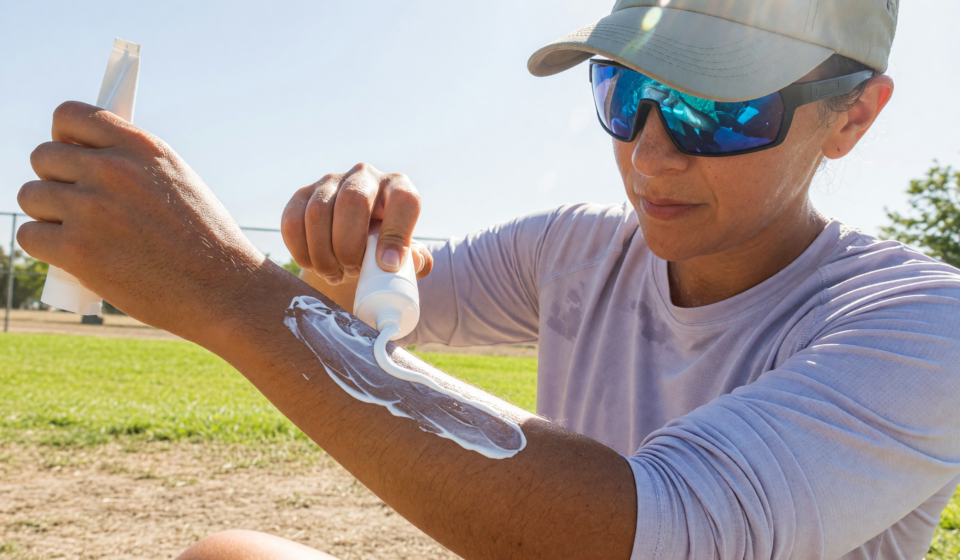
Application is where most athletes fall short. The AAD notes that people who still burn usually applied too little, missed spots or failed to reapply. Put sunscreen on before you dress and head out, use enough to coat all exposed skin generously, and do not forget easy-to-miss areas like the ears, the back of the neck and the tops of the feet.
The AAD is specific about timing: reapply sunscreen every two hours, and immediately after swimming or sweating. On a long training day, that means carrying it with you rather than relying on a single morning application.
For sport, sweat-resistant sticks and lotions are the practical choice. A stick is fast to reapply mid-run or between sets and is less likely to drip into your eyes. Keep one in a jersey pocket, a hydration vest or your kit bag so the two-hour rule is realistic instead of aspirational.
👉 Shop sport and sweat-resistant broad-spectrum SPF 30+ sunscreen — sticks and lotions on Amazon (Ad — as an Amazon Associate, we earn from qualifying purchases.)
Sunglasses and UV Eye Protection
Your eyes and the thin skin around them need protection too, and this is the layer athletes most often skip. UV exposure is linked to cataracts and other eye conditions over time, and squinting into glare hurts your performance in the moment. The CDC advises choosing sunglasses that block both UVA and UVB rays.
On labels, the clearest shorthand is UV400 or “100% UVA/UVB protection.” UV400 means the lenses block UV wavelengths up to 400 nanometers, which covers effectively all UVA and UVB. Tint darkness is not the same as UV protection, so do not assume a dark lens is a safe one; check for the rating. For sport specifically, prioritize these:
- UV400 or 100% UVA/UVB rating: Non-negotiable, and independent of how dark the lens looks.
- A secure, wrap-around fit: Wrap styles block light and reflection from the sides and stay put during hard efforts.
- Impact-resistant lenses: Shatter-resistant materials matter for cycling, running and racket sports where debris or contact is possible.
- Sport-ready extras: Non-slip nose pads, sweat channels and interchangeable or polarized lenses help in changing conditions.
👉 Shop UV400 sport sunglasses — wrap-around, impact-resistant frames on Amazon (Ad — as an Amazon Associate, we earn from qualifying purchases.)
Hats, Visors and Shade
A hat shields the highest-exposure real estate on your body: the scalp, face, ears and neck. The CDC recommends a hat with a brim all the way around that shades your face, ears and the back of your neck. A wide-brim hat is ideal when your sport allows it; for high-output efforts, a lightweight running cap or a visor paired with sunscreen and sunglasses is a reasonable compromise, though a visor leaves the scalp exposed and needs backup coverage.
Shade is free protection, so use it strategically. Warm up, cool down and rest in the shade rather than the open sun, choose shaded sides of a course when you can, and set up team tents or umbrellas at fields and courts. On the water or a bright deck, remember that reflected UV can reach you even under a canopy, so shade supplements your other layers rather than replacing them.
👉 Shop wide-brim sun hats and sport visors for training and race day on Amazon (Ad — as an Amazon Associate, we earn from qualifying purchases.)
Timing and the Cloudy-Day Myth
When you train changes how much UV you absorb. Because the CDC identifies 10 a.m. to 4 p.m. as the strongest UV window, shifting long or high-exposure sessions to early morning or evening meaningfully cuts your dose. That is not always possible with race times and league schedules, but when you have the choice, the edges of the day are kinder to your skin.
The most dangerous assumption in endurance sports is that an overcast day is a day off from sun protection. It is not. The CDC states plainly that UV rays can reach you on cloudy and cool days. Clouds scatter and let through a large share of UV, and cooler air can mask how much exposure you are getting because you never feel hot. Treat gray, mild and even chilly training days as sun days and protect accordingly.
Building a Sun-Protection Routine on Training Days
The layers only work if they fit into your normal preparation. A simple, repeatable sequence keeps protection consistent without adding much time:
- Dress for defense first: Reach for UPF 50+ tops, sleeves or tights so covered skin is handled before you think about anything else.
- Apply sunscreen early: Coat all exposed skin with broad-spectrum, water-resistant SPF 30+ before you leave, and give it a few minutes to set.
- Gear up your head and eyes: Add a brimmed hat or visor and UV400 sunglasses as standard kit, not optional extras.
- Carry reapplication: Stash a sunscreen stick in a pocket or vest and reapply every two hours and after heavy sweating or swimming.
- Plan the clock and the course: Favor early or late sessions, use shade for warm-ups and rest, and protect yourself on cloudy days too.
Do this a handful of times and it becomes automatic, the same way lacing your shoes or filling your bottles already is.
The Bottom Line
Sun protection is a low-effort, high-return habit for anyone who trains outdoors. Layer UPF 50+ clothing, broad-spectrum water-resistant SPF 30+ sunscreen reapplied every two hours, UV400 sunglasses and a good hat, then be smart about timing and shade, including on cloudy days. Follow the guidance from the AAD, FDA, Skin Cancer Foundation and CDC, and you can keep chasing your goals in the sun while protecting your skin and eyes for the long haul.
Disclaimer: This article is for general informational purposes only and is not medical advice. Individual sun-protection and skin-health needs vary; consult a qualified dermatologist or healthcare provider for guidance specific to you. PSAWEAR may earn a commission from qualifying purchases made through links on this page, at no additional cost to you.
Sources: American Academy of Dermatology (AAD) — sunscreen selection and application guidance; U.S. Food and Drug Administration (FDA) — sunscreen labeling and water-resistance standards; Skin Cancer Foundation — sun-protective clothing and UPF ratings; Centers for Disease Control and Prevention (CDC) — sun safety, timing, hats, sunglasses and cloudy-day UV exposure.