
Respirators and NIOSH: N95, Half-Masks and Fit Testing Explained
You can’t see most of what makes air dangerous. Welding fume, silica dust from cutting concrete, wood dust, spray-paint mist, mold spores, and countless chemical vapors are invisible or nearly so — and your lungs have no way to filter them on their own. A respirator is the last line of defense when you can’t engineer a hazard out of the air, and choosing the right one is one of the most consequential PPE decisions a worker makes. Get it wrong, and you’re breathing a false sense of security.
The trouble is that respirators are widely misunderstood. People reach for a paper “dust mask” against paint fumes it can’t stop, wear an N95 with a beard that breaks the seal, or assume any mask labeled “N95” is interchangeable. This guide clears it up: how NIOSH certifies and rates respirators, what N/R/P and 95/99/100 actually mean, the differences between disposable, half-mask, and powered options, and why a fit test is the step you can’t skip.
What NIOSH certification means
In the United States, respirators used for workplace protection are certified by the National Institute for Occupational Safety and Health (NIOSH), part of the CDC. A NIOSH-approved respirator has passed rigorous testing for filtration efficiency, breathing resistance, and construction. Every approved model carries a NIOSH approval number (starting with “TC-“) and a marking that tells you its filter class.
This matters enormously. A genuine NIOSH-approved N95 is a piece of certified safety equipment; a look-alike “surgical mask” or an uncertified import is not, no matter how similar it appears. When your health depends on it, look for the NIOSH stamp printed directly on the respirator itself.
Decoding the letters and numbers
Filtering respirators are rated by a letter and a number — for example N95, R95, or P100. Each half of the code tells you something different.
The letter: oil resistance
- N — Not oil resistant. Use where there are no oil-based aerosols. Fine for dust, most fumes, and water-based mists.
- R — Oil Resistant. Withstands oil aerosols for up to one shift (8 hours).
- P — Oil Proof. Strongly resistant to oil; suitable for oil-based aerosols with fewer time limits.
The number: filtration efficiency
- 95 — filters at least 95% of airborne particles.
- 99 — filters at least 99%.
- 100 — filters at least 99.97% (essentially HEPA-level).
So a P100 is oil-proof and filters 99.97% of particles — the most protective particulate class, and the reason its filters are usually marked with a magenta color. An N95, the most common respirator, is not oil resistant and filters 95%. Crucially, none of these filter gases or vapors. Solvent fumes, chlorine, ammonia, and similar hazards require a respirator fitted with the correct chemical cartridge (color-coded and rated for specific gas families), not a particulate filter.
The three main types
1. Filtering facepiece (disposable N95)
The familiar molded cup or fold-flat mask. Lightweight, inexpensive, and disposable, it protects against particulates only. It’s ideal for dusty work — sanding, sweeping, insulation — where there are no vapors and the concentration isn’t extreme. Its assigned protection factor (APF) is 10, meaning it’s rated to reduce exposure to one-tenth of the ambient concentration when properly fitted. Look for two straps (not ear loops) on a genuine industrial N95; a single-strap or ear-loop mask is usually not NIOSH-approved for the workplace.
👉 Shop NIOSH-approved N95 disposable respirators on Amazon (Ad — as an Amazon Associate, we earn from qualifying purchases.)
2. Elastomeric half-mask
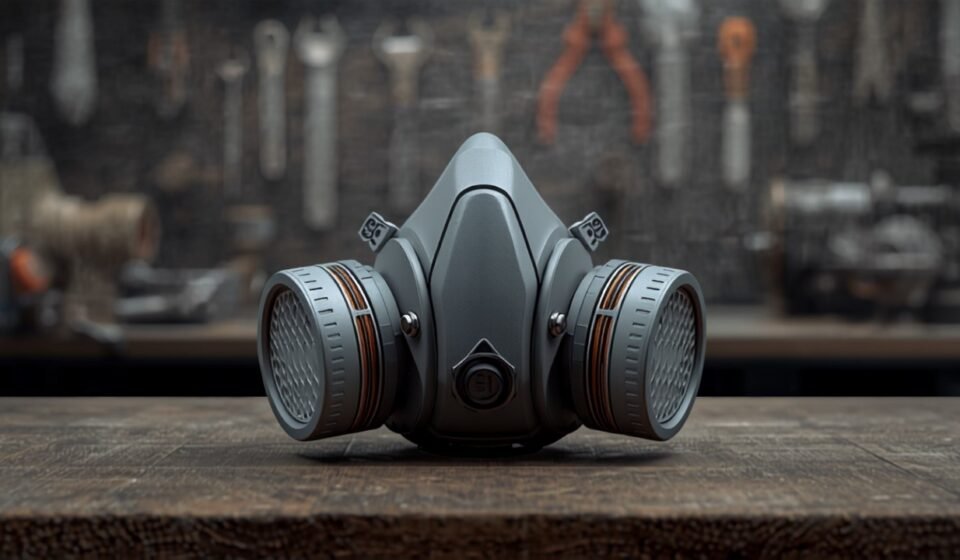
A reusable rubber or silicone facepiece that seals around the nose and mouth and accepts swappable filters and cartridges. This is the workhorse for painters, welders, and anyone facing vapors, because you can fit it with the exact cartridge the job requires — organic vapor, acid gas, or a combination — plus a P100 pre-filter. It also carries an APF of 10 but offers better durability, a more reliable seal, and far lower long-term cost than disposables. The trade-off is bulk and the need to clean and maintain it.
👉 Shop reusable half-mask respirator with cartridges on Amazon (Ad — as an Amazon Associate, we earn from qualifying purchases.)
3. Powered air-purifying respirator (PAPR)
A battery-powered blower pulls air through filters and pushes it into a hood, helmet, or facepiece. Because the airflow is positive, PAPRs are far more comfortable for long shifts, generate no breathing resistance, and — critically — work for people who can’t get a tight seal, including many with beards. Loose-fitting PAPR hoods can reach an APF of 25 or higher. They cost more and require battery and filter management, but for high-exposure or all-day work, they’re often worth it.
Why fit testing is non-negotiable
Here’s the part that undoes most respirator programs: a tight-fitting respirator only works if it actually seals to your face. Contaminated air always follows the path of least resistance, and a gap at the edge of the mask lets it flow straight past the filter and into your lungs. That’s why OSHA’s Respiratory Protection standard (29 CFR 1910.134) requires a fit test before a worker first uses a tight-fitting respirator, and at least annually thereafter.
- Qualitative fit test: a hood is placed over the head and a test agent (sweet or bitter aerosol, or irritant smoke) is released. If you can taste or smell it, the mask fails. Pass/fail only.
- Quantitative fit test: an instrument measures the actual leakage and produces a numeric fit factor. Required for higher-protection respirators.
Two rules follow directly from this. First, facial hair is the enemy of the seal. Any stubble or beard that crosses the sealing surface will break the fit — no exceptions — which is why clean-shaven faces or a switch to a loose-fitting PAPR are the only compliant options for bearded workers. Second, do a user seal check every single time you put the respirator on: cover the filters and inhale gently (the mask should collapse slightly and hold), then exhale (it should billow without leaking at the edges).
Medical evaluation first. OSHA also requires a medical evaluation before fit testing, because breathing through a respirator adds strain — a real concern for workers with heart or lung conditions. It’s a short questionnaire reviewed by a healthcare provider, and it comes before the fit test, not after.
Choosing the right respirator: a quick framework
- Identify the hazard. Particulate (dust, fume, mist), gas/vapor, or both? This is the single most important question — and it determines whether you need a filter, a cartridge, or a combination.
- Match the class. Oil present? Move from N to R or P. Need higher efficiency? Move from 95 to 100. Gases present? Add the correctly rated cartridge.
- Pick the type. Occasional dust → disposable N95. Vapors or daily use → elastomeric half-mask. High exposure, all-day wear, or facial hair → PAPR.
- Never exceed the APF. If the concentration is more than 10× the exposure limit, a half-mask isn’t enough — step up to a full-face or PAPR.
- Get fit tested and stay clean-shaven for any tight-fitting respirator.
When a respirator isn’t enough
Air-purifying respirators — everything covered above — clean the air around you, but they cannot add oxygen. In oxygen-deficient atmospheres (below 19.5%), or in environments that are Immediately Dangerous to Life or Health (IDLH) such as confined spaces with unknown air, no filter mask is acceptable. Those situations demand a supplied-air respirator or self-contained breathing apparatus (SCBA) that delivers clean air from a separate source. Knowing this boundary can save your life: a filter respirator in a low-oxygen space is worse than useless because it feels like protection while providing none.
The bottom line
Respiratory protection rewards precision. Start by identifying exactly what’s in the air, match the NIOSH letter-and-number rating to that hazard, and choose the facepiece type that fits your exposure and your face. Then respect the two rules that make all of it real: get fit tested, and keep the sealing surface clean-shaven. A respirator that seals and matches the hazard is genuine protection — one that doesn’t is just a mask.
Disclaimer: This article is for general educational purposes and is not a substitute for a formal respiratory hazard assessment, medical evaluation, or professional fit testing. Employers must follow OSHA 29 CFR 1910.134 and consult a qualified safety professional to build a compliant respiratory protection program.
Sources: OSHA Respiratory Protection standard (29 CFR 1910.134); NIOSH 42 CFR Part 84 respirator certification; NIOSH Guide to the Selection and Use of Particulate Respirators.