
Yuyitop Recalls 25,073 Aitjunz Dressers Over Tip-Over Death Risk to Children
On September 24, 2026, the U.S. Consumer Product Safety Commission (CPSC) and importer Yuyitop announced a dresser tip-over recall covering about 25,073 Aitjunz 8-Drawer Dressers, warning that the units are unstable when they are not anchored to a wall and can tip over onto a child. The recall (number 26-794) covers dressers sold online from May 2025 through July 2026, and CPSC says an unanchored unit poses a risk of serious injury or death from tip-over and entrapment. The agency and the company are urging owners to act now rather than wait.
What happened
The recall involves the Aitjunz 8-Drawer Dresser, a low, wide clothing storage unit measuring about 15.55 inches wide, 55.11 inches long, and 30.78 inches tall, and weighing roughly 129 pounds. It was sold in five finishes — black, white, brown, oak, and cream — under model numbers beginning with LDQMFJ8D (for example, LDQMFJ8D-BR, -CM, -WH, -BK, and -NA). The dressers were sold on Amazon.com, Wayfair, Temu, and Walmart for between about $230 and $270.
According to the CPSC notice, the recalled dressers do not comply with the mandatory federal stability standard for clothing storage units. When they are not anchored to a wall, they can tip over during ordinary use, creating a hazard that can trap or crush a young child. The company has received one report of a dresser tipping over; no injuries have been reported so far. The recalled units were imported by Maizhe International Trade Co., Ltd., doing business as yuyitop, and manufactured by Dongguan Meiying Sen Smart Home Co., Ltd., of China.
Why this dresser tip-over recall matters for safety
Furniture tip-overs are one of the most preventable causes of serious injury to children in the home, and they happen faster than most parents expect. A curious toddler who pulls open lower drawers to climb, or who tugs on the front of a tall unit, can bring more than a hundred pounds of furniture down in an instant. Because a child can be pinned against the floor, a wall, or an open drawer, tip-overs can cause suffocation and crushing injuries even when the piece itself does not appear especially heavy.
The federal government considers this hazard serious enough to regulate directly. CPSC data tied to the current standard documented 234 fatalities from clothing storage unit tip-overs between January 2000 and April 2022, including 199 child fatalities, along with an estimated 84,100 tip-over-related injuries treated in U.S. emergency departments from 2006 through 2021 — an average of roughly 5,300 injuries a year. A single recalled dresser in a child’s bedroom is not an abstract statistic; it is exactly the kind of product these rules were written to catch.
What you should do
If you own one of these dressers, the CPSC’s guidance is direct: stop using it immediately if it is not anchored to a wall, and move it to a space children cannot reach until it is secured. Then take the following steps.
- Check your unit: Look for the Aitjunz 8-Drawer Dresser in black, white, brown, oak, or cream, with a model number that starts with LDQMFJ8D, purchased online between May 2025 and July 2026.
- Anchor it or move it: If the dresser is not already fastened to a wall, keep children away from it until you have installed the remedy.
- Request the free fix: Contact Yuyitop for a free retrofit kit that includes counterweight blocks and installation instructions designed to improve the unit’s stability.
- Reach the company: Call 986-305-9671 from 9 a.m. to 6 p.m. ET, Monday through Friday, email recall.aitjunz@outlook.com, or visit the recall page at aitjunzrecall.pages.dev.
- Report problems: If your dresser has already tipped or you have a safety concern, you can file a report with the CPSC at SaferProducts.gov.
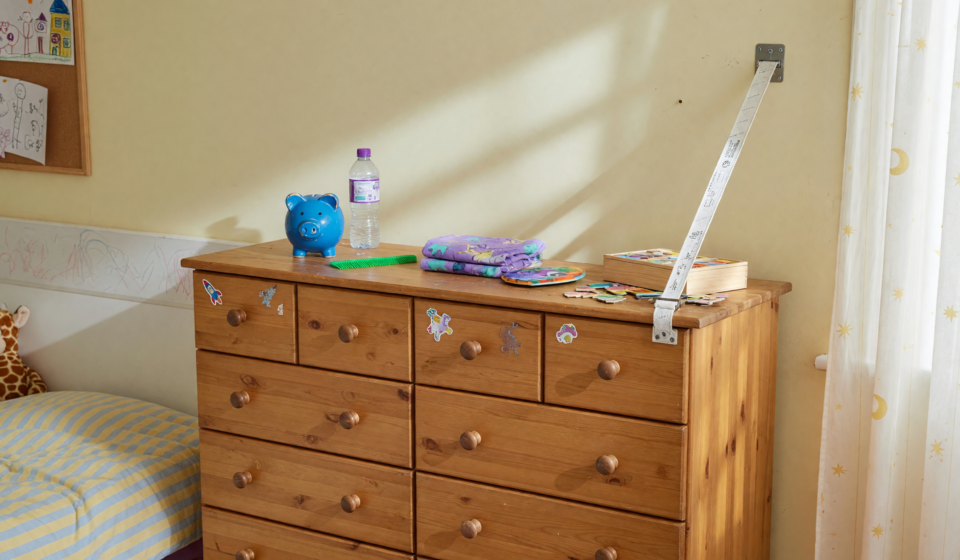
What to do right now. Do not wait for the retrofit kit to arrive before acting. If the dresser is not anchored, empty or relocate it so a child cannot climb or pull on it, and anchor every tall dresser in your home to a wall stud using a tip-over restraint. Anchoring is the single most effective step, and it protects against recalled and non-recalled furniture alike.
Context and what’s next
This recall is part of a broader federal push to make dressers safer by design rather than relying on parents to guess which units are stable. Under the STURDY Act, the CPSC adopted a mandatory safety standard for clothing storage units that took effect on September 1, 2023. The rule requires units to pass stability tests that reflect real-world use: it checks stability on carpeting, with drawers loaded and multiple drawers open at once, and with simulated forces representing children weighing up to 60 pounds interacting with the furniture. Products that cannot pass these tests are not supposed to be sold in the United States, which is why a stability failure on its own can trigger a recall even before anyone is hurt.
The enforcement picture also reflects how much furniture now moves through online marketplaces. Like a number of recent recalls, these dressers were sold through major e-commerce platforms rather than a single brick-and-mortar chain, which can make it harder for buyers to track down safety notices after the sale. Owners who bought the dresser as a gift, secondhand, or for a rental should assume the recall applies to them too and check the model number. The CPSC’s long-running Anchor It! campaign continues to press a simple message that applies well beyond this one product: anchor tall furniture and televisions, keep heavy items in lower drawers, and place tempting objects like remotes and toys off the top of dressers so children are not drawn to climb.
Disclaimer. This article is for general safety information only and is not legal, medical, or product-specific advice. Recall details, remedies, and contact information can change after publication. Always confirm current information directly with the CPSC and the manufacturer before acting, and follow the official recall instructions for your specific product.
Sources: CPSC recall notice (Sept. 24, 2026); CPSC / Anchor It! on the STURDY Act standard; CPSC Recalls index.