
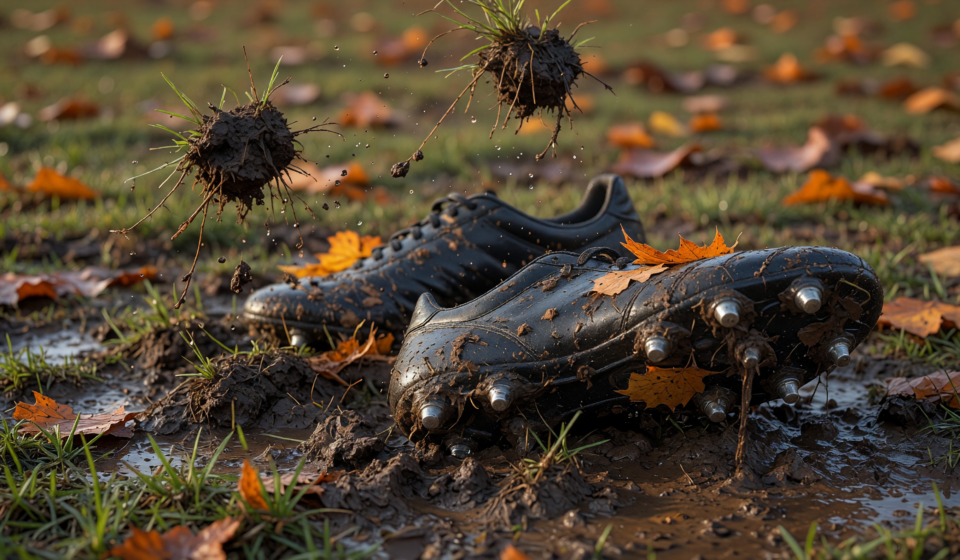
Soccer Cleats and Stud Types: Traction for Muddy Fall Fields
It is the third weekend of October, the grass is soaked from an overnight storm, and you watch a midfielder plant a foot to change direction only to have it slide out from under her like she stepped on ice. Nobody was tackled. Nobody tripped. The field simply won out. That single slip is a lesson in soccer cleat traction: on a muddy fall pitch, the shoe you chose that morning matters as much as the drill you ran all week. When the ground turns soft, the studs under your boot become the difference between a clean cut and a hard landing.
This guide walks through how soccer cleats actually grip a wet field and why the alphabet soup of stud types printed on the box is not marketing noise. We will decode firm ground (FG), soft ground (SG), artificial grass (AG), and the rest; explain the difference between conical and bladed studs; and cover what US governing bodies actually require, including the referee equipment check that can send a player back to the bench. The goal is simple: help you read the field, pick the right outsole, and keep your footing when fall conditions try to take it away.
Why Traction Falls Apart on a Muddy Fall Field
Grip on grass is mostly a story about shear. When you push off, your studs press sideways against the soil, and the ground pushes back. On a dry summer field, that soil is firm and holds. Come fall, cooler temperatures, shorter days, and steady rain leave the top layer saturated and loose. Now the studs have to reach past the greasy surface film to find soil that can actually resist your force. A shoe designed for firm ground may only bite the slick top layer and skate right across it.
Two variables drive whether your cleat finds purchase in those conditions:
- Stud length: Longer studs penetrate deeper to reach undisturbed soil beneath the mush, which is why soft-ground designs run longer than firm-ground ones.
- Stud count and spacing: Fewer, longer studs concentrate force to dig in, while more, shorter studs spread load across a hard surface where deep penetration is neither possible nor safe.
Match the design to the ground and the physics works for you. Mismatch them and you are fighting the field all game.
Decoding the Alphabet: FG, SG, AG, MG, TF, and IN
Cleat makers use a short code, usually stamped near the size on the box, to tell you what surface the outsole was built for. Here is what each one means and where it belongs:
- FG (Firm Ground): The default game-day boot for dry or slightly damp natural grass. Molded studs are shaped for grass and offer balanced grip, but they can catch on artificial turf and struggle in heavy mud.
- SG (Soft Ground): Built for wet, muddy natural grass, exactly the fall-field scenario. It uses longer studs, often removable metal or metal-tipped, that sink deep into loose soil for a secure plant.
- AG (Artificial Grass): Designed for modern synthetic turf, with shorter, rounder studs spread across the plate to grip without locking in when you pivot or stop.
- MG (Multi-Ground): A compromise for players who move between firm grass and artificial surfaces; it does a bit of everything and specializes in nothing.
- TF (Turf): Many small rubber lugs for older-style turf and hard artificial surfaces. Great on shallow surfaces, but not enough bite on wet grass.
- IN / IC (Indoor): Flat, non-marking rubber soles for futsal and gym floors. No outdoor traction to speak of.
For a rain-soaked October match, that list narrows fast. SG is the specialist, FG is the versatile default, and the rest are wrong tools for muddy grass.
👉 Shop soft-ground (SG) soccer cleats for wet grass on Amazon (Ad — as an Amazon Associate, we earn from qualifying purchases.)
How Stud Shape Drives Soccer Cleat Traction
Beyond length, the shape of each stud changes how the shoe behaves the instant you load it. The two families you will see are conical and bladed, and each makes a real trade-off.
- Conical (round) studs: Cylindrical or cone-shaped points that release cleanly from the ground, so your foot rotates and repositions without hanging up. That easy release tends to be gentler on the knee and ankle during quick pivots.
- Bladed studs: Flatter, elongated fins that present more edge to the soil, delivering strong grip for straight-line acceleration. The trade-off is that a blade can lock into the turf, which is a bigger concern when the surface suddenly grabs.
On soft fall grass, many players favor conical or mixed patterns for that predictable release, especially when the field is uneven and every step lands a little differently. The right answer depends on your position and cutting style, but understanding the release behavior is the key to choosing rather than guessing.
Field-read tip. Before kickoff, press a thumb into the grass along the sideline. If your thumb sinks easily and comes up muddy, the surface will swallow short firm-ground studs; that is a soft-ground day. If the ground is springy but holds shape, firm ground will do the job.
Soft-Ground Cleats and the Muddy-Field Advantage
Soft-ground cleats exist for one reason: to reach solid soil when the top of the field has turned to soup. Their longer studs, frequently metal or metal-tipped and often removable, punch through the loose layer and anchor in the firmer ground below. That extra reach is what keeps a player planted when a firm-ground boot would be sliding.
The catch is specialization. Those same long studs are a liability the moment the ground firms up:
- Wrong on hard surfaces: On dry grass or turf, long SG studs cannot sink properly, leaving you perched on stud tips with poor stability and added joint strain.
- Removable studs need maintenance: Screw-in studs must be checked and tightened; a loose or worn stud is both a performance problem and a safety flag at the equipment check.
- Not a year-round shoe: SG boots earn their place on wet weeks, but most players keep a firm-ground pair as the everyday default.
If your fall schedule includes regular rain and heavy natural grass, a dedicated soft-ground pair is one of the highest-value additions to a kit bag. If conditions swing week to week, keep both and choose on game morning.
👉 Shop replacement metal and metal-tipped studs plus stud wrench on Amazon (Ad — as an Amazon Associate, we earn from qualifying purchases.)
What the US Rulebooks Say About Studs
Footwear is governed equipment, and the rules matter before you ever think about grip. At the international level, the Laws of the Game maintained by the International Football Association Board (IFAB) cover players’ equipment under Law 4, which requires that a player’s gear not be dangerous and gives the referee authority over what is allowed on the field. US high school play follows the National Federation of State High School Associations (NFHS) soccer rules, and college play follows National Collegiate Athletic Association (NCAA) rules.
A common myth is that metal studs are banned in soccer. They are not, provided they are not dangerous. NCAA rules, for example, permit shoes with cleats of aluminum, leather, rubber, nylon, or plastic as long as the referee does not consider them dangerous. The recurring theme across these governing bodies is the same:
- Safety is the standard: The rules judge cleats by whether they endanger anyone, not by material alone.
- The referee has final say: A match official can prohibit any footwear judged unsafe, even if it is technically legal.
- Condition counts: Sharp edges, burrs, or worn studs with exposed metal are the kind of thing that gets a shoe flagged, so upkeep is part of compliance.
Because the specifics differ by league and age group, always confirm your competition’s current rules. What is allowed in a college match may be handled differently in a youth recreational league, and the referee’s judgment on the day is the last word.
Metal Versus Molded and the Referee Check
Most players today wear molded plastic or rubber studs, which perform well on modern pitches and rarely raise eyebrows at inspection. Metal comes into play mainly on soft-ground boots, where metal or metal-tipped studs deliver that deep muddy-field bite. Both can be legal; the deciding factor is condition and safety, not the metal itself.
Pre-game equipment checks are routine in officiated matches. To pass without drama:
- Feel for sharp edges: Run a hand over the studs; a burr or a worn cap with exposed metal edge is the classic reason a shoe gets pulled.
- Tighten removables: On screw-in studs, confirm each is seated and snug before you leave the house, and carry a stud wrench.
- Retire worn studs: Studs ground down flat lose grip and can expose hardware; replace them rather than pushing one more week.
- Arrive early: Give yourself time to swap into a legal pair if the official flags something.
None of this is about gaming the rules. A cleat that passes a thorough safety check is usually the same cleat that protects your own joints and everyone else on the field.
👉 Shop firm-ground (FG) molded soccer cleats on Amazon (Ad — as an Amazon Associate, we earn from qualifying purchases.)
Fit, Care, and Reading the Field
The best outsole in the world underperforms in a shoe that does not fit. On slick fall grass, a snug, locked-in heel lets your foot drive the studs into the ground instead of sliding around inside the boot. Try cleats on with the socks you actually play in, and check for a firm midfoot hold with a small amount of room at the toe.
Care habits stretch the life of your traction, too:
- Clean off mud after every wet game: Caked soil in the stud channels hides wear and adds slippery weight; knock it off and let the boots air dry away from direct heat.
- Inspect studs weekly: Look for flat spots, cracks, and, on removables, worn threads, and swap parts before they fail mid-match.
- Keep two pairs if you can: A firm-ground default and a soft-ground option cover almost any fall condition without compromise.
- Read the surface, not the forecast: Fields drain differently, so judge the actual grass at the venue rather than assuming from the weather app.
Reading the field is a skill that compounds. The more you connect what you feel underfoot to which studs you laced up, the faster you will make the right call before kickoff.
The Bottom Line
Muddy fall fields are unforgiving, but they are also predictable if you know what you are looking at. Grip comes down to matching stud length, count, and shape to the ground in front of you: soft-ground boots with longer studs for saturated grass, firm-ground molds for everyday natural surfaces, and the right code on the box for everything in between. Layer in the rules, keep your studs clean and safe enough to sail through any referee check, and dial in a snug fit, and you turn a slippery liability into a genuine edge. Choose your soccer cleats for the field you are actually standing on, and let the traction take care of the rest.
Disclaimer: This article is provided for general educational purposes only and does not constitute equipment, safety, medical, or officiating advice. Rules on footwear vary by league, age group, and governing body and change over time. Always confirm the current requirements of your specific competition and defer to the match official’s judgment on game day.
Sources: International Football Association Board (IFAB), Laws of the Game, Law 4 (The Players’ Equipment); National Federation of State High School Associations (NFHS), soccer rules; National Collegiate Athletic Association (NCAA), soccer equipment rules; Pro:Direct Soccer, cleat ground-type guides (FG, SG, AG, MG, TF, IN).