
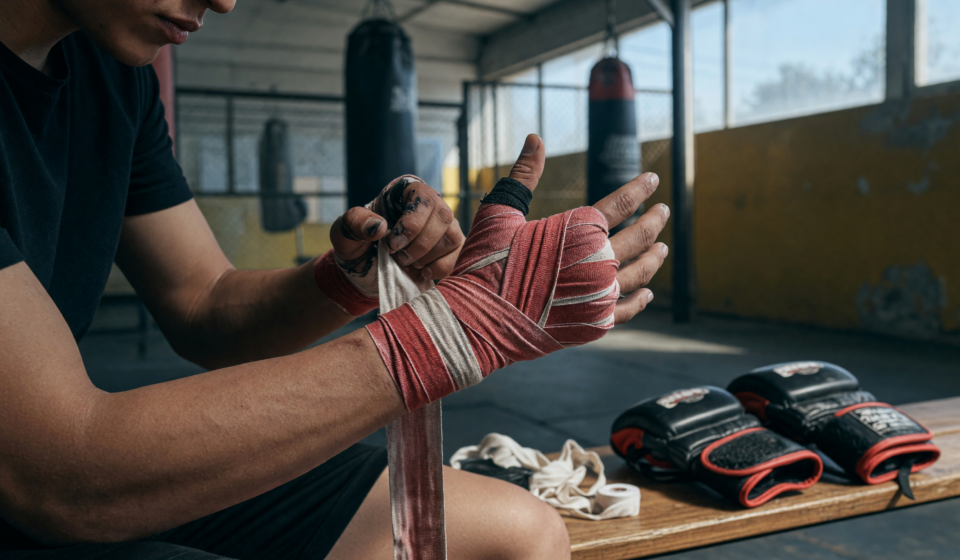
Hand Wraps and MMA Gloves: Wrapping Technique and Knuckle Protection
The first time you throw a hook and feel your wrist fold on impact, you understand why fighters obsess over their hands. Your fist is a stack of small, mobile bones held together by soft tissue, and a punch sends real force straight back through those bones into the wrist. Good hand wraps are the quiet piece of gear that keeps all of that lined up. They do not turn a bad punch into a good one, but they hold your knuckles, joints, and wrist in a stable bundle so the shock has somewhere to go besides the weakest link in the chain.
This guide covers both halves of the system that protects a fighter’s hands: the hand wraps underneath and the MMA gloves or bag gloves on top. We will walk through the anatomy of a boxer’s fracture, the difference between what wraps do and what padding does, what the Unified Rules of MMA actually allow for competition wrapping, a plain-English wrapping walkthrough, how to choose wraps and gloves that fit, and how to keep the whole kit clean. The goal is to explain the why behind each habit so your choices hold up in the gym and, if you compete, at the commission table.
Why Your Hands Need Protection in the First Place
The hand is a marvel of engineering built for gripping and manipulating, not for repeatedly slamming into a heavy bag or an opponent’s skull. When you make a fist, the long bones behind your knuckles, called the metacarpals, take the brunt of the load. The most common combat-sports hand injury is so routine it has a nickname: the boxer’s fracture, a break at the neck of a metacarpal, most often the one behind the pinky. It usually happens when the fist is not tightly packed and the outer knuckles absorb force they were never meant to carry alone.
Wrapping exists to solve two problems at once. First, it compresses the loose bones of the hand into a single unit so they move and land together instead of shifting on impact. Second, it braces the wrist so it cannot bend backward at the moment of contact, which is where a lot of sprains and long-term joint pain come from. Padding in a glove softens the blow to your skin and to your target, but padding does nothing for the internal alignment of your hand. That is the wrap’s job, and no glove replaces it.
- Knuckle stability: A snug wrap keeps the metacarpals bundled so force spreads across the hand instead of concentrating on one knuckle.
- Wrist support: Anchoring turns around the wrist limit hyperextension, the motion behind many sprains.
- Skin and joint cushioning: Layers over the knuckles reduce abrasion and blunt the shock to the small joints underneath.
- Sweat management: Cloth wraps absorb moisture that would otherwise soak into and break down your glove lining.
Hand Wraps vs. Gloves: Two Jobs, One System
It helps to think of your hands as protected by a layered system rather than a single product. The wrap is structural: it manages what happens inside your hand. The glove is protective padding: it manages what happens between your hand and whatever you are hitting. They are designed to work together, and skipping either one leaves a gap. A well-wrapped hand in a thin, worn glove will still bruise your knuckles on a heavy bag. A thick glove over unwrapped hands will still let your wrist collapse and your metacarpals shift.
MMA gloves add their own wrinkle because they are deliberately small and open. Competition MMA gloves are lightly padded and leave the fingers free so fighters can grip, clinch, and grapple. That open design means far less foam over the knuckles than a boxing glove offers, which puts even more of the protective burden on the wrap and on the padded backhand of the glove. Boxing and bag gloves, by contrast, wrap the whole fist in foam and are built for repeated striking volume, not grappling.
👉 Shop cotton and semi-elastic hand wraps on Amazon (Ad — as an Amazon Associate, we earn from qualifying purchases.)
What the Unified Rules Actually Say
If you compete, wrapping is not a matter of personal preference. In the United States, professional and most amateur MMA bouts run under the Unified Rules of MMA, maintained by the Association of Boxing Commissions and Combative Sports and enforced by each state’s athletic or combat sports commission. Those rules spell out exactly what can go on your hands, and an inspector checks and signs off before you glove up. The reasoning is straightforward: hand wraps can be built into weapons, and loose or hardened wraps change how much damage a punch does.
- Gauze limits: The Unified Rules permit up to one roll of soft cloth gauze per hand, no more than 2 inches wide by 15 yards long, and it may not extend past the wrist.
- Tape limits: Athletic tape is capped at one roll per hand, no more than 1.25 inches wide by 10 feet long.
- Knuckles stay bare of tape: Tape may pass between the fingers but may not cover the knuckles, so nothing hard sits on the striking surface.
- Nothing past the wrist: Wraps and tape must stay on the hand and wrist and cannot run up the forearm.
Amateur bouts often add stricter requirements and sometimes have the wrapping done or closely supervised by officials. The glove itself is also regulated: commissions specify approved, lightly padded MMA gloves for competition, commonly in the range of about 4 ounces, with the exact spec set by the promotion and the local commission. The practical takeaway is simple. Learn the wrap your commission allows before fight week, because that is the only wrap you will be permitted to wear.
Commission tip. Never harden your wraps with excess tape over the knuckles or by soaking them. Inspectors are trained to catch it, it will get you disqualified, and it defeats the point: a rigid striking surface hurts your own hand as much as your opponent.
How to Wrap Your Hands: A Practical Walkthrough
There is no single correct wrap, but every good one follows the same logic: anchor the wrist, bundle the hand, protect the knuckles, brace the thumb, and lock it all together. Keep your hand relaxed with fingers spread while you wrap so the fit is snug in a fist and not choking when your hand is open. If your fingers tingle or go pale, it is too tight, and a too-tight wrap can do as much harm as none at all.
- Anchor at the wrist: Loop the thumb hole and make several turns around the wrist first, building the foundation everything else pulls against.
- Cross the hand: Bring the wrap up and around the knuckles a few times, then diagonally back to the wrist to tie the two zones together.
- Weave the fingers: Run turns between the fingers to spread the knuckles slightly and keep the metacarpals from splaying on impact.
- Secure the thumb: Wrap around the base of the thumb and back to the wrist so the thumb is supported but never yanked outward.
- Finish over the knuckles: Close with cushioning passes across the knuckles and lock the hook-and-loop at the wrist with a little tension to spare.
Make a fist and press it into your other palm as a final check. It should feel like one solid, padded block, with your wrist held straight and no pinching at the fingers. If a punch feels like it wobbles the wrap or your wrist gives, unwrap and start over. Wrapping is a skill, and it gets fast with reps.
👉 Shop gel knuckle guards and inner gloves on Amazon (Ad — as an Amazon Associate, we earn from qualifying purchases.)
Choosing Hand Wraps: Material, Length, and Fit
Reusable cloth hand wraps are the everyday choice for training. Length is the first decision. Shorter wraps, often around 120 inches, go on fast and suit smaller hands or lighter bag work, while longer wraps, up to roughly 180 inches, give you more passes for wrist and knuckle coverage on bigger hands or heavier sessions. The right length is the one that anchors the wrist, weaves the fingers, and cushions the knuckles without a huge tail left over or coming up short.
- Cotton wraps: Breathable and affordable, they stay where you put them and are forgiving for beginners still learning tension.
- Semi-elastic wraps: A little stretch molds to the hand for a snugger, more even fit, which many experienced strikers prefer for heavy bag and pad work.
- Gauze and tape: The traditional fight-day wrap, applied fresh under a commission’s supervision and used once, not for daily training.
- Closure and width: A wide hook-and-loop strap that lies flat holds tension better and will not dig into your wrist.
Fit beats brand. A wrap that is comfortable at rest but locks your hand into a stable fist under load is doing its job. Buy two or three pairs so you always have a clean, dry set, because a damp wrap loses tension and breeds odor fast.
MMA Gloves and Knuckle Protection
Once your hands are wrapped, the glove takes over. For MMA specifically, the small competition glove is a compromise between striking protection and grappling function, which is why serious fighters often train in more than one type. Heavier sparring gloves protect your partner during hard rounds, bag gloves stand up to volume on equipment, and the lighter competition-style MMA glove is reserved for fight-specific work. Matching the glove to the task protects both your hands and everyone you train with.
- Competition MMA gloves: Light, open-fingered, and lightly padded for gripping and clinching, with the weight and model set by your commission and promotion.
- Sparring gloves: More foam over the knuckles to keep training partners safe during hard contact.
- Bag and training gloves: Built to absorb high-volume striking on heavy bags and pads over long sessions.
- Fit and closure: The glove should hold your wrapped hand firmly with no sliding, and the wrist closure should reinforce, not replace, your wrap.
Remember that the open design of an MMA glove means your knuckles have less foam over them than in any boxing glove. That is exactly why the wrap underneath matters so much in this sport, and why sloppy wrapping shows up as bruised, swollen knuckles the next morning.
👉 Shop MMA training and sparring gloves on Amazon (Ad — as an Amazon Associate, we earn from qualifying purchases.)
Care, Hygiene, and When to Replace
Wraps and glove linings spend hours pressed against sweaty skin, which makes them a natural home for bacteria and fungi. Skin infections spread easily in grappling gyms, so hygiene is not vanity here; it is part of staying healthy and training uninterrupted. The good news is that wraps are cheap and washing them is simple, so there is no excuse for a stiff, sour pair living at the bottom of your bag.
- Wash wraps regularly: Fasten the hook-and-loop and use a mesh laundry bag so they do not tangle, then air dry to preserve the fibers.
- Air out gloves: Open them fully after every session and let them dry completely; damp foam breeds odor and breaks down faster.
- Rotate your gear: Two or three sets of wraps let each pair dry fully between uses and last far longer.
- Retire worn gear: Replace wraps that have lost their stretch and gloves with flattened, cracked, or compressed padding, because thin foam no longer protects your knuckles.
👉 Shop quick-dry wraps and glove deodorizers on Amazon (Ad — as an Amazon Associate, we earn from qualifying purchases.)
The Bottom Line
Your hands are the tools this entire sport runs on, and they are far more fragile than they feel when the adrenaline is up. Hand wraps bundle your knuckles and brace your wrist so force travels through a stable structure instead of one vulnerable bone, and MMA gloves add the padding and the grip your discipline demands. Learn to wrap well, learn the rules your commission enforces, match your gloves to the task in front of you, and keep the whole kit clean and current. Do those four things consistently and you protect the one piece of equipment you cannot replace: your own two hands.
Disclaimer: This article is provided for general educational purposes only and is not medical, legal, or professional safety advice. Combat sports carry an inherent risk of injury. Always follow the rules of your athletic or combat sports commission, the guidance of qualified coaches and medical professionals, and the manufacturer’s instructions for any protective equipment you use.
Sources: Association of Boxing Commissions and Combative Sports (ABC), Unified Rules of Mixed Martial Arts and ABC MMA Officials Handbook (hand wrap gauze and tape specifications, glove requirements); U.S. state athletic and combat sports commission regulations (equipment approval and inspection); general orthopedic references on metacarpal (“boxer’s”) fractures.