Grip and Wrist Support for Lifting: Straps, Wraps and Sleeves
You are three reps into a heavy set of deadlifts, your legs and back still have plenty left, and yet the bar starts sliding out of your fingers. That moment, where your grip quits before the muscle you are actually trying to train does, is one of the most common frustrations in the weight room, and it is exactly the problem that lifting grip support is built to solve. Straps, wraps, and sleeves are not about being tougher or lazier; they are simple tools that let you keep loading the target muscle safely after your hands, or your wrists, would otherwise tap out.
This guide walks through the three main categories of hand and wrist gear you will see on the gym floor: lifting straps, which tie your hands to the bar for pulling; wrist wraps, which brace the wrist joint for pressing; and wrist sleeves and supports, which offer lighter compression for warmth and mild stability. We will cover what each one actually does, when it helps and when it can hold you back, how competition rules and workplace ergonomics guidance apply, and how to size and use them without trading a short-term win for a long-term problem. The goal is simple: help you match the right piece of lifting grip support to the right job.
Why Grip and Wrist Are the Weak Links
Your forearms and hands are small muscle groups asked to do an outsized job. On a heavy pull, the large muscles of your back, hips, and legs can generate far more force than your fingers can hold onto, so the grip becomes the bottleneck. On a heavy press, the opposite happens: the load wants to fold your wrist backward into extension, and the small stabilizers around the joint fatigue long before your chest or shoulders do. In both cases, the limiting factor is not the muscle you set out to train.
This is not just a gym problem. The same principle shows up in the workplace, where hand and wrist demands are a well-documented source of strain. The National Institute for Occupational Safety and Health (NIOSH) built its Revised Lifting Equation around exactly these ideas, and one of its factors is a “coupling multiplier” that accounts for how well a person can grip a load. When the grip is poor, the safe recommended weight drops. The takeaway for lifters is the same one ergonomists reached long ago: how well you can hold something changes how much you can safely handle.
- Grip fatigue: your fingers open before the prime movers are truly done working.
- Wrist extension: heavy pressing loads bend the wrist back, straining the joint and killing pressing power.
- Coupling matters: NIOSH ergonomics guidance treats a secure grip as a factor in what a load is safe to handle.
Lifting Straps: Tying Your Hands to the Bar
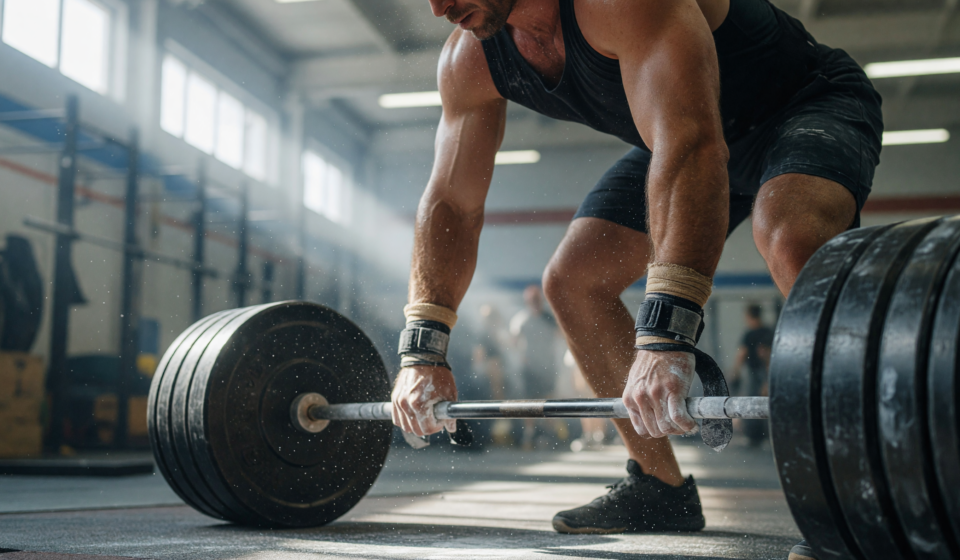
Lifting straps are lengths of non-stretch material, usually nylon or cotton, that loop around your wrist and then wrap around the bar so that the load hangs partly on the strap rather than entirely on your finger flexors. They shine on pulling movements: deadlifts, rows, shrugs, rack pulls, and heavy pulldowns, where grip is the first thing to fail on higher-rep or maximal sets. By taking your grip out of the equation, straps let you keep training your back and posterior chain with full loads even after your hands are toast.
The trade-off is that straps do their job so well they can let your natural grip strength lag behind if you lean on them for everything. Most experienced coaches suggest building raw grip on lighter and mid-range work, then reaching for straps on your heaviest or highest-rep sets where grip, not the target muscle, is the true limiter. The common styles are the simple loop strap, the lasso strap with an adjustable tail, and figure-eight straps for maximal pulls where security matters most.
👉 Shop lifting straps (lasso and figure-eight) on Amazon (Ad — as an Amazon Associate, we earn from qualifying purchases.)
- Best for: deadlifts, rows, shrugs, rack pulls, and heavy pulldowns.
- Loop straps: quick and simple, good for most gym pulling.
- Lasso straps: an adjustable tail for a more locked-in wrap.
- Figure-eight straps: the most secure hold for maximal or strongman pulls.
Wrist Wraps: Bracing the Joint for Pressing
Wrist wraps are often confused with straps, but they do a completely different job. Instead of connecting you to the bar, a wrist wrap is a stiff elastic band that winds tightly around the wrist joint itself, usually with a thumb loop and a hook-and-loop closure. Their purpose is to keep the wrist from bending backward under heavy pressing loads. On a max bench press, overhead press, or a low-bar squat where the bar sits in your hands, that support keeps the joint stacked and stable so force transfers cleanly through a neutral wrist.
Wraps come in different stiffnesses. Softer, more elastic wraps allow more movement and suit higher-rep bodybuilding-style pressing, while stiff, competition-grade wraps give maximum support for heavy singles. Powerlifting federations allow wrist wraps in competition but regulate them: under International Powerlifting Federation technical rules, for example, wraps may not exceed one meter in length and eight centimeters in width. It is worth loosening wraps between sets, since leaving them cinched tight for long stretches restricts blood flow and gets uncomfortable fast.
👉 Shop wrist wraps (stiff competition-grade and flexible) on Amazon (Ad — as an Amazon Associate, we earn from qualifying purchases.)
- Best for: bench press, overhead press, and low-bar squats.
- Stiff wraps: maximum support for heavy singles and near-maximal work.
- Flexible wraps: more comfort and range for higher-rep pressing.
- Know the rules: IPF caps competition wraps at one meter long and eight centimeters wide.
Wrist Sleeves and Lighter Supports
Between the two heavy-duty options sits a softer category: wrist sleeves and light compression supports. A wrist sleeve is typically a slip-on tube of neoprene or knit fabric that provides warmth and mild compression without the aggressive bracing of a stiff wrap. Many lifters like sleeves for higher-volume training, cross-training, or general gym work where they want a little support and joint warmth but do not need to lock the wrist rigid. They are also popular for people managing minor aches who want gentle stability throughout a session.
It is important to be honest about what a sleeve can and cannot do. Light compression may feel reassuring and can help keep the joint warm, but it will not brace a wrist against a true maximal press the way a stiff wrap will. If you are dealing with persistent wrist pain rather than ordinary training fatigue, that is a signal to see a qualified medical professional, not to strap on more gear and push through. Support tools manage load; they are not a treatment for injury.
Rule of thumb. Straps fix a grip problem, wraps fix a wrist-stability problem, and sleeves add warmth and light support. If you cannot clearly name the problem you are solving, you probably do not need the gear for that set.
Building Real Grip Instead of Hiding a Weakness
Support gear is a multiplier, not a replacement. If you strap up for every single working set, your raw grip strength never gets a reason to improve, and grip is genuinely useful, both in the gym and in daily life where carrying, gripping, and holding are constant demands. The smarter approach is to train unassisted where it makes sense, so your hands keep developing, and save the straps for the sets where grip would otherwise cut your training short.
Practical grip work does not require fancy equipment. Holding your last warm-up sets without straps, adding a few timed holds at the end of a session, using a thicker bar or grips, and carrying loaded implements like a farmer’s walk all build the forearms and hands directly. Think of it as a two-track system: develop the grip on purpose in some places, and remove it as a limiting factor with straps in others.
- Train strapless first: take warm-ups and lighter sets without support to build the hands.
- Add direct work: timed holds, thick-bar work, and loaded carries strengthen grip.
- Reserve straps: use them on the heaviest or highest-rep sets where grip is the true limiter.
Sizing, Materials, and Fit
Getting good use out of any of these tools starts with fit. Straps should be long enough to wrap the bar securely without so much excess that they bunch up in your palm. Cotton straps offer a bit of give and comfort, while stiffer nylon and leather hold up under the heaviest loads. Wraps should be snug across the wrist joint but never so tight that your hand tingles or goes numb; that is a sign to back off the tension. Sleeves should slide on with light resistance and stay put without cutting off circulation.
Inspect your gear regularly, because worn-out equipment fails at the worst possible moment. Fraying stitching on a strap, stretched-out elastic on a wrap, or a velcro closure that no longer holds are all reasons to retire a piece. As with any protective equipment, a tool only protects you while it is intact, so treat the retirement of a worn strap the same way you would treat replacing any other safety-critical gear: promptly.
👉 Shop wrist sleeves and compression supports on Amazon (Ad — as an Amazon Associate, we earn from qualifying purchases.)
- Strap length: enough to wrap the bar securely, not so much that it bunches.
- Wrap tension: firm and stable, never tight enough to cause numbness or tingling.
- Sleeve fit: snug and warm without restricting circulation.
- Retire the worn: replace frayed stitching, stretched elastic, or failing closures.
Matching the Tool to the Lift
Once you understand what each tool does, the choice on any given day gets simple. Ask what is actually limiting the lift. If your hands are opening on a pull, that is a grip problem, so reach for straps. If your wrist is caving backward under a press, that is a stability problem, so reach for wraps. If you just want a little warmth and light support through a higher-volume session, a sleeve fits the bill. Many lifters keep all three in the gym bag and rotate based on the day’s work.
None of this replaces sound technique and a sensible load progression. Support gear widens the margin around a lift you are already prepared to do; it does not license you to skip the fundamentals of bracing, positioning, and gradually adding weight. Used that way, straps, wraps, and sleeves are among the most cost-effective additions you can make to a training setup.
The Bottom Line
Grip and wrist support is not about masking weakness; it is about making sure the muscle you set out to train is the one that actually gets trained. Lifting straps keep your hands tied to the bar so your back and legs can keep working, wrist wraps brace the joint so heavy presses transfer force cleanly, and sleeves add warmth and light stability for everyday sets. Learn what each does, keep building raw grip on purpose, respect the fit and the federation rules that apply, and treat persistent pain as a reason to see a professional rather than to add more gear. Match the right tool to the right job and your training gets safer, more productive, and a good deal less frustrating.
Disclaimer: This article is provided for general educational purposes only and is not medical, legal, or professional training advice. Individual needs vary, and equipment rules change over time. Consult a qualified coach, medical professional, or the current rulebook of your chosen federation before making decisions about training gear, and seek medical care for any persistent pain or injury.
Sources: National Institute for Occupational Safety and Health (NIOSH), Revised NIOSH Lifting Equation and coupling multiplier guidance; Occupational Safety and Health Administration (OSHA), ergonomics guidance for manual material handling; International Powerlifting Federation (IPF), Technical Rules Book (wrist wrap dimensions); USA Powerlifting (USAPL) equipment guidelines.