Backyard Pool Barriers: Fencing, Alarms and Drowning Prevention Layers
A backyard pool can go from calm to catastrophe in the time it takes to answer a phone. A young child slips out a sliding door, crosses the patio, and reaches the water in under a minute, often without a splash loud enough to hear from inside. That is the quiet reality behind every drowning-prevention conversation, and it is exactly why pool barrier safety is built on redundancy rather than a single fence. No one layer is meant to be perfect. The point is that when one fails, another is still standing between a child and the water.
This guide walks through the full stack of protection the way safety agencies actually frame it: physical barriers like fencing and gates, alarms on doors, gates, and the water surface, safety covers, anti-entrapment drain covers, and the human layers of supervision and swim skills. We will lean on U.S. guidance from the Consumer Product Safety Commission (CPSC), the ASTM standards that govern pool alarms and covers, and the federal Virginia Graeme Baker Pool and Spa Safety Act. The goal is not to sell you a single gadget, but to help you understand why each layer exists and how they work together.
Why One Barrier Is Never Enough
The CPSC and its Pool Safely campaign consistently describe drowning prevention as a system of layers of protection. The logic is simple: every barrier has a failure mode. A gate gets propped open on a hot afternoon. An alarm battery dies. An adult looks away for thirty seconds. If your entire strategy rests on one of those, a single lapse is all it takes. Stack several independent layers, and a child has to defeat all of them at once for tragedy to occur, which is far less likely.
Here is the practical menu of layers most safety authorities point to:
- Barriers: Isolation fencing, self-closing and self-latching gates, and secured doors and windows that separate the home from the pool.
- Alarms: Door, gate, and surface or subsurface pool alarms that announce when the protected zone is breached.
- Covers: Power safety covers that carry weight and block access when the pool is not in use.
- Anti-entrapment measures: Compliant drain covers and drainage systems that prevent suction entrapment.
- People: Constant, undistracted adult supervision plus swim competency and CPR readiness.
The Fence: What Pool Barrier Safety Really Requires
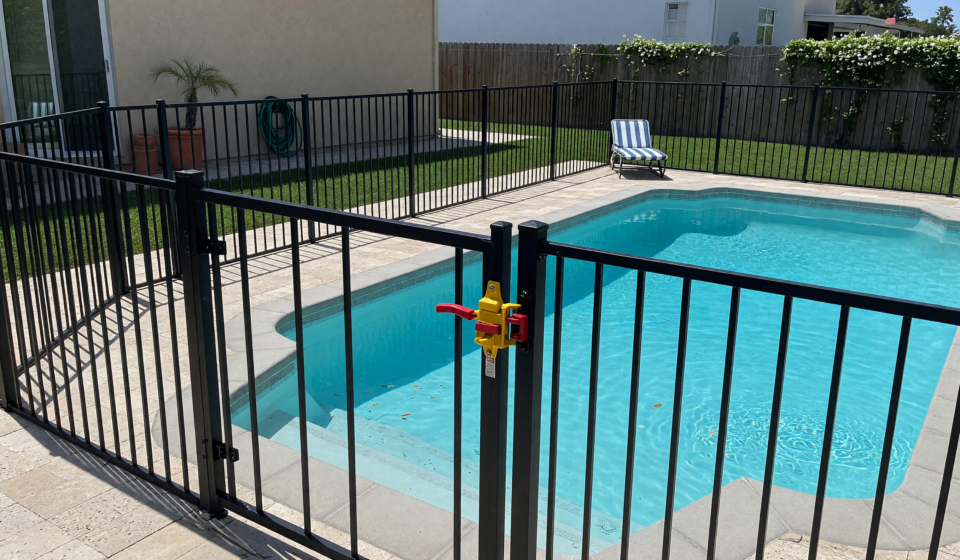
A fence is the foundation layer, and the CPSC’s Safety Barrier Guidelines for Residential Pools lay out specifics worth memorizing. The recommended barrier height is at least 48 inches measured from the ground on the side facing away from the pool. Just as important is what happens at the bottom and between the pickets: the guidelines call for a maximum clearance beneath the barrier of about 4 inches on a solid surface, and spacing between vertical members that does not exceed roughly 1¾ inches so a small child cannot squeeze through.
Climbability matters as much as height. If a fence has horizontal rails a child could use as a ladder, CPSC guidance recommends placing those horizontal members on the pool side of the fence and keeping the outside face smooth. This is where mesh isolation fencing has become popular for backyards, and why the best choice for one yard is not automatically right for the next.
- Isolation, not perimeter: The most protective setup fences the pool off from the house, so the home itself is not one of the four sides. That way an unnoticed exit from the back door does not lead straight to open water.
- Non-climbable design: Smooth exterior face, minimal footholds, and narrow gaps defeat the determined toddler who treats a fence as a challenge.
- Solid footing: Check the gap at the bottom on uneven ground, where dips can quietly create a crawl space.
👉 Shop removable mesh pool safety fence on Amazon (Ad — as an Amazon Associate, we earn from qualifying purchases.)
Gates and Latches: The Weakest Link
Investigators who study backyard drownings keep landing on the same detail: the barrier was there, but the gate was open, broken, or propped. A fence is only as trustworthy as the gate in it. CPSC guidance is direct here. Pedestrian gates should be self-closing and self-latching, and they should open outward, away from the pool, so a child leaning on the gate pushes it shut rather than open.
The latch placement is a small design choice with big consequences. When the latch is mounted low, small hands can reach it. The guidelines address this by recommending the release mechanism be positioned to stay out of a child’s easy reach, generally high on the gate with shielding around it. A gate that latches reliably on every single swing is doing more work than most people realize.
- Test the swing: Open the gate to several positions and let go. It should close and latch on its own every time, not just when fully opened.
- Never prop it: A rock, a hose, or a wedge turns a compliant gate into an open door. Treat propping as a hard no.
- Add a gate alarm: An alarm that sounds when the gate opens turns a silent breach into an audible one, backing up the hardware with a warning.
Reality check. A gate that does not self-latch is not a partial barrier; functionally it is no barrier at all the moment it drifts open. Inspect the hinge tension and latch every few weeks, because springs weaken and hardware loosens over a season of sun and use.
When the House Is the Fourth Wall: Door Alarms
Many older pools use the house as one side of the enclosure. It is legal in some jurisdictions, but it is the riskiest configuration because every door and low window becomes a potential path to the water. If your setup relies on the house as a wall, CPSC guidance recommends alarms on the doors that lead to the pool area. These door alarms are meant to sound a loud audible warning, on the order of 85 decibels heard from about 10 feet away, when a door is opened, with a momentary bypass an adult can reach but a child cannot.
Door alarms are cheap insurance for the specific, common scenario that ends in tragedy: a child slips outside during a quiet moment indoors. The alarm buys the seconds a caregiver needs to react. It does not replace a fence, but where the house forms a wall, it is close to essential.
👉 Shop pool door and gate alarm on Amazon (Ad — as an Amazon Associate, we earn from qualifying purchases.)
Surface and Subsurface Pool Alarms
Beyond the perimeter, in-pool alarms watch the water itself. These devices are governed by ASTM F2208, the standard safety specification for residential pool alarms, and they generally fall into two families. Surface-wave alarms float and trigger when the water is disturbed. Subsurface alarms detect the pressure or wave change caused by a body entering the water and are less prone to false alarms from wind. Wearable wristband alarms that sound when submerged are a related option for specific children.
It is worth being honest about where these sit in the stack. An in-water alarm announces that someone or something has already entered the pool, so it is a last-line warning rather than a barrier. It cannot keep a child out of the water; it can only shorten the time before an adult knows. Treated as the final backstop behind fencing and gates, it earns its place. Treated as a substitute for a fence, it is a dangerous shortcut.
- Look for the standard: Choose alarms that reference ASTM F2208 so you know they were tested against a recognized specification.
- Mind false alarms: An alarm that cries wolf in every breeze gets unplugged. Subsurface models tend to be steadier in windy yards.
- Keep it powered: Test batteries on a schedule. A dead alarm is worse than none because it breeds false confidence.
👉 Shop ASTM F2208 subsurface pool alarm on Amazon (Ad — as an Amazon Associate, we earn from qualifying purchases.)
Safety Covers and Anti-Entrapment Drains
Two more layers work below the waterline and over it. A true power safety cover, distinct from a flimsy solar or winter tarp, is engineered to support weight and block access when the pool is closed. Covers built to the ASTM F1346 performance standard are designed so that a child who wanders onto a properly installed, secured cover is held out of the water rather than trapped beneath it. The key words are properly installed and fully secured; a partially attached cover or one with standing water on top can be more hazardous than none.
Then there is entrapment, the hidden danger that gives the federal Virginia Graeme Baker Pool and Spa Safety Act its name. Powerful suction at a single drain can hold a child underwater. The Act, enforced by the CPSC, requires compliant anti-entrapment drain covers and, in many cases, additional layers such as safety vacuum release systems for public pools. For home pools, the takeaway is concrete: make sure your main drains have compliant, undamaged anti-entrapment covers, and replace any that are cracked, missing, or loose.
- Cover to standard: Prefer covers that meet ASTM F1346 and anchor completely across the pool with no gaps at the edges.
- Drain covers matter: Confirm anti-entrapment covers are intact and secured, in line with Virginia Graeme Baker Act requirements.
- Drain standing water: Pooled water on top of a cover is both a drowning hazard and a sign the cover is not doing its job.
👉 Shop ASTM F1346 power safety cover on Amazon (Ad — as an Amazon Associate, we earn from qualifying purchases.)
The Human Layers: Supervision and Swim Skills
Hardware buys time; people prevent tragedies. The CPSC and drowning-prevention groups emphasize designating an undistracted water watcher whenever children are near the pool, someone whose only job in that window is to watch the water, phone down and eyes up. Drowning is fast and silent, nothing like the thrashing shown in movies, so continuous close supervision is the layer that catches what every device misses.
Two more human layers round out the system. Formal swim lessons reduce drowning risk for young children, and knowing CPR can change the outcome in the minutes before help arrives. None of these replace barriers, and barriers do not replace them. They are complementary, which is the entire point of a layered approach.
- Name the watcher: Hand off supervision explicitly so responsibility never falls into the gap between two distracted adults.
- Teach the water: Age-appropriate swim lessons build competence and calm around the pool.
- Learn CPR: Keep certification current and post emergency steps where guests can see them.
The Bottom Line
A safe backyard pool is not one purchase; it is a set of independent layers that each cover for the others’ weak moments. Start with an isolation fence that meets CPSC height and spacing guidance, hang a gate that self-closes and self-latches without fail, add alarms where doors or gates form part of the perimeter, back the water with an ASTM F2208 alarm, close the pool with a real safety cover, keep your drain covers compliant with the Virginia Graeme Baker Act, and never let any of it stand in for a watchful adult. Build the layers thoughtfully and maintain them honestly, and you turn a serious hazard into a place your family can enjoy with far greater peace of mind.
Disclaimer: This article is provided for general educational purposes only and does not constitute safety, legal, or engineering advice. Barrier codes and requirements vary by state and municipality, and product standards are periodically updated. Always confirm current CPSC guidance, applicable ASTM standards, and your local building and pool codes, and consult a qualified professional before installing or modifying any pool barrier or safety system.
Sources: U.S. Consumer Product Safety Commission (CPSC), Safety Barrier Guidelines for Residential Pools and the Pool Safely campaign; ASTM International F2208 (Standard Safety Specification for Residential Pool Alarms) and F1346 (safety covers); Virginia Graeme Baker Pool and Spa Safety Act, as enforced by the CPSC.