
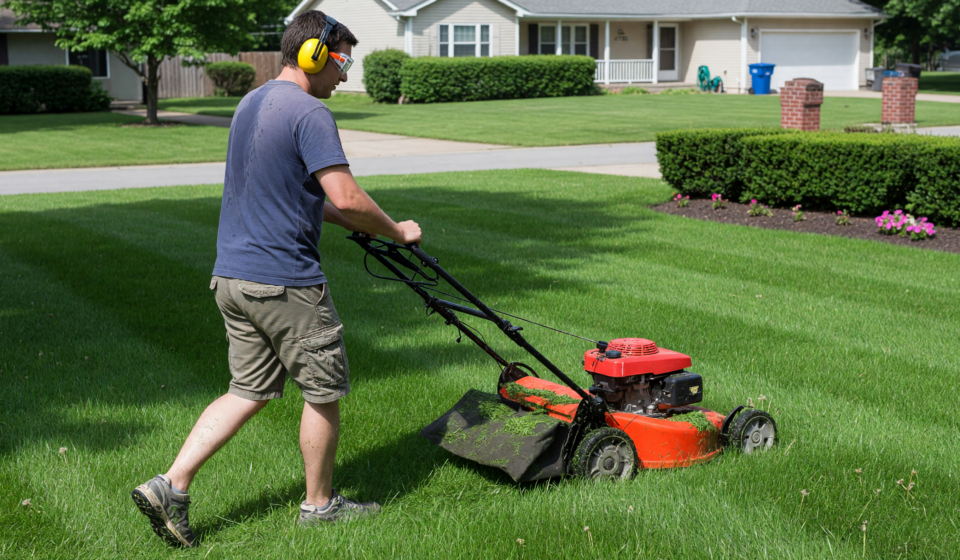
Lawn Mower Safety: Eye and Ear PPE, Slope Rules and Kid Zones
Every spring and summer, millions of Americans fire up a lawn mower without a second thought. But a mower is not a household appliance. It is a high-speed cutting machine that can throw debris, sever fingers and toes, tip over on a hillside, and in the most heartbreaking cases, run over a child. Practicing good lawn mower safety is not about being fearful. It is about respecting a tool that spins a steel blade thousands of times per minute and treating it with the same caution you would give any piece of power equipment on a job site.
The numbers back this up. According to the American Academy of Orthopaedic Surgeons (AAOS), more than 253,000 people were treated for lawn mower-related injuries in a single recent year, and children under 19 accounted for more than 10,000 of those cases. The American Academy of Pediatrics (AAP) reports that over 5,000 children each year land in emergency departments because of power mowers. The good news is that nearly all of these injuries are preventable with the right personal protective equipment (PPE), a few smart operating habits, and clear rules about where children can and cannot be. This guide walks through the gear, the ground rules, and the one mistake you can never afford to make.
How Lawn Mowers Actually Hurt People
Understanding the injury patterns makes the safety rules make sense. Mower injuries fall into a handful of recognizable categories, and they are surprisingly violent for a machine most people associate with a quiet Saturday chore.
Thrown objects are one of the most common hazards. A spinning blade can pick up a rock, a stick, a bit of wire, or a forgotten toy and eject it at speeds up to 100 mph, according to AAOS. That projectile can strike the operator, a bystander, or a nearby window. The AAOS also puts the raw power of a mower blade in perspective: the energy transferred by a blade tip is comparable to being shot in the hand with a .357 Magnum. That is why blade-contact injuries, when a hand or foot reaches under the deck, so often result in deep lacerations or the amputation of fingers and toes.
Rollovers are the signature danger of riding mowers. On a slope, a tractor or zero-turn can tip sideways or slide, pinning or crushing the operator underneath. Burns are another quiet hazard, since mufflers and engine covers get hot enough to sear skin during refueling or maintenance. And the most tragic category of all involves children being run over, particularly backover incidents where a riding mower reverses over a small child the operator never saw.
Eye and Ear PPE: Your First Line of Defense
Because debris comes off the deck fast and unpredictably, eye protection is non-negotiable. Everyday prescription glasses do not count. You want safety glasses or goggles rated to the ANSI/ISEA Z87.1 standard, which are impact-tested to stop flying particles. Look for the Z87 marking stamped on the lens or frame. Wraparound designs give the best coverage against objects that come in from the side, and a lightly tinted lens cuts glare on bright days without hiding obstacles in the grass.
👉 Shop ANSI Z87 safety glasses / goggles on Amazon (Ad — as an Amazon Associate, we earn from qualifying purchases.)
Hearing is the sense people forget. A typical gas mower runs in the range of 85 to 95 decibels, and prolonged exposure at or above 85 dB is the threshold where NIOSH recommends hearing protection to prevent permanent noise-induced hearing loss. An hour spent mowing every week adds up over a lifetime, and once that hearing is gone it does not come back. Foam earplugs are inexpensive and effective, but many operators prefer earmuff-style protectors because they are easy to pull on and off and can be worn over earplugs for very loud equipment.
👉 Shop earmuff-style hearing protection / earplugs on Amazon (Ad — as an Amazon Associate, we earn from qualifying purchases.)
Footwear, Gloves and Clothing
What you wear from the ankles down matters more than almost anything else. Both AAP and AAOS are blunt about this: never mow in sandals, flip-flops, or bare feet. Wear sturdy, closed-toe shoes, and ideally leather work boots that can shield your feet if you slip near the deck or step on ejected debris. Solid traction also helps you keep your footing on damp or uneven ground, which is exactly where slips near a running blade turn catastrophic.
Long pants protect your shins and calves from thrown gravel and give a layer of defense against scrapes and hot surfaces. Gloves improve your grip on the handlebar and protect your hands during blade inspection, cleanup, and maintenance, when your fingers come closest to the sharpest part of the machine. Cut-resistant gloves are a smart upgrade for anyone who handles or sharpens blades. Skip loose clothing, dangling drawstrings, and jewelry that could catch on moving parts.
👉 Shop sturdy closed-toe work boots on Amazon (Ad — as an Amazon Associate, we earn from qualifying purchases.)
👉 Shop cut-resistant work gloves on Amazon (Ad — as an Amazon Associate, we earn from qualifying purchases.)
Before You Start: Clearing the Yard and Fuel Safety
A huge share of thrown-object injuries are prevented before the engine ever starts. Walk the entire area you plan to mow and pick up stones, sticks, wire, dog bones, bottles, and especially children’s toys. Anything the blade can find, it will launch. This one habit, recommended by both the U.S. Consumer Product Safety Commission (CPSC) and AAP, eliminates a large fraction of projectile hazards for the cost of a few minutes of walking.
Fuel deserves respect too. Gasoline vapor is what ignites, not just the liquid. The AAP advises letting the engine cool before refueling and never refueling inside a garage or shed where fumes can collect. Fill the tank outdoors, add fuel before you start rather than topping off a running or hot engine, and wipe up spills before pulling the cord. Confirm that all guards, shields, and the grass discharge chute are in place before you begin, since these are the parts that direct debris away from your body.
Slopes and Terrain: Getting the Direction Right
Slopes are where technique genuinely changes depending on your machine, and getting it backwards can be deadly. Per manufacturer guidance echoed by AAOS, the two mower types call for opposite approaches:
- Walk-behind or push mower: mow across the face of a slope, not up and down. This keeps the machine from rolling back onto your feet if you lose your grip.
- Riding mower or tractor: do the opposite and drive up and down the slope, never across it. Mowing across a hill on a rider dramatically raises the risk of a sideways tip-over.
- Any machine on wet grass: stop. Traction disappears the moment the surface is slick, and a slide on a hill leaves you no good options.
The Outdoor Power Equipment Institute (OPEI) adds that you should survey the terrain first for holes, ruts, and hidden obstacles, use equipment suited to the hill rather than an undersized machine, and know how to stop quickly before you commit to a grade. If a slope feels too steep to mow confidently, it probably is, and a string trimmer is the safer tool for that patch.
Children and the Number-One Tragic Mistake
If you remember only one rule from this entire guide, make it this one. The single most preventable mower tragedy is a child being run over, and it almost always happens the same way: a small child follows an adult outside, moves into a blind spot, and a riding mower backs over them before anyone realizes they are there.
The safest place for a child while any mower is running is indoors, supervised by another adult. Never let a child ride as a passenger, never let children play in the yard while you mow, and never mow in reverse when children could be anywhere nearby.
Children are drawn to the noise and motion of a mower, they are small enough to disappear from a driver’s sightline in an instant, and they cannot be relied upon to stay clear. AAP and CPSC are emphatic: never allow a child to ride as a passenger on a riding mower or lawn tractor, because kids fall or are pulled under far more often than parents expect. Backover incidents, where a rider reverses over a small child, are among the most devastating outcomes in all of home safety, and they are the reason the no-reverse rule exists.
Age matters as well. AAP recommends children be at least 12 before operating a walk-behind mower and at least 16 before operating a riding mower, and only when they show the maturity, strength, and judgment to do it safely.
Maintenance, Blades and Guards
A well-maintained mower is a safer mower. Keep the blade sharp and balanced, because a dull blade tears grass, strains the engine, and tempts you to clear clogs more often. Speaking of clogs: never reach under the deck or into the discharge chute with your hand or foot to clear a jam. Shut the engine off, wait for the blade to come to a complete stop, disconnect the spark plug wire, and use a stick or tool to clear the debris.
Inspect the mower after you hit any hard object, since a bent blade or cracked housing can fail unexpectedly. Never remove or disable the safety features engineered into modern mowers, including the operator-presence control (the bar or lever that stops the blade when you let go), the discharge guard, and the deflector shield. These devices exist because earlier generations of mowers caused exactly the injuries they now prevent. Store fuel in an approved container away from ignition sources, and keep the machine itself out of children’s reach when it is not in use.
The Bottom Line
Lawn mower safety comes down to a short, memorable set of habits: gear up with Z87 eye protection and hearing protection, wear sturdy boots and gloves, clear the yard before you start, respect the slope rules for your specific machine, and keep children indoors and off the mower entirely. None of it takes more than a few extra minutes, and every one of those minutes buys down the risk of an injury that can change a life in a single second. Treat the machine with respect, follow the manufacturer’s manual, and you can keep your lawn, your family, and everyone around it safe all season long.
Disclaimer: This article is for general informational and educational purposes only and does not constitute professional, medical, or safety advice. Always read and follow the operating manual and safety instructions supplied by your mower’s manufacturer. PSAWEAR may earn a commission from qualifying purchases made through affiliate links in this article, at no additional cost to you.
Sources: American Academy of Orthopaedic Surgeons (OrthoInfo), Lawn Mower Safety; American Academy of Pediatrics / HealthyChildren.org, Lawn Mower Safety: Information for Families; U.S. Consumer Product Safety Commission (CPSC), riding and power mower safety guidance; Outdoor Power Equipment Institute (OPEI), slope and seasonal mowing safety tips; National Institute for Occupational Safety and Health (NIOSH), noise exposure and hearing loss prevention.