Open-Water Swimming Safety: Tow Floats, Bright Caps and Buddy Systems
There is nothing quite like slipping into a quiet lake at dawn or riding the gentle swell of the ocean under an open sky. But the same wildness that makes open water so rewarding is exactly what makes it demanding, and good open-water swimming safety is what separates a memorable morning from a genuine emergency. Unlike the controlled, lifeguarded lane of a pool, open water is cold, moving, crowded with boats and free of the walls, lines and rescue staff we quietly rely on indoors.
This guide walks you through the essentials, drawing on advice from bodies such as U.S. Masters Swimming, the United States Lifesaving Association (USLA) and the RNLI. We cover why open water behaves so differently from the pool, how to check conditions and acclimatize, the visibility gear that keeps you seen, the buddy system and how to pick safe spots, cold water and hypothermia, sighting and navigation, and what to do if things go wrong. Read it before your next swim, and treat the water with the respect it deserves.
Why Open Water Is a Different Animal
A pool is a predictable environment: clear water, a stable temperature, a black line to follow and a lifeguard watching every lane. Open water strips all of that away. The water is often cold enough to trigger a physical shock response, currents and tides can move you faster than you can swim, and boats and personal watercraft share the same space you do, frequently without seeing you. In many places there is no lifeguard at all, which means you and the people you swim with are the whole safety net.
The USLA underscores how much that supervision matters. It reports that the chance of drowning at a beach protected by its lifeguards is roughly one in 18 million. Away from that protection, the margin for error shrinks dramatically. Understanding these differences is the first step in swimming safely.
- Temperature: Open water is frequently far colder than a pool and can provoke cold-water shock.
- Movement: Currents, tides and rip currents can carry you off course or offshore.
- Traffic: Boats, kayaks and jet skis may not be looking out for a swimmer’s head at the surface.
- Supervision: Often there is no lifeguard, so you rely on your own preparation and your buddy.
Before You Go: Check Conditions and Acclimatize
Safe swims begin on dry land. U.S. Masters Swimming frames it simply as an ounce of prevention: before you get in, assess the air and water temperature, the wind, the tide and current, any marine life, and hazards such as submerged rocks or boat channels. Check a local forecast, look for posted signs and flags, and never assume today’s conditions match your last visit. If something feels wrong, it is always acceptable to skip the swim.
Acclimatization matters just as much as the forecast. Rather than plunging in and striking out for a distant buoy, enter gradually and give your body time to adjust. Experienced cold-water swimmers described by U.S. Masters Swimming wade in slowly, splash water on the face, then swim a short distance, stop, tread water and check their breathing before committing to more. As the organization puts it, do not jump in expecting to swim for 45 minutes. Build your cold tolerance over multiple sessions across a season, not in a single heroic effort.
Visibility Gear: Bright Caps and Tow Floats
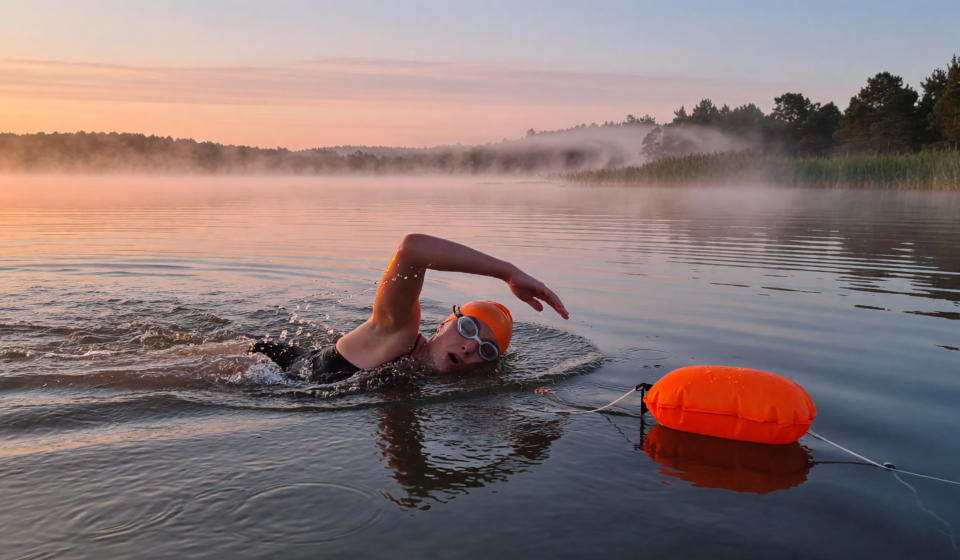
Being seen is a core pillar of open-water swimming safety, because a swimmer’s head is a small, low target against a moving surface. A high-visibility swim cap in neon orange, pink or yellow makes you dramatically easier to spot for boaters, paddlers and your own group. It is one of the cheapest pieces of safety equipment you can own, and there is little reason not to wear one every time you swim.
The tow float, sometimes called a swimmer’s buoy, is the other essential. U.S. Masters Swimming notes that a brightly colored float makes you more visible to other swimmers and, more importantly, to boaters, while also giving you something to hold onto and rest against if you tire. Many models double as a dry bag, with a sealed pocket for a phone, identification, keys and nutrition. A float is not a life jacket and will not keep an unconscious swimmer’s airway clear, but as flotation you can grab in a moment of doubt, it is invaluable.
👉 Shop tow float / swim buoy on Amazon (Ad — as an Amazon Associate, we earn from qualifying purchases.)
👉 Shop high-visibility swim cap on Amazon (Ad — as an Amazon Associate, we earn from qualifying purchases.)
Be seen, be safe. A bright cap and a tow float cost little and weigh almost nothing, yet they are the difference between a boater spotting you from a distance and never seeing you at all. Treat them as non-negotiable, not optional extras.
The Buddy System and Choosing Safe Spots
The single most repeated rule across every safety authority is deceptively simple: never swim alone. The USLA points out that many fatal drownings involve swimmers who were in the water by themselves, with no one nearby to help or to signal for aid. A buddy watches you, you watch them, and either of you can raise the alarm the instant something changes. If you swim in a group, agree on a turnaround point and count heads regularly.
Where you swim is just as important as who you swim with. Whenever possible, choose a location supervised by lifeguards, and if you can, swim near them. Learn the specific hazards of your spot, obey posted signs and flags, and tell someone on shore your planned route and expected finish time so they can raise the alarm if you are overdue.
- Swim with a buddy: Always have at least one person who can help or call for aid.
- Pick supervised water: Where lifeguards are present, swim near them.
- Share your plan: Tell someone your route and when you expect to be out.
- Know the hazards: Learn the currents, entry and exit points, and boat channels before you start.
Cold Water and Hypothermia
Cold water is the hazard swimmers most often underestimate. The RNLI classifies water at 15°C (about 59°F) and below as cold, and warns that sudden immersion causes cold-water shock: the skin cools abruptly, blood vessels constrict, blood pressure and heart rate spike, and you experience an involuntary gasp followed by rapid, uncontrollable breathing that can increase as much as tenfold. That gasp reflex is dangerous because it can pull water into the lungs, and the shock can trigger cardiac events even in young, healthy people.
The RNLI’s advice if cold-water shock hits is to fight the urge to thrash and instead float to live: lean back, keep your airway clear, and let the shock pass, which typically takes around a minute, before trying to swim or call for help. A wetsuit and neoprene accessories buy you time and comfort in cold conditions, and flotation greatly increases your chances of surviving that first minute.
Longer exposure brings hypothermia. U.S. Masters Swimming flags blue lips, slurred speech, shivering, dizziness and nausea as warning signs that mean you should get out and rewarm immediately. Be aware of afterdrop, too: your core temperature can keep falling even after you leave the water, so change out of wet gear quickly, add dry layers and warm up gradually with a hot drink rather than a scalding shower, which can cause dizziness.
👉 Shop wetsuit on Amazon (Ad — as an Amazon Associate, we earn from qualifying purchases.)
Sighting and Navigation
Without a black line on the pool floor to follow, staying on course in open water is a skill of its own. Sighting is the technique of lifting your eyes just above the surface every few strokes to check your position against a fixed landmark, such as a buoy, a headland, a moored boat or a tall tree on shore. Line up two markers when you can, so you notice quickly if a current is pushing you sideways.
Practice sighting close to shore before you rely on it in deeper water. Sight frequently enough to stay straight but not so often that you exhaust yourself, and be honest about how currents and wind are affecting your line. Straying off course wastes energy and can carry you into boat traffic or away from your intended exit point, so treat navigation as part of your safety plan, not an afterthought.
What to Do If You Get Into Trouble
Even well-prepared swimmers can find themselves in difficulty, and the key is to respond rather than react. U.S. Masters Swimming advises staying calm, assessing the situation, and using your surroundings, including other swimmers who can help while someone summons professional aid. Panic burns energy and clouds judgment; a few slow breaths and a clear head are your best tools.
If you are caught in a rip current, the USLA is emphatic: do not try to swim straight back against it. Instead, swim parallel to the shore, following the shoreline or toward breaking waves, until you are out of the pull, then angle back to the beach. If you are simply tired or cold, roll onto your back, hug your tow float, float to recover, and signal for help by waving an arm and calling out. A whistle on your buoy strap carries far further than your voice.
👉 Shop waterproof whistle on Amazon (Ad — as an Amazon Associate, we earn from qualifying purchases.)
The Bottom Line
Open water rewards the swimmer who prepares. Check the conditions and enter slowly, wear a bright cap and tow a float so you are seen, never swim alone, and respect cold water for the serious hazard it is. Learn to sight so you stay on course, know how to escape a rip current, and keep a whistle within reach. None of this dulls the joy of a wild swim; it is precisely what lets you keep coming back to enjoy it. Build these habits into every session and open water becomes not a gamble but a lifelong pleasure.
Disclaimer: This article is educational only and is not a substitute for professional instruction, a qualified swim coach or local safety guidance. Conditions in open water change rapidly and vary by location. Always swim within your limits, heed local warnings, signs and flags, and follow the direction of lifeguards and local authorities.
Sources: U.S. Masters Swimming (How to Do Cold Open Water Swimming Safely; What to Do in an Open Water Swimming Emergency); United States Lifesaving Association (Top Ten Beach and Water Safety Tips; Rip Currents); RNLI (Cold Water Shock; Open Water Swimming advice).