
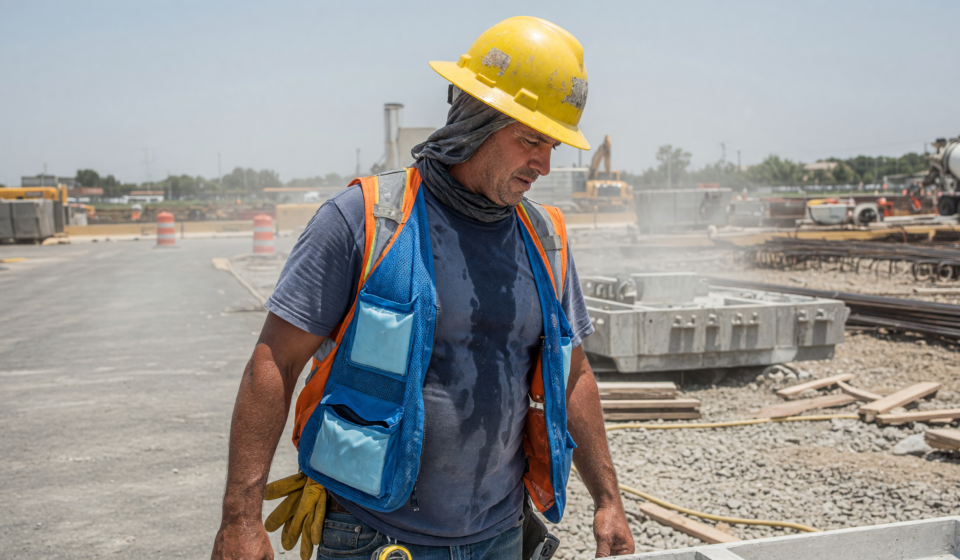
Cooling PPE for Outdoor Crews: Vests, Neck Gaiters and Ice Packs
When the heat index climbs and the shade runs out, the right cooling PPE can be the difference between a crew that finishes the shift strong and one that ends up in the back of an ambulance. Evaporative vests, phase-change packs, circulating ice-water systems, cooling neck gaiters and chilled towels have all moved from novelty to standard-issue on construction sites, road crews, landscaping teams, utility lines and warehouse loading docks across the country. But not every product works the same way, and a vest that keeps a bricklayer comfortable in dry Arizona air can feel like a wet blanket on a humid Gulf Coast morning.
This guide breaks down the main categories of personal cooling gear, explains the science behind each one, and shows where the humidity limits and best-use cases fall. Just as important, it puts these tools in their proper place: as a supplement to a real heat-illness prevention program built on water, rest, shade, acclimatization and hydration, not a replacement for it. Choose well, train your people, and cooling gear becomes one more layer of protection. Treat it as a magic fix, and it can give crews a false sense of security in genuinely dangerous conditions.
Why Heat Is a Jobsite Killer
Heat is one of the most underestimated hazards in outdoor work. According to OSHA, thousands of workers are sickened by occupational heat exposure every year, and heat stress can escalate from mild discomfort to heat exhaustion and life-threatening heat stroke faster than many supervisors expect. The body sheds heat mainly by sweating and by moving warm blood to the skin. When the air is already hot and humid, sweat cannot evaporate efficiently, core temperature rises, and the cooling system starts to fail.
The workers most at risk are often the newest ones and those returning after time away. NIOSH and the CDC stress that people who are not yet acclimatized to heat carry a disproportionate share of serious and fatal heat illnesses, frequently within their first few days on a hot job. Physical exertion, heavy or non-breathable clothing, direct sun, and dehydration all stack the odds against the body’s natural defenses. Personal cooling gear is designed to give those defenses a hand, lowering skin temperature and easing the burden on the cardiovascular system so workers can keep functioning safely.
Evaporative Cooling Vests
Evaporative vests are the simplest and most affordable option. You soak the garment in water for a few minutes, wring it out, and put it on. As the trapped water evaporates, it pulls heat away from the body, the same principle that makes a breeze feel cold on wet skin. They are lightweight, need no batteries or freezer, and can be re-wetted from any water source throughout the day, which makes them attractive for crews far from power or refrigeration.
- Best use case: Hot, dry climates such as the desert Southwest, where low ambient humidity lets water evaporate quickly and steadily.
- Humidity limit: Effectiveness drops sharply in high humidity. When the surrounding air is already saturated, water cannot evaporate, and the vest simply feels heavy and damp without delivering much cooling.
- Trade-offs: Very low cost and easy to maintain, but cooling is mild compared with active systems, and a soaked vest adds weight and moisture next to the skin.
👉 Shop evaporative cooling vest on Amazon (Ad — as an Amazon Associate, we earn from qualifying purchases.)
Phase-Change (PCM) Cooling Vests
Phase-change material (PCM) vests use inserts filled with a substance engineered to melt at a specific, comfortable temperature rather than at the freezing point of water. As the packs shift from solid to liquid, they absorb body heat while holding a steady surface temperature, so the wearer gets consistent cooling without the shock of ice against the skin. The packs are frozen or refrigerated before the shift and then slipped into pockets in the vest. Because their performance does not depend on evaporation, they keep working in humid air where evaporative vests fall flat.
- Best use case: Humid regions and situations that call for predictable, even cooling over a couple of hours, such as heavy exertion under PPE or protective coveralls.
- Humidity limit: None to speak of. PCM vests perform in high humidity because they rely on heat absorption, not evaporation.
- Trade-offs: Higher upfront cost and the need to pre-chill packs. Cooling lasts only until the packs fully melt, so crews typically rotate a second set of inserts to extend coverage across a full day.
👉 Shop phase-change cooling vest on Amazon (Ad — as an Amazon Associate, we earn from qualifying purchases.)
Circulating and Ice-Pack Vests
At the heavy-duty end of the spectrum are circulating (circulatory) and ice-pack vests. Circulating systems run cold water through a network of thin tubes woven into the garment; a small pump moves the water from a chilled reservoir around the torso and back. Ice-pack vests take a more direct route, holding frozen gel or ice inserts in insulated pockets. Both deliver the most aggressive cooling of any category and hold up well even in high humidity, which is why they show up in extreme environments and demanding industrial jobs.
- Best use case: Prolonged, high-intensity work in severe heat, or roles where a worker stays near a power source or vehicle that can support the pump and reservoir.
- Humidity limit: Effective across humidity levels, since cooling comes from direct conductive contact rather than evaporation.
- Trade-offs: Circulating systems need a power source and add bulk and cost; ice-pack vests can feel intensely cold at first and require a freezer to recharge. Both are heavier than evaporative or PCM options.
No vest, gaiter or towel replaces water, rest and shade. Cooling PPE lowers heat strain at the margins; the fundamentals of a heat-illness program are what actually keep crews alive.
Cooling Neck Gaiters, Towels and Hard-Hat Accessories
You do not have to wear a full vest to benefit from targeted cooling. The neck carries major blood vessels close to the surface, so chilling that area helps moderate how hot a worker feels. Cooling neck gaiters and bandanas often use either evaporative fabric or PCM beads that stay cool for hours, and they slip easily under a hard hat’s chin strap or over a collar. Cooling towels work on the same evaporative principle: wet them, snap them, and drape them over the neck or shoulders for quick relief during breaks.
👉 Shop cooling neck gaiter on Amazon (Ad — as an Amazon Associate, we earn from qualifying purchases.)
Head and face protection matter just as much. Wide-brim attachments and full-brim hard hats shade the neck and ears from direct sun, and hard-hat sweatbands or cooling liners help manage the heat that builds up under a shell. These accessories are inexpensive, easy to distribute across a crew, and simple to combine with a vest for layered protection. For workers who find a full vest too warm or restrictive, a good gaiter, towel and shaded hard hat can cover a lot of ground on their own.
👉 Shop cooling towel on Amazon (Ad — as an Amazon Associate, we earn from qualifying purchases.)
How to Choose by Climate and Humidity
The single most important selection factor is the humidity your crew actually works in, because it determines whether evaporation is on your side or working against you. Match the technology to the environment and the job rather than buying whatever is cheapest or most heavily marketed.
- Hot and dry: Evaporative vests, gaiters and towels shine here and cost the least. Re-wetting is easy and the payoff is strong.
- Hot and humid: Lean toward phase-change vests or PCM gaiters, which do not depend on evaporation. Skip evaporative gear as a primary solution in saturated air.
- Extreme or prolonged heat: Consider circulating or ice-pack vests where the work is stationary enough, or a power source is available, to justify the bulk.
- Mobility and access: Crews far from freezers or outlets favor evaporative options; those with vehicle power or a jobsite freezer can support PCM rotation or circulating systems.
- Fit and weight: Any vest must allow full range of motion and layer correctly with high-visibility clothing, fall harnesses and other required PPE.
Where Cooling PPE Fits in a Heat-Illness Prevention Plan
Here is the message that has to travel with every vest and gaiter you hand out: cooling PPE supplements a heat-illness prevention plan, it does not replace one. OSHA’s guidance centers on water, rest and shade, providing cool drinking water, mandating breaks that grow longer and more frequent as heat rises, and giving workers genuine access to shaded or air-conditioned recovery areas. OSHA also notes that for jobs lasting more than about two hours, electrolyte-containing beverages help replace the salts lost through heavy sweating, and that workers should drink regularly rather than waiting until they feel thirsty.
Acclimatization is equally non-negotiable. NIOSH and the CDC recommend easing new workers into the heat with the “20% rule,” no more than about 20% of the normal workload on the first day, increasing by roughly 20% each following day, so that full exposure is reached over roughly one to two weeks. Experienced workers returning after time off should ramp up on an accelerated schedule of about 50% of exposure on day one, then 60%, 80% and 100% over the next three days. A vest cannot substitute for this physiological adjustment, and it cannot cancel out dehydration, skipped breaks or an unshaded jobsite. Use cooling gear to reduce strain at the margins while the real controls, hydration, rest, shade, acclimatization and active supervision, do the heavy lifting. Train supervisors to watch for early warning signs and to treat cooling PPE as one layer in a system, never the whole system.
The Bottom Line
Personal cooling gear has earned a permanent spot in the outdoor safety toolkit. Evaporative vests, gaiters and towels are cheap, simple and excellent in dry heat. Phase-change vests deliver steady cooling and hold up in humidity. Circulating and ice-pack vests bring the most powerful cooling for extreme or prolonged jobs. Neck gaiters, cooling towels and shaded hard hats add lightweight, low-cost relief that any crew can adopt today. Match the technology to your climate, mind the humidity limits, and fit the gear so it works with your other PPE rather than against it.
Most of all, keep the hierarchy straight. The gear that lowers a worker’s skin temperature is valuable, but the water bottle, the shaded break area, the acclimatization schedule and the supervisor who calls a rest are what prevent the emergencies. Build the plan first, then equip your crews with cooling PPE that fits the conditions they actually face.
Disclaimer and Sources
Disclaimer: This article is for general informational purposes only and does not constitute professional safety, medical or legal advice. Heat-illness risk depends on site-specific conditions, individual health and applicable regulations. Always consult your organization’s safety officer and follow current OSHA, NIOSH and CDC guidance, along with any state or local heat rules, when building a heat-illness prevention program. Some links in this article may be affiliate links; PSAWEAR may earn a commission on qualifying purchases at no extra cost to you.
- OSHA — Heat: Water. Rest. Shade, and Heat Exposure overview (Occupational Safety and Health Administration).
- NIOSH — Heat Stress recommendations and acclimatization guidance (National Institute for Occupational Safety and Health).
- CDC — Heat Stress: Acclimatization and workplace recommendations (Centers for Disease Control and Prevention).