Jobsite Hydration Programs: Electrolytes, Schedules and Shade Stations
By mid-morning on a July slab pour, the concrete crew is already soaked through their shirts, the pump truck is throwing off engine heat, and the nearest patch of shade is a sliver behind the material trailer. Nobody has stopped for water in over an hour because the cooler is parked back at the gang box, fifty yards away. This is exactly how heat illness sneaks onto a site: not through one dramatic moment, but through a hundred small frictions that make drinking, resting, and cooling down harder than just pushing on.
This guide walks through how to build a real jobsite hydration program instead of relying on willpower and a warm water jug. We will cover what OSHA and NIOSH actually recommend, when plain water needs help from electrolytes, how to set a drinking and rest schedule your crew will actually follow, what makes a shade station worth setting up, and how to ease new workers in through acclimatization. The goal is a system that keeps people working safely through the hottest stretch of the year.
Why Jobsite Hydration Is a Safety System, Not a Water Cooler
Treating jobsite hydration as “we have water on site” is where most programs quietly fail. When you sweat in the heat, you lose both fluid and salt, and your body’s core temperature climbs. If you cannot shed that heat faster than the work and the weather add it, you slide from feeling hot, to heat cramps, to heat exhaustion, and potentially to heat stroke, which is a medical emergency. A program treats hydration, rest, and cooling as one connected loop rather than three separate afterthoughts.
OSHA frames the whole approach around three words: Water. Rest. Shade. The reason it is a memorable slogan is that the three pieces only work together. Water without a rest break means people gulp and get right back into the heat. Rest without shade means workers recover in the same conditions that overheated them. A program’s job is to remove the friction from all three at once so the safe choice becomes the easy choice.
What the US Standards Actually Say
There is no single federal number you can point to yet, but the guidance from the major agencies lines up closely. Under OSHA’s General Duty Clause, employers are already required to protect workers from recognized hazards including extreme heat, and OSHA’s “Water. Rest. Shade.” campaign spells out the practical expectations. In 2024, OSHA published a proposed Heat Injury and Illness Prevention standard covering both outdoor and indoor work settings, which would formalize requirements like drinking water access, rest breaks, and acclimatization plans. As of this writing that rule is still in the rulemaking process and not yet final, so it is worth tracking.
- OSHA: Provide cool drinking water close to the work, encourage frequent drinking rather than waiting for thirst, and for work lasting more than two hours, offer fluids that also contain electrolytes.
- NIOSH: For moderate activity in moderate heat, drink about one cup (8 ounces) of water every 15 to 20 minutes, and generally do not exceed roughly six cups in an hour, keeping drinking water cool.
- ACGIH: Publishes Threshold Limit Values based on Wet Bulb Globe Temperature (WBGT) that many programs use to set work-rest cycles by workload and conditions.
- State plans: Some states, such as California, already enforce their own heat illness prevention rules with specific water, shade, and break provisions that can be stricter than federal guidance.
The takeaway is that the agencies do not disagree; they describe the same commonsense loop. Your program just needs to translate that guidance into the specific gear, locations, and timing your site uses.
Electrolytes: When Water Alone Is Not Enough
Water is the foundation, but on long, sweaty shifts it is not the whole answer. Heavy sweating flushes out sodium and other electrolytes, and if a worker keeps replacing only plain water, blood sodium can drop too low, a condition called hyponatremia that can be just as dangerous as dehydration. That is why OSHA specifically calls out adding electrolyte-containing fluids once work runs beyond a couple of hours, and why NIOSH points to balanced sports beverages during prolonged sweating.
- Balance over sugar: Look for products formulated with sodium and potassium rather than drinks that are mostly sugar; NIOSH advises steering clear of heavily sugary or high-caffeine drinks for hydration.
- Dilute if needed: Very concentrated sports drinks can be cut with water; the goal is fluid your crew will actually drink in volume.
- Skip alcohol and energy drinks: Both work against hydration and have no place in a heat plan.
- Make it easy: Single-serve electrolyte packets or tablets that drop into a bottle remove the excuse of “the good stuff ran out.”
👉 Shop electrolyte powder packets and hydration tablets for jobsite use on Amazon (Ad — as an Amazon Associate, we earn from qualifying purchases.)
Rule of thumb. If a worker is sweating hard for more than about two hours, plain water alone is no longer the plan. Pair it with an electrolyte source, and keep both cool and within a few steps of the task.
Building a Drinking and Rest Schedule That Sticks
The single most common failure point is timing. Left to instinct, most people under-drink because thirst lags behind actual fluid loss, and they skip breaks because stopping feels like falling behind. A schedule fixes both by making hydration a scheduled task rather than a personal decision. NIOSH’s guidance of roughly a cup every 15 to 20 minutes is a useful anchor to design around.
- Set a cadence: Build short, frequent water breaks into the workflow instead of one long lunch stop, and lengthen them as the heat climbs.
- Use cues: A supervisor whistle, a phone timer, or a simple “top off every 20” call keeps drinking on rhythm without anyone having to track it.
- Scale to conditions: On higher-WBGT days, or when workers wear heavy PPE that traps heat, shorten work intervals and stretch the rest and cooling periods.
- Watch the urine chart: A posted color chart in the restroom or break area gives workers a private, honest gauge of whether they are keeping up.
Placement matters as much as timing. If water is fifty yards away, the schedule collapses. Keep coolers staged near the active work area and refill them so nobody hits a warm, empty jug at hour three.
👉 Shop insulated jobsite water coolers and dispensers on Amazon (Ad — as an Amazon Associate, we earn from qualifying purchases.)
Shade Stations: Designing Real Recovery Zones
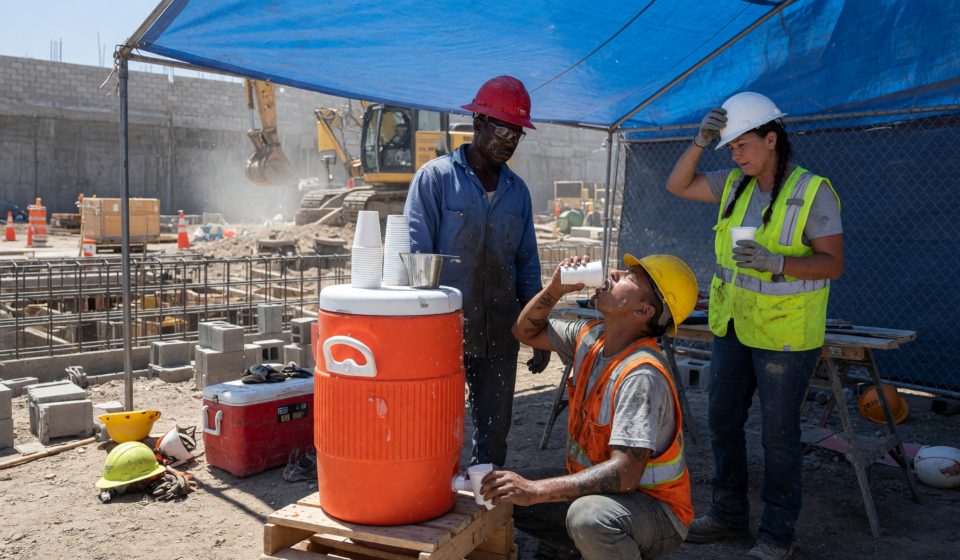
A shade station is where the “rest” and “shade” halves of the OSHA loop actually happen, and it needs to be a genuine cool-down spot, not just any patch out of direct sun. The point is to let a worker’s core temperature come back down, so a good station blocks sun overhead, allows air movement, and sits close enough that using it does not cost fifteen minutes of walking.
- Overhead coverage: A pop-up canopy, tent, or shaded trailer keeps direct sun off; on indoor jobs, a spot away from ovens, engines, and radiant sources does the same job.
- Air and cooling: Fans, misting units, or an air-conditioned vehicle or trailer speed recovery well beyond passive shade.
- Seating and water: Put the drinking water and electrolytes at the shade station so rest, rehydration, and cooling all happen in one place.
- Proximity: Locate stations near the work so breaks are quick to take; a station nobody can reach is a station nobody uses.
👉 Shop pop-up shade canopies and jobsite cooling fans on Amazon (Ad — as an Amazon Associate, we earn from qualifying purchases.)
Acclimatization: Easing New Workers In
Heat is hardest on the people who are least used to it. New hires, workers returning from vacation, and anyone coming off a stretch of cool weather have not built the physiological tolerance that lets a seasoned crew shrug off a hot afternoon. A large share of serious heat incidents happen in a worker’s first days on the job, which is exactly why acclimatization is built into the guidance.
- New workers: NIOSH suggests starting new employees at no more than about 20 percent of the normal workload in heat on day one, then increasing by roughly 20 percent each day across a 7-to-14-day ramp.
- Returning workers: Those with prior heat experience can move faster, on the order of 50 percent of normal duration on day one, then 60, 80, and 100 percent over the following days.
- Watch the first two weeks: Supervisors should keep an especially close eye on newcomers until they are fully acclimatized.
- Reset after breaks: Tolerance fades after time away, so treat someone back from a long absence like a partial restart, not a veteran.
Gear That Makes Hydration Automatic
The best program is the one your crew barely has to think about, and the right gear removes friction at every step. When cool water is within arm’s reach and cooling wearables are part of the daily kit, staying ahead of the heat stops being a chore and becomes the default.
- Personal hydration: Insulated bottles and hydration backpacks let workers sip on the move instead of trekking back to a central cooler.
- Cooling wearables: Evaporative cooling towels, neck wraps, and cooling vests help shed heat between breaks, especially under required PPE.
- Sun protection: Wide-brim hard hat attachments and UPF-rated high-visibility layers cut the radiant load the body has to fight.
- Central supply: Insulated bulk coolers and dispensers keep the whole crew stocked with cold water and mixed electrolytes through the shift.
👉 Shop cooling towels, neck wraps and cooling vests on Amazon (Ad — as an Amazon Associate, we earn from qualifying purchases.)
Warning Signs and the Buddy System
Even a well-run program needs a backstop, because heat illness can escalate quickly and the affected worker is often the last to notice. Training the whole crew to spot symptoms in each other, and pairing people up so someone is always watching, turns every worker into part of the safety net.
- Early signs: Heavy sweating, muscle cramps, headache, dizziness, and nausea signal it is time to stop, cool down, and rehydrate.
- Emergency signs: Confusion, slurred speech, fainting, or hot dry skin can point to heat stroke, which is a medical emergency requiring 911 and rapid cooling.
- Buddy checks: Assign partners who check in on each other, since a confused worker rarely recognizes their own condition.
- Have a plan: Post the site’s emergency response steps and make sure everyone knows the address and who calls for help.
The Bottom Line
A jobsite hydration program is not a jug and a hope. It is a deliberate loop of cool water within reach, electrolytes for the long sweaty stretches, a drinking and rest schedule that runs on a cadence instead of willpower, shade stations that let people truly cool down, and an acclimatization ramp that protects your newest workers when they are most at risk. OSHA and NIOSH have already done the hard part of telling you what works; your job is to remove the friction so the safe choice is also the easy one. Set it up before the first heat wave, not during it, and you keep your crew working, productive, and safe through the hottest weeks of the year.
Disclaimer: This article is for general educational purposes only and does not constitute legal, medical, or safety compliance advice. Heat-related regulations vary by state and change over time. Always consult the current OSHA and NIOSH guidance, any applicable state plan, a qualified safety professional, and a medical provider when building or following a heat illness prevention program.
Sources: OSHA, Heat – Water. Rest. Shade.; OSHA, Heat Injury and Illness Prevention in Outdoor and Indoor Work Settings Rulemaking (proposed rule, 2024); NIOSH/CDC, Heat Stress Workplace Recommendations; ACGIH Threshold Limit Values for heat stress (WBGT).