E-Scooter Commuter Protection: Helmets, Wrist Guards and Night Lights
It is 7:40 on a weekday morning, and the person weaving past the bus stop is not on a bike. They are standing on a stand-up electric scooter, coffee in one hand, backpack on their shoulders, riding to the office at the speed of city traffic. Scenes like this have become ordinary in American downtowns, and so has the pile of scraped palms, bruised wrists, and cracked helmets that lands in emergency rooms afterward. The U.S. Consumer Product Safety Commission (CPSC) has tracked a steep, multi-year climb in micromobility injuries, and its single most repeated piece of advice is refreshingly simple. Sensible e-scooter protection starts before you ever push off, and most of it fits in a backpack.
This guide walks through the three pieces of gear that do the most work for a daily commuter: a properly certified helmet, a set of wrist guards, and front and rear night lights. We will explain the U.S. standards worth knowing, why each item matters in the specific way scooter crashes happen, and how to choose gear that you will actually wear every day. The goal is not to scare you off a genuinely useful commute. It is to make sure that the ride you take a thousand times ends the same boring, uneventful way it always does.
Why e-scooter crashes are different from bike crashes
A stand-up scooter puts you in an unusual posture. Your feet are close together on a narrow deck, your center of gravity is high, and the wheels are small. That small wheel diameter is the quiet villain here: a pothole, a streetcar track, or a raised sidewalk seam that a bicycle would roll over can stop a scooter wheel dead. When that happens, the rider keeps moving and goes over the handlebars. Because there is no frame to step through or pedals to brace against, riders tend to land hard on outstretched hands and on the head.
That pattern shows up in the injury data. In its review of micromobility incidents, CPSC has reported that fractures and contusions or abrasions are among the most common injuries, affecting the upper limbs, lower limbs, head, and neck. In plain English: wrists, arms, knees, and heads. Understanding that mechanism is what makes the gear choices below feel less like a checklist and more like common sense.
The helmet: your most important purchase
If you buy one thing, buy a good helmet and wear it every time. CPSC’s guidance for e-scooter riders is direct: always wear a helmet to protect your head in a fall. A head injury is the one outcome you cannot walk off, and it is the one a helmet is specifically engineered to blunt.
In the United States, any bicycle helmet sold at retail must meet a mandatory federal safety standard, 16 CFR Part 1203, enforced by CPSC. That means a basic bike helmet from a reputable retailer has already passed impact testing before it reaches the shelf. For many urban commuters riding at moderate speeds, a well-fitted helmet carrying that CPSC certification is a reasonable and legitimate choice.
Here is the nuance worth knowing. The federal bike-helmet standard was written with pedal-powered cycling speeds in mind. Faster e-bikes and higher-speed micromobility gave rise to a separate certification, the Dutch standard NTA 8776, which is designed for the higher speeds of speed pedelecs and offers extended coverage lower at the back and sides of the head. If your scooter and your route regularly put you at the upper end of urban speeds, a helmet certified to NTA 8776 is worth considering. Whatever you choose, look for a clear certification label inside the shell rather than trusting looks alone.
- Check the certification: Look for a CPSC 16 CFR 1203 sticker, or NTA 8776 if you ride faster routes.
- Fit beats features: The helmet should sit level, about two finger-widths above your eyebrows, snug enough that it does not shift when you shake your head.
- Buckle the strap: A loose or unbuckled helmet can rotate off on impact and protect nothing.
- Retire after a crash: Foam crushes once. Replace any helmet that has taken a real hit, even if it looks fine.
The two-finger test. A helmet only works when it is positioned right. Two fingers above the eyebrows, straps forming a snug V under each ear, and one finger of room under the buckled chin strap. If you can rock it far forward or back, keep adjusting before you ride.
👉 Shop certified commuter helmet (CPSC / NTA 8776) on Amazon (Ad — as an Amazon Associate, we earn from qualifying purchases.)
Wrist guards: the gear commuters skip and regret
Reach for the ground when you fall and you are only doing what every human reflex demands. The problem is that a scooter fall sends your full body weight through your palms and wrists at once, and the wrist is a fragile stack of small bones. This is why fractures of the upper limbs are so common in the micromobility injury picture, and why wrist guards deserve far more respect than they usually get from commuters.
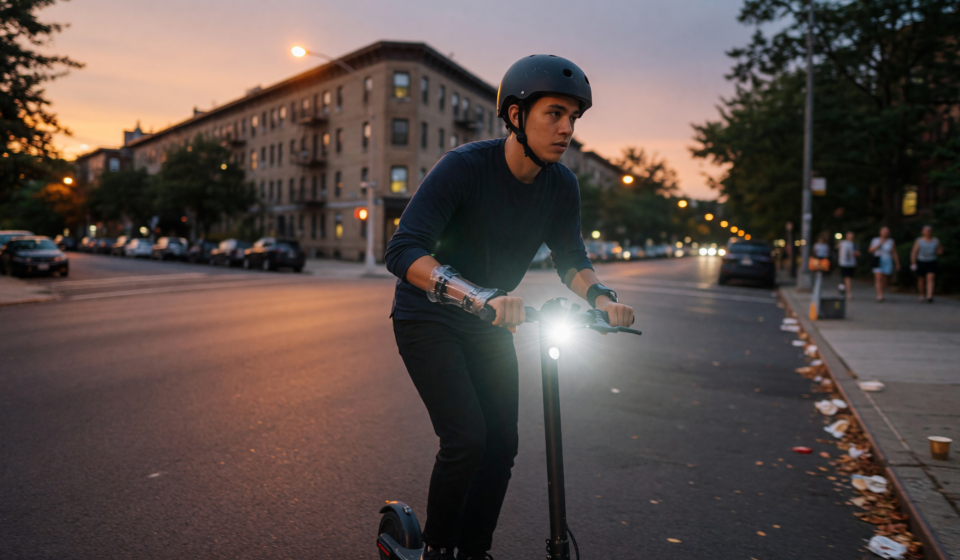
Wrist guards borrowed from skateboarding and inline skating do two things at once. A rigid splint on the palm side limits how far the wrist can bend backward, which is the motion that snaps bones. A tough outer shell lets your hand slide across pavement instead of grabbing and twisting. Together they turn a likely fracture into a bad scare. Look for guards built to a recognized protective-equipment standard for skateboarding or roller sports, which is the closest established category to scooter use.
- Splint on both sides, ideally: Guards with a palm-side and back-side stay resist bending in either direction.
- Full finger movement: You still need to work the brake and throttle, so choose a low-profile design.
- Snug but not numb: Straps should hold the splint in place without cutting off circulation on a long ride.
- Pair with gloves: Even lightweight gloves add abrasion protection for the parts a guard does not cover.
👉 Shop wrist guards for skating and scooting on Amazon (Ad — as an Amazon Associate, we earn from qualifying purchases.)
Night lights and staying visible after dark
A large share of commuting happens in the dark half of the year, when riders leave in gray dawn light and return after sunset. A scooter is small, quiet, and low to the ground, which makes it easy for a distracted driver to miss until the last second. Being seen is not a nice-to-have; it is a core layer of e-scooter protection that costs very little.
Most U.S. jurisdictions that regulate scooters borrow their lighting rules from bicycles: a white light on the front and a red light or reflector on the rear when riding at night. Requirements vary by state and city, so it is worth checking your local ordinance, but the bicycle-style setup is a safe default everywhere. Treat your scooter’s built-in lights as a minimum, not a maximum, because factory lights are often dim and aimed mainly to help you see rather than to help others see you.
- White front, red rear: The universal convention drivers already understand at a glance.
- Add a blinking mode: A flashing rear light draws the eye far better than a steady one in traffic.
- Wear something reflective: Ankle bands and a reflective strip on your backpack move as you ride, which catches attention.
- Keep them charged: A dead light is no light. Top them up on the same schedule as your phone.
👉 Shop rechargeable front and rear scooter lights on Amazon (Ad — as an Amazon Associate, we earn from qualifying purchases.)
Rounding out the kit: hands, knees, and eyes
Beyond the big three, a few small additions close common gaps. Knees take a beating in the same forward tumble that hurts wrists, so slim knee pads under your work trousers are cheap insurance for anyone commuting daily. Gloves protect palms and improve grip on cold or wet mornings. And clear or tinted eyewear keeps grit, rain, and bugs out of your eyes at speed, which matters more than it sounds when a single blink at the wrong moment can cost you the road.
None of this needs to be bulky or expensive. The best protective gear is the gear you will wear without thinking, so favor pieces that pack down small and pair with normal clothes. A commuter who wears a modest kit every single day is far better protected than one who owns premium gear that stays in the closet.
👉 Shop commuter knee pads and riding gloves on Amazon (Ad — as an Amazon Associate, we earn from qualifying purchases.)
Habits that protect you as much as gear
Gear is only half of the equation. How you ride shapes whether you ever test that gear in the first place. Because scooter wheels are small, scanning the pavement a few seconds ahead for cracks, gravel, wet leaves, and metal plates gives you time to slow or steer around them instead of hitting them at speed. Braking earlier and gentler than instinct suggests keeps that high center of gravity settled over the deck.
- Ride your own pace: Match traffic where the law allows, but never let a faster crowd push you past your comfort.
- Two hands on the bars: Save the coffee and the phone for when you are stopped.
- Respect wet ground: Painted lines, manhole covers, and tracks turn slick in the rain. Cross them upright and straight.
- Know your machine: Check tire pressure and brakes before the week starts, the way a driver would check a car.
The Bottom Line
An e-scooter commute can be one of the easiest, most pleasant ways to move through a city, and the vast majority of rides end without incident. The riders who stay out of the injury statistics are rarely the luckiest ones; they are the ones who made a few small decisions before pushing off. A certified helmet on your head, wrist guards on your hands, and bright lights front and rear cover the exact places scooter crashes tend to hurt people, and they ask almost nothing of you in return. Build the habit once, keep the gear by the door, and let good preparation turn your daily ride into the uneventful commute it should always be.
Disclaimer: This article is provided for general educational purposes only and does not constitute safety, medical, or legal advice. Protective equipment reduces but does not eliminate the risk of injury. Always follow the manufacturer’s instructions, replace damaged gear, and check the e-scooter and lighting laws that apply in your state and city before riding.
Sources: U.S. Consumer Product Safety Commission (CPSC) e-scooter safety guidance and micromobility injury reporting; CPSC federal bicycle helmet standard 16 CFR Part 1203; NTA 8776 speed-pedelec helmet standard (as described by the National Bicycle Dealers Association); state and local e-scooter lighting ordinances modeled on bicycle requirements.