Life Jackets and Water Safety: USCG Types Explained
Here is the hard truth that changes how you should think about a day on the water: the U.S. Coast Guard consistently reports that the majority of people who drown in recreational boating accidents were not wearing a life jacket. Not that they did not own one, or that the boat was not carrying enough of them, but that in the moment it mattered, the life jacket was stowed in a locker instead of on a body. A capsize or a fall overboard happens in seconds, often with no time to reach for anything. Understanding the different life jacket types is the first step toward choosing one you will actually keep on.
This guide walks through everything a thoughtful boater, paddler, or angler needs to know: why a personal flotation device (PFD) only protects you when it fits and is worn, the traditional Type I through V classification, the newer performance-based label system the Coast Guard has moved toward, the difference between inherently buoyant foam and inflatable designs, how to check fit, what to put on your kids, and what federal and state law actually require. The goal is simple: help you match the right device to your activity so that water safety becomes second nature rather than an afterthought.
A Life Jacket Only Works If You Wear It
Every conversation about flotation should start here, because it is the point that saves lives. A PFD sitting under a seat cushion has a buoyancy rating of exactly zero to the person in the water. Cold-water shock, panic, injury from the fall, and the sheer speed of a capsize all conspire to make it nearly impossible to find, grab, and don a life jacket after you are already overboard. The devices that work are the ones you have on before trouble starts.
Two conditions have to be met for a life jacket to do its job. First, it must be Coast Guard-approved. Only USCG-approved PFDs count toward legal carriage requirements and are tested to known flotation and construction standards; a novelty float, a water-wings toy, or an uncertified vest does not qualify and should never be trusted for safety. Second, it must fit the intended wearer and be worn correctly, with all straps, zippers, and buckles fastened. A jacket that is too big rides up over the face; one that is too small will not close. Comfort matters more than most people think, because comfort is what keeps the jacket on your shoulders all day.
👉 Shop USCG-approved life jacket on Amazon (Ad — as an Amazon Associate, we earn from qualifying purchases.)
The Traditional Type I-V System: Life Jacket Types Explained
For decades the Coast Guard organized flotation devices into five numbered categories, and you will still see these Type designations on millions of jackets in service and in stores. Learning them is worthwhile because they describe real trade-offs between flotation, comfort, and how a device behaves in the water.
- Type I (Offshore Life Jacket): The most buoyant wearable, with about 22 pounds of flotation for adults. It is designed to turn most unconscious wearers face-up and is meant for open, rough, or remote water where rescue may be delayed. Bulky, but it buys time.
- Type II (Near-Shore Vest): Around 15.5 pounds of foam buoyancy, intended for calmer inland waters with a good chance of quick rescue. It may turn some unconscious wearers face-up but performs poorly in rough conditions.
- Type III (Flotation Aid): Similar buoyancy to a Type II but built for comfort and freedom of movement, which makes it the popular choice for kayaking, water sports, and general recreation. It will not reliably turn an unconscious person face-up, so it assumes you are conscious and rescue is close.
- Type IV (Throwable Device): A ring buoy or seat cushion, not a wearable. It is thrown to a conscious person in the water and must stay immediately accessible, never buried in a hatch.
- Type V (Special Use): Purpose-built devices such as paddling vests, deck suits, and inflatable harnesses. Many are approved only when worn, and they must be used according to the conditions printed on the label.
The Newer Performance-Based Labels
To simplify selection and harmonize with international and Canadian standards, the Coast Guard has moved toward a performance-based labeling system that emphasizes what a device does rather than which numbered box it fits. Instead of leading with a Roman numeral, these labels use bold performance-level numbers and a set of intuitive icons.
- Performance levels: Bold numbers such as 50, 70, 100, and 150 indicate ranges of buoyancy, with higher numbers meaning greater flotation. Roughly speaking, Level 70 corresponds to a typical recreational Type III, while Level 150 is a high-flotation offshore jacket with strong self-righting ability.
- Turning icon: A curved arrow shows whether the device is designed to turn most wearers face-up; the same icon with a slash means it is not.
- Water-condition icons: Simple graphics signal whether a device suits calm, protected water or rougher, more exposed conditions.
- Activity exclusions: Rather than listing approved uses, the new labels flag activities the device is not approved for, such as water skiing, towed sports, or personal watercraft operation.
During this transition you will encounter both systems on the shelf, and that is perfectly fine. A jacket labeled the old way is not obsolete. The practical takeaway is the same regardless of the label: read it, match the flotation and turning behavior to your activity and water, and confirm it is Coast Guard-approved.
Inherently Buoyant Foam vs. Inflatable PFDs
Once you know the category, the next decision is the technology that provides the flotation. There are two families, and each fits a different kind of boater.
- Inherently buoyant (foam): Flotation comes from closed-cell foam that is always ready, with nothing to activate and nothing to fail mechanically. Foam jackets are approved for all ages, tolerate abuse well, and are the right call for weak swimmers, non-swimmers, children, and high-impact activities such as whitewater. The trade-off is bulk.
- Inflatable: These stay slim and comfortable until a CO2 cartridge inflates them, either automatically on water contact or manually by pulling a cord. Comfort is their great advantage, which means people wear them more. The trade-offs are real: they demand regular maintenance, they are generally not recommended for non-swimmers unless pre-inflated, and they carry an age and use restriction. Inflatable PFDs are typically approved only for adults and older children (commonly not for children under 16), and each model is approved for specific activities, not for high-impact sports.
👉 Shop inflatable PFD on Amazon (Ad — as an Amazon Associate, we earn from qualifying purchases.)
Getting the Right Fit and the Float Check
The correct life jacket is the one sized for the person who will wear it. Adult PFDs are sized primarily by chest measurement and rated weight range, not by clothing size, while children’s jackets are sized by body weight. Put the jacket on, fasten every strap and buckle, and have someone lift firmly at the shoulders. If the jacket slides up toward your ears or the armholes reach your chin, it is too loose; tighten the straps or size down until it stays put.
Then do the real test. Whenever you can, wade into shallow, safe water, relax, and let the jacket float you. A properly fitted device should keep your chin above the surface and let you breathe comfortably without a struggle. This float check is especially valuable for children and for anyone trying a new style, because a jacket that passes on the dock can still ride up in the water.
Quick check. If the life jacket rides up past your chin when you or a helper tug at the shoulders, it does not fit. On the water it will ride even higher. Adjust it, size down, or choose another model before you leave the dock.
Life Jackets for Kids
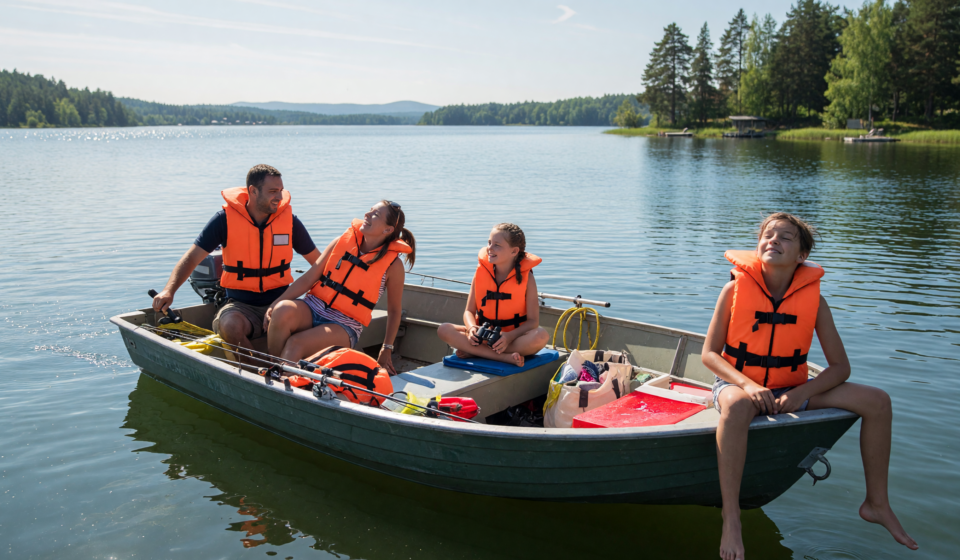
Children need PFDs designed for them, and they need to wear them. Choose a Coast Guard-approved jacket rated for your child’s weight, and look for youth-focused features that keep a scared or tired child face-up: a padded head-support collar, a grab handle at the top of the collar, and a crotch or leg strap that stops the jacket from riding up over the head. For young children, avoid inflatables entirely and stick with foam, which is always ready and approved for their age.
Federal rules require children under 13 to wear a properly fitting, Coast Guard-approved PFD on a moving recreational vessel unless they are below deck or in an enclosed cabin. Many states set stricter ages or conditions, so always confirm the specific rule where you boat. The single most effective habit is to make a worn life jacket a non-negotiable rule for kids on any boat, dock, or paddlecraft.
👉 Shop kids’ life jacket on Amazon (Ad — as an Amazon Associate, we earn from qualifying purchases.)
What the Law Requires on Your Boat
Federal carriage rules are the floor, not the ceiling, and states routinely add to them. At the federal level, every recreational vessel must carry at least one wearable, Coast Guard-approved PFD in serviceable condition and of the proper size for each person aboard. Simply having jackets is not enough; they must fit the people on the boat and be readily accessible, not sealed in original packaging or buried under gear.
- One per person: A properly sized, wearable, USCG-approved PFD for everyone on board, in good condition.
- Throwable device: Vessels 16 feet and longer, excluding canoes and kayaks, must also carry at least one Type IV throwable device, kept immediately accessible near the helm.
- Children’s rules: Federal law sets a baseline for children under 13, and state laws vary widely on age, vessel length, and required conditions.
- State add-ons: Many states require jackets to be worn during certain activities or seasons. Check your state boating agency before you launch.
👉 Shop throwable Type IV on Amazon (Ad — as an Amazon Associate, we earn from qualifying purchases.)
Care, Inspection, and When to Replace
A life jacket is safety equipment, and it needs the same routine attention you would give any gear your life depends on. Before the season and periodically through it, inspect foam jackets for tears, waterlogged or hardened flotation, broken buckles, frayed straps, and failing stitching. Rinse them in fresh water after use, let them air-dry away from direct heat, and store them somewhere dry and ventilated rather than crammed wet into a locker. Never use a jacket as a boat fender or kneeling cushion; crushing the foam destroys the buoyancy you are counting on.
Inflatables need more discipline. Follow the manufacturer’s schedule to inspect the CO2 cartridge for corrosion and secure threading, verify the automatic-inflation mechanism, and periodically test for leaks by orally inflating the bladder and leaving it overnight to confirm it holds air. Rearm any device after it has been inflated, and replace expended or corroded cartridges promptly. Any life jacket that has lost buoyancy, no longer fits, or shows structural damage should be retired. When in doubt, replace it; a new PFD is far cheaper than the alternative.
The Bottom Line
Choosing among the many life jacket types comes down to a short, honest checklist: pick a Coast Guard-approved device, match its flotation and turning behavior to your activity and water using either the traditional Type I-V labels or the newer performance levels, choose foam or inflatable based on who is wearing it and what they are doing, and confirm the fit with a real float check. Then do the one thing that makes all of it count. Wear it. A comfortable, well-fitted PFD that stays on your shoulders is worth more than the most advanced jacket left in the locker, and it is the simplest, surest habit in all of water safety.
Disclaimer: This article is for general educational purposes only and does not constitute legal or safety advice. Regulations and product approvals change and vary by location. Always read the label on your specific device, follow the manufacturer’s instructions, and follow USCG and your state’s boating laws before heading out on the water.
Sources: U.S. Coast Guard (PFD approvals & requirements; PFD Selection, Use, Wear & Care); BoatUS Foundation (Life Jacket Types and state requirements); U.S. Coast Guard-recognized performance-based PFD labeling guidance.