
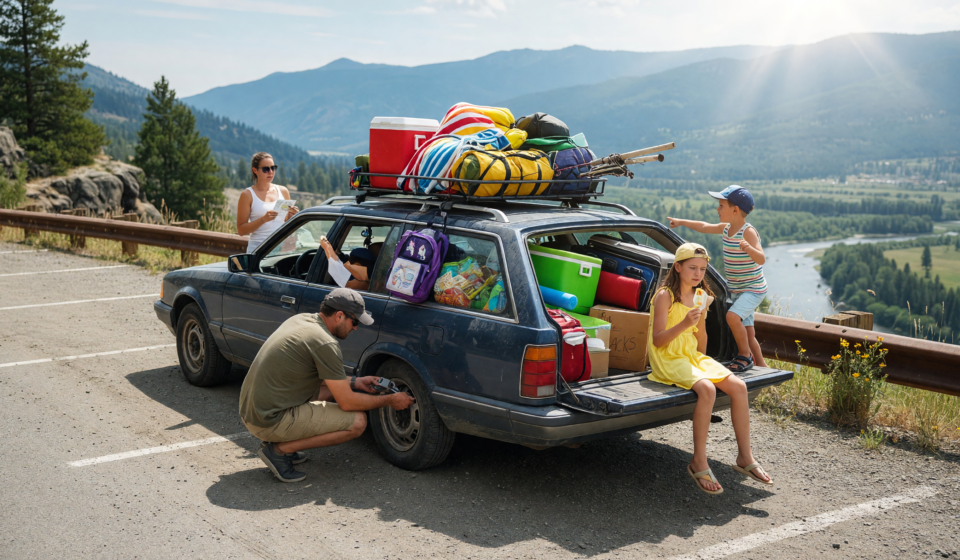
Summer Road Trip Safety: Tire Heat, Coolants and Kid Hydration
Picture the classic August scene: the car is loaded, the kids are buckled in the back with their snacks, and the highway ahead shimmers with heat rising off the asphalt. It is the best part of the year to travel, but that same sun beating down on the pavement is quietly working against you. Heat softens rubber, thins fluids, and turns a parked cabin into an oven within minutes. Good summer road trip safety is not about fear or fancy gear; it is about understanding what the heat actually does to your vehicle and your passengers, and getting ahead of it before you pull out of the driveway.
This guide walks through the three things that cause the most trouble on hot-weather trips: tire heat, your engine’s cooling system, and kid hydration (plus the very real danger of children in hot cars). We will lean on guidance from the National Highway Traffic Safety Administration (NHTSA) and other US agencies, explain the “why” behind each recommendation in plain English, and point you toward the simple tools that make prevention easy. None of this requires a mechanic’s license, just a little attention the day before you leave.
Why Summer Heat Is So Hard on Your Tires
Tires are the only part of your car that actually touches the road, and in summer they take a beating from two directions at once: hot air inside and scorching pavement outside. As a tire rolls, the rubber flexes thousands of times a minute, and that flexing generates heat. Add an under-inflated tire, which flexes even more, plus road surfaces that can run far hotter than the air temperature, and you have the recipe for a blowout. NHTSA has repeatedly warned that hot weather combined with low tire pressure is a leading cause of tire failure during the summer months.
The frustrating irony is that under-inflation is invisible until it is a problem. A tire can look perfectly fine and still be down enough pressure to run dangerously hot on a long, loaded drive. Here is what heat does to a tire that is not properly maintained:
- Extra flexing: A soft tire bulges and flexes more with every rotation, and all that friction turns into heat that the rubber cannot shed fast enough.
- Weakened structure: Sustained heat degrades the bonds between the rubber and the internal belts, which is what leads to tread separation and sudden failure.
- Heavier loads: A trip with a full trunk, a roof carrier, and four passengers puts more strain on tires than your daily commute, and that load multiplies the heat effect.
- Worn tread: Bald or nearly bald tires run hotter and grip worse, especially on the wet roads left behind by a summer thunderstorm.
Building a Summer Road Trip Safety Routine for Your Tires
The single most valuable habit for summer road trip safety is checking your tire pressure the right way. NHTSA recommends checking inflation at least once a month, and always when the tires are “cold,” meaning the car has been sitting for three hours or more. This matters because driving heats the air inside the tire and temporarily inflates the reading, so a pressure check on a hot tire will fool you into thinking everything is fine. Check in the morning before you leave, not at the halfway rest stop.
The correct pressure for your vehicle is not the number stamped on the tire sidewall; that is the maximum. The right target is printed on a label inside the driver’s door jamb (the door pillar) or in your owner’s manual. Set each tire to that number, and do not forget the spare.
- Use a real gauge: The little pencil gauges are notoriously inconsistent. A quality digital tire-pressure gauge gives you a repeatable reading you can trust.
- Trust the TPMS, but verify: Every new light vehicle sold in the US since the 2008 model year has a Tire Pressure Monitoring System under Federal Motor Vehicle Safety Standard 138. The dashboard light warns you when a tire is significantly under-inflated, but it is a last line of defense, not a substitute for a monthly manual check.
- Do the penny test: Put a penny into the tread with Lincoln’s head pointing down. If you can see the top of his head, your tread is worn to the limit and it is time for new tires.
- Look for uneven wear: Cupping, feathering, or a bald patch on one edge points to alignment or inflation problems worth fixing before a long haul.
👉 Shop digital tire-pressure gauge and portable 12V tire inflator on Amazon (Ad — as an Amazon Associate, we earn from qualifying purchases.)
Coolant and the Cooling System: Keeping the Engine From Boiling Over
Your engine makes an enormous amount of heat, and on a 95-degree day crawling through vacation traffic, the cooling system is working at the very edge of its capacity. Coolant (also called antifreeze) circulates through the engine, absorbs that heat, and dumps it out through the radiator. When the coolant is low, old, or the wrong mixture, the system loses its margin and the temperature needle starts climbing toward the red. An overheated engine is not just an inconvenience on the shoulder of the interstate; it can warp components and cause expensive, permanent damage.
You do not need to be a mechanic to keep your cooling system healthy before a trip. A few checks with the engine cold cover most of the risk:
- Check the level when cold: Look at the coolant reservoir’s minimum and maximum marks with the engine completely cool. Topping off a low reservoir is a simple job.
- Never open a hot cap: A hot cooling system is pressurized, and opening the radiator or reservoir cap can spray scalding coolant. Wait until the engine has cooled entirely.
- Use the right mix: Most vehicles call for a proper coolant-and-water blend, commonly around 50/50. Your owner’s manual specifies the type and ratio; the wrong coolant can corrode the system.
- Watch for warning signs: Sweet-smelling steam, puddles under the car, or a temperature gauge that keeps creeping up all mean it is time to stop and let things cool before you have a bigger problem.
- Know the emergency move: If the gauge spikes in traffic, turning off the air conditioning and turning the heater on full blast pulls heat away from the engine and can buy you time to reach a safe place to pull over.
If your coolant has not been serviced in a few years, or you cannot remember the last time it was flushed, a quick visit to a shop before a big trip is cheap insurance compared to a breakdown far from home.
👉 Shop pre-mixed engine coolant and a coolant tester/hydrometer on Amazon (Ad — as an Amazon Associate, we earn from qualifying purchases.)
The Most Serious Risk: Children and Hot Cars
Of everything in this guide, this is the one that matters most. A parked car turns into a deadly heat trap with terrifying speed, and children are far more vulnerable than adults. According to NHTSA, a child’s body heats up three to five times faster than an adult’s. Heatstroke can begin when core body temperature reaches about 104 degrees, and death can occur at 107 degrees or higher. Rolling the windows down a crack or parking in the shade does very little to slow how fast the cabin heats.
The hardest truth in NHTSA’s messaging is that most of these tragedies are not the result of neglect. More than half of child hot-car deaths happen because a busy, exhausted, or distracted caregiver simply forgot a quiet child was in the back seat. NHTSA notes that more than 1,000 children have died in hot cars over roughly the past 25 years. These are always preventable, and the agency promotes a simple habit called “Stop. Look. Lock.”
Stop. Look. Lock. Every single time you park, open the back door and look in the back seat before you walk away. Keep your vehicle locked when it is not in use so curious kids cannot climb in and become trapped, and store the keys where children cannot reach them. If you ever see a child alone in a hot car, call 911 immediately.
- Create a visual cue: Put something you always need, like a phone, a work badge, or a purse, in the back seat next to the child so you have to open that door.
- Set up a check-in: Ask your childcare provider to call you if your child does not arrive as expected.
- Lock it up: Keep the car locked and the keys out of reach at home, since children who let themselves into an unlocked car account for a meaningful share of these deaths.
- Never leave them “just for a minute”: Even a short errand on a mild day can push cabin temperatures to dangerous levels faster than most people expect.
Kid Hydration on Long, Hot Drives
Even in an air-conditioned cabin, kids on a long summer drive can drift toward dehydration without anyone noticing. Children have a harder time regulating their body temperature than adults, they may not think to ask for water while absorbed in a movie or a nap, and rest stops can be hours apart. Public health guidance from the CDC on heat safety emphasizes drinking water regularly rather than waiting until thirst hits, and the American Academy of Pediatrics stresses that water is the best everyday drink for most kids.
The goal is to make water the easy default and to know the early signs of trouble so you can respond before a cranky kid becomes a sick one:
- Give everyone a bottle: An insulated water bottle within each child’s reach beats a shared jug they have to ask for. Kids drink more when it is right there and still cold.
- Offer water on a schedule: Prompt sips at every rest stop and between stops, rather than waiting for anyone to complain of thirst.
- Watch for warning signs: Dry lips, unusual fatigue, headache, dizziness, or noticeably fewer trips to the bathroom can all signal that a child needs fluids and a cool-down break.
- Favor water over sugary drinks: Soda and heavily sweetened juices are poor hydrators for a hot day; plain water, and occasionally a low-sugar electrolyte drink for older kids, works better.
- Take real breaks: Stop every couple of hours to let everyone stretch, use the restroom, and drink in the shade rather than in the hot car.
👉 Shop insulated kids’ water bottles and a soft-sided car cooler on Amazon (Ad — as an Amazon Associate, we earn from qualifying purchases.)
Packing a Hot-Weather Emergency Kit
Even a well-prepared car can end up stranded, and summer heat raises the stakes of any roadside wait. NHTSA recommends carrying a basic emergency kit year-round, and for hot-weather trips a few additions go a long way. The idea is to be able to keep your family safe, cool, and hydrated for a couple of hours if you break down somewhere with no shade and spotty cell service.
- Extra water: Pack more than you think you need, both for drinking and for topping off a thirsty cooling system in a pinch.
- Sun protection: Sunscreen, hats, and a windshield sunshade help if you are stuck waiting in the open.
- First-aid and medications: A stocked first-aid kit plus any daily medications your family needs.
- Phone power: A charged power bank and a charging cable so you can call for help even if the car is off.
- Visibility gear: A reflective triangle or flares and a flashlight so you can be seen safely on the shoulder.
👉 Shop roadside emergency kit and reflective warning triangles on Amazon (Ad — as an Amazon Associate, we earn from qualifying purchases.)
The Bottom Line
Summer road trips are worth every mile, and heat should never keep your family home. The trick is that almost every hot-weather danger is predictable, which means it is preventable. Set your tires to the pressure on the door jamb while they are cold, glance at your coolant level before you back out of the driveway, keep cold water within reach of every kid in the back, and build the “Stop. Look. Lock.” habit so it becomes automatic every time you park. Ten minutes of preparation the night before turns the scary scenarios in this guide into things that simply never happen to you. Load up, buckle in, and enjoy the drive, knowing you have handled the heat before it could handle you.
Disclaimer: This article is provided for general educational purposes only and does not constitute automotive, medical, or safety advice for your specific situation. Vehicle needs vary by make, model, and condition; always follow your owner’s manual and the guidance of qualified professionals. In any emergency, including a child left in a hot car, call 911 immediately.
Sources: National Highway Traffic Safety Administration (NHTSA) — Child Heatstroke Prevention and “Stop. Look. Lock.” campaign; NHTSA Consumer Advisory: Summer Safety Road Tips and hot-weather tire safety guidance; NHTSA TireWise tire maintenance and penny-test guidance; Federal Motor Vehicle Safety Standard (FMVSS) No. 138 on Tire Pressure Monitoring Systems; U.S. Centers for Disease Control and Prevention (CDC) heat and hydration guidance; American Academy of Pediatrics (AAP) guidance on children’s hydration.