Youth Sports Eye Protection: ASTM-Rated Goggles by Sport
Ask any pediatric eye doctor about their busiest weeks, and many will point straight at the sports calendar. A tipped basketball, an elbow under the rim, a racquetball moving faster than a car on the highway, a batted ball that hooks the wrong way: these are the everyday moments that send kids to the emergency room with eye injuries. According to the American Academy of Ophthalmology, baseball and basketball are associated with the most eye injuries among athletes roughly 5 to 24 years old, and a large share of all sports eye injuries happen to people under 25. The hard truth is that most of these injuries are preventable with the right eyewear.
This guide breaks down youth eye protection the way parents and coaches actually shop for it: one sport at a time. We will explain what the ASTM ratings printed on a pair of goggles really mean, why a basketball eye guard is not the same as a racquet-sport model, and where a helmet-mounted faceguard takes over from standalone goggles. Along the way we will lean on guidance from ASTM International, the American Academy of Ophthalmology (AAO), and Prevent Blindness so you can match the right ASTM-rated gear to the sport your young athlete plays.
Why Youth Eyes Need Their Own Rulebook
Everyday glasses and drugstore sunglasses are built for comfort and clarity, not for stopping a projectile. Their lenses can shatter into the eye on impact, and their frames are not designed to absorb a direct hit. Sports eye protection is a different category of product entirely: the lenses, the frame, and the way they work together are all tested to survive an impact and keep the eye intact.
Effective youth eye protection generally shares a few features. Here is what separates real protective eyewear from ordinary glasses:
- Polycarbonate lenses: The AAO recommends polycarbonate as the most shatter-resistant clear lens material for all safety eyewear, with a minimum center thickness of about 3mm in sports goggles.
- An impact-rated frame: Sports frames are engineered to hold the lens in place and spread the force of a blow, rather than snapping toward the eye.
- A sport-specific ASTM rating: The eyewear is tested as a complete unit against a standard written for that category of sport.
- A secure fit for a growing face: An adjustable strap or temples keep the guard in position during hard play.
The Standard Behind the Sticker: ASTM F803
When people talk about protective sports goggles, the standard they most often mean is ASTM F803. Published by ASTM International, it is the specification for eye protectors used in a range of selected sports, and it is the rating you will most commonly see for basketball, soccer, and racquet-sport style goggles. Gear that meets F803 has been tested to withstand impacts representative of the ball or implement used in the covered sport.
The important detail is that F803 and its sibling standards are written by sport, not one-size-fits-all. That is why matching the rating to the activity matters so much:
- ASTM F803: The core standard for eye protectors used in sports such as basketball, racket sports, women’s lacrosse, field hockey, and baseball fielding, per the AAO.
- ASTM F910: Covers face guards for youth baseball batters and base runners, according to the AAO.
- ASTM F1776: The standard the AAO cites for eye protection in paintball.
- ASTM F513: The AAO’s referenced standard for ice hockey eye and face protection.
- Newer sport-specific standards: Prevent Blindness also points to updated specifications for certain sports, so it is worth checking the current ASTM listing for your child’s activity.
Read the label, not the marketing. A product photographed on an athlete is not the same as a product tested to a standard. Look for the specific ASTM designation printed on the frame, temple, or packaging, and confirm it matches the sport your child actually plays.
Basketball and Soccer: The Everyday Contact Sports
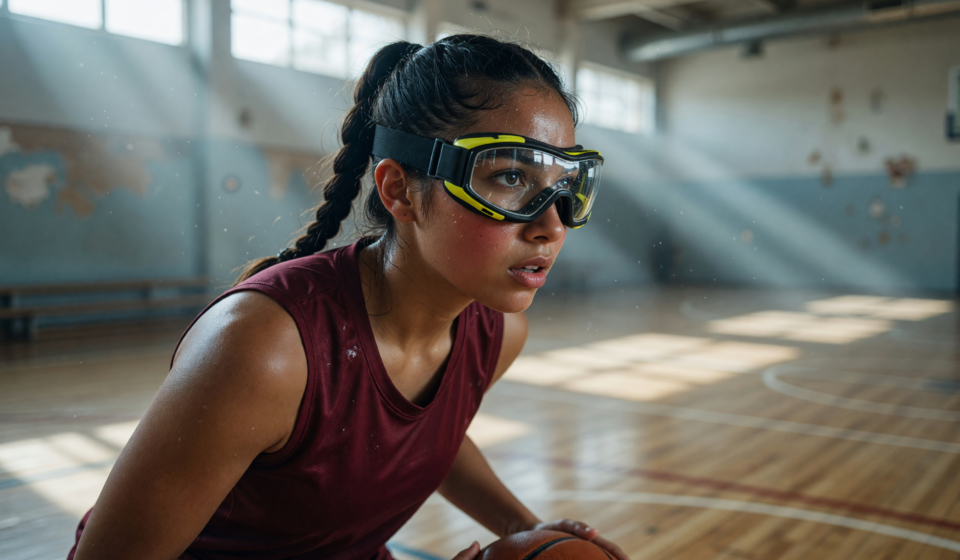
Basketball is a leading cause of eye injuries in young athletes, and the reasons are obvious once you watch a game: fingers, elbows, and the ball itself all end up near the face in a crowd under the basket. There is no helmet to hide behind, so the eye guard is the entire line of defense. For basketball, look for wraparound goggles rated to ASTM F803 with a padded bridge and a strap that holds them steady during rebounds.
Soccer is classified by the AAO as a moderate-risk sport for the eyes, but heading duels, stray fingers, and goalmouth scrambles still produce real injuries. The same style of F803-rated sports goggle works well here. A few things to prioritize for both sports:
- A retention strap: Keeps the goggle on through contact and quick direction changes.
- Cushioned bridge and brow padding: Absorbs the shock of an errant elbow and improves comfort over a full game.
- Ventilation and anti-fog: Fogged lenses tempt kids to push the goggles up onto their forehead, which defeats the purpose.
- A prescription option: Many F803 goggles accept prescription inserts so kids who need correction still get full protection.
👉 Shop ASTM F803-rated basketball/soccer sports goggles for youth on Amazon (Ad — as an Amazon Associate, we earn from qualifying purchases.)
Baseball and Softball: Two Standards, One Helmet Question
Baseball and softball are the trickiest sports to shop for because the risk changes with the position. When a child is fielding, standalone ASTM F803 sports goggles guard against a bad hop or a line drive that gets past the glove. When that same child steps into the batter’s box or onto the bases, the concern shifts to a pitched ball striking the face, which is why the AAO points to ASTM F910 for youth batters’ and base runners’ face guards mounted on the batting helmet.
In practice, that means many young players benefit from a layered approach across the game:
- At bat and on the bases: A helmet-mounted face guard meeting ASTM F910 addresses the pitched-ball threat.
- In the field: F803-rated goggles protect against thrown and batted balls when there is no helmet.
- Check your league: Youth organizations often set their own equipment rules, so confirm what is required or permitted before buying.
- Mind the fit over a cap: Fielders’ goggles need to sit correctly with a ball cap, not fight it.
👉 Shop ASTM F910 batting helmet face guard and F803 fielding goggles for youth baseball/softball on Amazon (Ad — as an Amazon Associate, we earn from qualifying purchases.)
Racquet Sports: Small Ball, Big Speed
Racquetball and squash sit near the top of the eye-injury risk list for a simple reason: a small, hard ball travels at high speed in an enclosed court, and it fits neatly inside the eye socket. The AAO classifies these among the high-risk sports for the eyes, and it is one of the few activities where playing without protection is genuinely reckless. For racquet sports, choose sturdy eye guards with closed, impact-rated lenses; open eye guards with no lens do not stop a ball that can squeeze through the gap.
ASTM F803 has long been the reference for racquet-sport eye protectors, and Prevent Blindness notes there is also a more recent racket-sports specification, so check the current ASTM listing when you buy. Whatever the exact designation, prioritize these features:
- Solid polycarbonate lenses: Closed lenses are essential; lens-less “eye guards” are not adequate for a small ball.
- A snug, sport-tested frame: The guard should stay put during fast lunges and swings.
- A wide field of view: Kids need to track a fast ball off the walls without blind spots.
- Anti-fog ventilation: Indoor courts get warm, and fogging is a constant nuisance.
👉 Shop closed-lens ASTM-rated racquetball/squash eye guards for youth on Amazon (Ad — as an Amazon Associate, we earn from qualifying purchases.)
Lacrosse and Field Hockey: Sport-Specific Cages
Women’s lacrosse and field hockey both use dedicated eyewear that looks more like a wire or cage-style guard than a simple pair of goggles, because the threats include a hard ball and a stick swung near the face. The AAO references ASTM F803 for both sports, and Prevent Blindness points to newer sport-specific specifications as well, so the smart move is to buy eyewear labeled for that exact sport rather than a generic goggle.
What matters most in these sports:
- Sport-labeled eyewear: Look for a guard explicitly designated for women’s lacrosse or field hockey, tested to the relevant ASTM standard.
- League compliance: Governing bodies frequently mandate specific eyewear, so match your purchase to the rulebook.
- Secure retention: The guard should not shift when a player runs, cradles, or takes contact.
- Clear sightlines: A cage design should protect without cutting off the peripheral vision players rely on.
Hockey and Paintball: When ASTM Meets HECC
Ice hockey is a special case. Standalone goggles are not the answer here; protection comes from a full cage or shield attached to the helmet. The AAO cites ASTM F513 for hockey face protection, and Prevent Blindness notes that hockey gear typically carries a Hockey Equipment Certification Council (HECC) approval label rather than a simple goggle rating. For hockey, the certified helmet-and-cage system is what keeps a puck or a high stick away from a young player’s eyes.
Paintball is another activity where casual eyewear is dangerous. A paintball travels fast enough to rupture an eye, so the AAO points to ASTM F1776 for paintball eye protection. The takeaways for these higher-energy sports:
- Hockey needs a certified system: Use a helmet with an approved cage or shield, not sports goggles.
- Paintball needs a full mask: Look for paintball-specific protection meeting ASTM F1776; regular goggles are not enough.
- Never modify certified gear: Removing or altering a cage or mask voids its protection and often its certification.
Fit, Lenses, and Replacement: Getting It Right
Even the best-rated goggle only works if it fits and stays on. Prevent Blindness and the AAO both emphasize that properly fitted protective eyewear dramatically reduces the risk of serious sports eye injury. A guard that slides down the nose, pinches, or fogs will end up pushed onto the forehead, where it protects nothing. Because kids grow and gear takes a beating, fit is not a one-time decision.
- Fit for the current season: The guard should sit level, with padding on the bridge and brow and no gaps at the temples.
- Insist on polycarbonate: It is the shatter-resistant lens material the AAO recommends for all safety eyewear.
- Inspect regularly: Retire eyewear with cracked lenses, crazing, or a frame that has taken a hard hit.
- Replace as they grow: A guard that no longer fits a bigger face is no longer doing its job.
- Involve an eye doctor: For kids who need correction, an eye care professional can fit prescription sports eyewear that still meets the standard.
👉 Shop youth prescription-ready polycarbonate sports goggles with anti-fog on Amazon (Ad — as an Amazon Associate, we earn from qualifying purchases.)
The Bottom Line
Sports eye injuries in kids are common, they can be severe, and they are overwhelmingly preventable. The single most important habit a parent or coach can build is simple: match the eyewear to the sport, and confirm the ASTM rating on the label rather than trusting a product’s looks. F803 goggles for basketball, soccer, and racquet play; F910 face guards for youth batters; certified helmet cages for hockey; a full mask for paintball. Add polycarbonate lenses, a secure fit, and a habit of replacing gear as your athlete grows, and you have covered the real risks. Protective eyewear is inexpensive next to an eye injury, and once it becomes part of putting on the uniform, kids stop thinking about it and just play.
Disclaimer: This article is for general educational purposes only and is not medical advice. Sports eye-protection standards, league rules, and product certifications change over time and vary by activity. Always confirm the current ASTM designation and any governing-body requirements for your child’s sport, and consult a qualified eye care professional for guidance on fit and prescription needs.
Sources: ASTM International (F803, F910, F1776, F513 and related sport-specific standards); American Academy of Ophthalmology (AAO), “Protective Eyewear for Young Athletes”; Prevent Blindness, “Recommended Sports Eye Protectors”; Hockey Equipment Certification Council (HECC).