
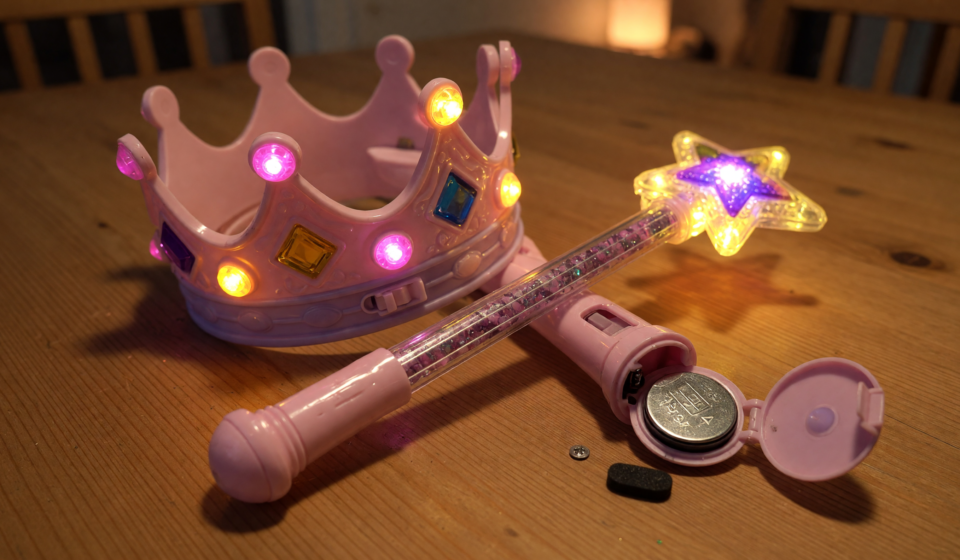
Light-Up Princess Costumes Recalled Days Before Halloween Over Button Battery Risk
With trick-or-treating only days away, federal regulators have pulled a children’s Halloween-style costume off the market over a hazard that sends kids to the emergency room every year. On October 22, 2026, the U.S. Consumer Product Safety Commission (CPSC) announced a recall of CIYTI light-up princess costumes sold on Amazon, warning that children can easily reach the button batteries hidden inside the glowing crown, wand, and remote. The timing is a pointed reminder that button battery safety deserves as much attention this season as reflective tape and well-fitting masks, because a swallowed coin cell can injure a child within hours.
What happened
The recall (CPSC recall number 27-038) covers about 94 CIYTI light-up princess costume sets. Each set includes a blue dress along with a crown and wand that light up and a remote control. The crown, wand, and remote all contain button cell batteries. According to the CPSC, the costumes violate the mandatory federal toy safety standard because children can easily access those batteries, creating a serious ingestion risk.
The sets were sold on Amazon from February 2025 through June 2025 for between $21 and $35, imported by a China-based seller. The products carry no identifying markings on the item itself; the only branding is the word “CIYTI” printed on the front of the package. No injuries had been reported at the time of the announcement, and the company is offering refunds to anyone who bought one.
This is not an isolated case. Earlier in 2026, the CPSC announced a recall of Besslly Halloween pumpkin carving kits (recall number 26-396) whose tea lights contained 15 preinstalled button cell batteries that children could easily access, also in violation of the federal standard. Light-up ballet skirts, “recolorable” light-up ghost statues, and light-up toys from other sellers have drawn similar warnings over the past year. Seasonal, inexpensive light-up novelties sold through online marketplaces have become a recurring source of these pulls.
Why button battery safety can’t wait
The danger with a button or coin battery is not simply choking. When a lithium coin cell lodges in a child’s esophagus, saliva completes a circuit that generates a caustic chemical reaction, and that reaction can begin burning through delicate tissue in as little as two hours. The damage can continue even after the battery is removed, and severe cases can lead to permanent injury or death. Larger 20-millimeter lithium cells, common in light-up gadgets and remotes, are especially dangerous because they are more likely to become stuck.
Poison-control specialists at the National Capital Poison Center, which tracks battery ingestion cases nationwide, note that batteries stuck in the esophagus can be life-threatening and may require prompt removal. The most severely affected group is young children, who tend to put small, shiny objects in their mouths. What makes glowing costumes and props so risky is that the battery compartment is often secured by nothing more than a friction-fit cover or a bit of tape, which small hands can pry open.
What you should do
If you bought a CIYTI light-up princess costume, the CPSC says to act now rather than wait for Halloween to pass:
- Take it away immediately: Remove the costume from your child and stop using it, including the crown, wand, and remote.
- Request your refund: Contact the company for a full refund as directed in the recall notice.
- Mark and photograph it: Write “RECALLED” in permanent marker on the dress, crown, wand, and remote, then email a photo of the discarded items to the address listed by the firm (Norakid2026@outlook.com).
- Dispose of batteries safely: Follow your local hazardous-waste procedures for the button batteries rather than tossing them in household trash where a child or pet could find them.
Beyond this specific product, a quick check of every light-up item in your Halloween bin is worth the few minutes it takes. Glowing jewelry, light-up shoes, flashing wands, LED pumpkins, and novelty tea lights are all candidates. If a battery door opens without a tool or pops loose when you squeeze it, keep that item away from young children.
If you suspect a swallowed battery, treat it as an emergency. Go to the emergency room right away and call the National Battery Ingestion Hotline at 800-498-8666. Do not wait for symptoms, do not induce vomiting, and do not let the child eat or drink until a doctor has checked them. Tell the medical team it may be a battery so they can image the chest and throat quickly.
Context and what’s next
These recalls are unfolding against the backdrop of Reese’s Law, a federal statute enacted in 2022 and named for a Texas toddler who died after swallowing a button battery. The law directed the CPSC to set a mandatory safety standard, and the resulting rule now requires that battery compartments for replaceable button and coin cells resist a child’s access, typically by needing a tool or two independent simultaneous hand movements to open. It also requires specific warnings on packaging, on the product where practicable, and in instructions. Those requirements phased in through 2023 and 2024, incorporating the ANSI/UL 4200A-2023 standard.
The pattern behind these recalls is that low-cost imported novelties keep reaching U.S. consumers through online marketplaces without meeting that standard, and the CPSC continues to catch them after the fact. For families, the practical takeaway is that a product being sold on a major platform is not a guarantee that its battery compartment is child-resistant. Expect the agency to keep issuing these notices, particularly around gift-giving seasons when light-up items surge. Checking the CPSC recall list before buying, and keeping loose batteries and spares locked away, remain the most reliable defenses while enforcement catches up with the marketplace.
Disclaimer: This article is for general safety information only and is not medical, legal, or professional advice. Recall details, model numbers, and remedy instructions can change; always confirm the current guidance directly with the CPSC and the recalling company before acting. If you believe a child has swallowed a battery, seek emergency medical care immediately.
Sources: CPSC recall 27-038 (CIYTI light-up princess costumes); CPSC recall 26-396 (Besslly Halloween pumpkin carving kits); CPSC button cell and coin battery business guidance (Reese’s Law); National Capital Poison Center button battery statistics.