
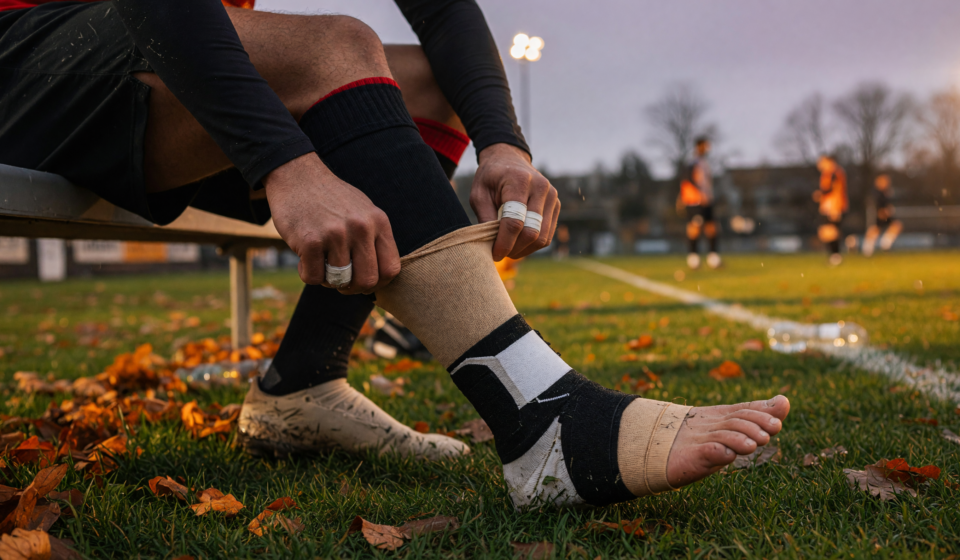
Soccer Ankle Guards and Sock Sleeves: Extra Support for Fall Season
It is a crisp October Saturday, the grass is slick with morning dew, and somewhere on a rutted municipal field a midfielder plants a foot to change direction, catches a cleat in a soft patch of turf, and feels that sickening roll on the outside of the ankle. If you have spent any time on a soccer sideline in the fall, you have seen it happen, and you have heard the silence that follows. The ankle is the joint that pays the price for cutting, sprinting, and challenging for the ball on uneven autumn pitches, and it is the injury coaches and parents ask us about most as the season wears on.
This guide walks through how soccer ankle guards, sock sleeves, and properly fitted shin guards work together to give the ankle more support during the demanding fall season. We will cover what the ankle actually needs, what the U.S. governing bodies require, how compression sleeves and lace-up ankle braces differ, and how to build a layered setup that holds up from the first whistle in September through playoffs. The goal is plain English and practical advice, not marketing, so you can make smart choices for yourself or your player.
Why the Ankle Takes a Beating in Fall Soccer
The ankle sprain is widely recognized by sports-medicine sources, including the National Institutes of Health’s StatPearls library, as one of the most common injuries in cutting and jumping sports, and soccer is a textbook example. The usual mechanism is a lateral, or inversion, sprain: the foot rolls inward and the ligaments on the outside of the ankle get stretched past their limit. It does not take a dramatic collision. A quick change of direction, an awkward landing after a header, or a plant foot that slips on wet grass is often all it takes.
Fall conditions stack the deck. Here is why the season is especially hard on ankles:
- Soft, uneven ground: Autumn rain leaves fields muddy and pocked, so the surface shifts under a planted foot.
- Longer, denser schedules: League play, tournaments, and school games pile up, and fatigue dulls the reflexes that stabilize a joint.
- Colder muscles: Chilly mornings mean tissues are stiffer at kickoff, which shortens the margin for a safe recovery when the foot lands wrong.
- Reinjury risk: An ankle sprained earlier in the year is more vulnerable, and fall is often late enough in the calendar for old injuries to resurface.
None of this means the ankle is fragile. It means the joint benefits from support that adds stability without stealing the mobility a soccer player relies on.
What U.S. Rules Actually Require
Before you shop, it helps to know what the rulebook mandates and what it merely allows. In the United States, high school soccer is governed by the National Federation of State High School Associations, or NFHS, and college play falls under the NCAA. Both require shin guards, and the shin guards themselves are the piece with a formal safety standard behind them.
- NOCSAE certification: NFHS rules require shin guards that meet the National Operating Committee on Standards for Athletic Equipment (NOCSAE) standard. Look for the NOCSAE stamp; the relevant standard for newly manufactured soccer shin guards is designated ND090.
- Fit and coverage: Guards should be worn under the socks, fit snugly, and sit roughly two inches below the knee so they cover the shin properly.
- Ankle guards are optional but encouraged: Governing-body guidance recommends full-length shin guards with attached or removable ankle guards for added protection, and notes this is especially useful for younger players facing wild kicks.
In short: shin guards are required and regulated, ankle guards are a recommended add-on, and ankle braces and sleeves are personal choices most leagues permit as long as they are not dangerous to other players. Always confirm with your specific league, because officials can rule on anything hard or abrasive.
Quick reality check. Gear reduces risk; it does not erase it. No sleeve, guard, or brace replaces conditioning, balance work, and a proper warm-up. Think of ankle support as one layer in a larger plan, not a magic fix for a joint that has never been trained to stabilize itself.
Soccer Ankle Guards Explained
“Ankle guard” gets used loosely, so it is worth separating the two things people usually mean. The first is the padded ankle guard built into or clipped onto a shin guard. These wrap the malleoli, the bony knobs on either side of the ankle, and are designed to blunt the impact of a stray cleat or a kick that misses the ball. Their job is impact protection, not joint stability.
The second is a supportive ankle brace, which is a different tool with a different purpose. Here is how to think about each:
- Padded ankle guards: Best for younger players and anyone who takes a lot of contact around the feet. They cushion blows but do little to limit how far the joint can roll.
- Lace-up ankle braces: Designed to restrict excessive inversion and eversion. Research on lace-up braces in high school athletes has linked them to lower rates of acute ankle injury, which is why they are a common choice for players with a history of sprains.
- Hinged or stirrup braces: Firmer support often used during return-to-play after a sprain, though some players find them bulky under a cleat.
For a healthy player who wants a bit of insurance on rough fall fields, a slim lace-up brace or a shin guard with an integrated ankle guard is usually the sweet spot. For someone coming back from an injury, a more structured brace makes sense, ideally chosen with input from an athletic trainer or physical therapist.
👉 Shop lace-up soccer ankle brace on Amazon (Ad — as an Amazon Associate, we earn from qualifying purchases.)
Where Sock Sleeves Fit In
Sock sleeves, also called grip socks or footless compression sleeves, have quietly become one of the most popular pieces of soccer kit. They serve two related but distinct roles, and understanding the difference keeps you from expecting the wrong thing.
- Grip socks: Short, cushioned socks with rubberized grip pads on the sole. They lock the foot in place inside the cleat, cutting the internal slipping that leads to blisters and, some players feel, contributes to awkward foot positioning.
- Compression sock sleeves: Footless tubes that cover the calf and ankle, worn to hold shin guards in place and to provide gentle compression that many athletes say helps with proprioception, the body’s sense of where the joint is in space.
- The layered system: Players commonly wear a grip sock, add a shin guard and ankle guard, then pull a compression sleeve and the team sock over the top so everything stays put through 90 minutes.
Compression sleeves are not braces. They do not mechanically stop the ankle from rolling. What they do well is manage warmth, reduce shin-guard slippage, and give the lower leg a snug, supported feel that helps some players stay aware of their footing on a slick fall pitch. Paired with a true brace or a padded guard, they round out a setup rather than replace its protective core.
👉 Shop soccer grip socks and compression sock sleeves on Amazon (Ad — as an Amazon Associate, we earn from qualifying purchases.)
Building a Layered Support System
The strongest setups are not about any single hero product. They are about layers that each do one job well and stay comfortable together. A common fall configuration, from the skin out, looks like this:
- Base layer: A grip sock to anchor the foot and prevent internal slide inside the cleat.
- Stability layer: A lace-up ankle brace if the player wants or needs joint support, sized so it fits inside the cleat without cramping the toes.
- Protection layer: A NOCSAE-stamped shin guard, with an integrated or removable ankle guard if extra impact coverage is the goal.
- Retention layer: A compression sock sleeve and the team sock pulled over everything to keep guards and braces from shifting.
The order matters because comfort drives compliance. A brace that pinches or a guard that slides gets abandoned by the second half, and abandoned gear protects no one. Have your player test the full stack in training before relying on it in a match, and check that they can still sprint, cut, and strike the ball naturally.
👉 Shop NOCSAE-certified soccer shin guards with ankle protection on Amazon (Ad — as an Amazon Associate, we earn from qualifying purchases.)
Fit, Sizing, and Common Mistakes
Even good gear underperforms when it is the wrong size or worn incorrectly. A few recurring mistakes show up on sidelines every fall, and all of them are easy to avoid.
- Buying a brace too big: An ankle brace should be snug enough to limit rolling. Too loose and it becomes padding, not support. Measure and follow the manufacturer’s sizing chart.
- Forgetting cleat volume: A brace adds bulk. If the cleat was already tight, the player may need a slightly larger boot or a lower-profile brace so circulation and toe room are not compromised.
- Skipping the break-in: New braces and grip socks feel different. Wear them in practice first so match day is not the debut.
- Ignoring wear and tear: Straps stretch, grip pads wear smooth, and foam compresses over a long season. Inspect gear periodically and replace what has lost its function.
One more note on expectations: support gear is a complement to training, never a substitute. Single-leg balance drills, calf and hip strengthening, and a genuine dynamic warm-up before cold-morning games do more for ankle resilience over a season than any product on this page. Gear buys margin; conditioning builds the joint.
The Bottom Line
Fall soccer asks a lot of the ankle, and the smartest players meet that demand with a layered plan rather than a single gadget. Start with what the rules require, a NOCSAE-certified shin guard worn correctly under the socks, then add the pieces that fit your situation: a padded ankle guard for impact, a lace-up brace for stability if you have a history of sprains, and grip socks or compression sleeves to keep the whole system locked in and comfortable. Test it in training, size it honestly, replace it when it wears out, and pair it with real strength and balance work. Do that, and you give the ankle the extra support it needs to carry you from the first cold Saturday of the season all the way through playoffs.
Disclaimer: This article is provided for general educational purposes only and is not medical advice. Protective equipment reduces but does not eliminate the risk of injury. If you have an existing injury, pain, or a history of ankle problems, consult a qualified physician, athletic trainer, or physical therapist before choosing or relying on any ankle support product, and always follow your league’s equipment rules and the manufacturer’s fitting instructions.
Sources: National Federation of State High School Associations (NFHS) soccer uniform and shin guard requirements; National Operating Committee on Standards for Athletic Equipment (NOCSAE), Standard ND090 for newly manufactured soccer shin guards; National Institutes of Health, StatPearls (acute ankle sprain); peer-reviewed research on lace-up ankle braces and injury rates in high school athletes.


