
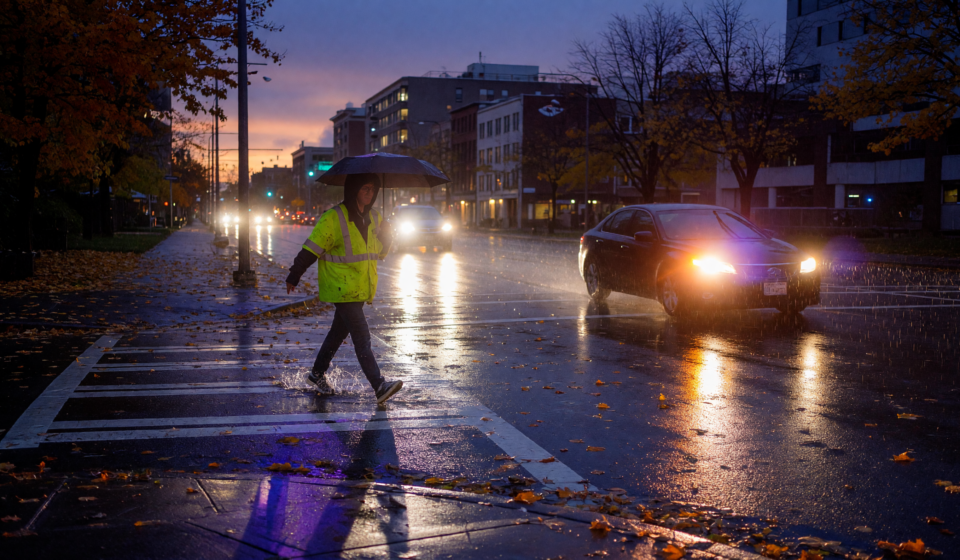
Clocks Fall Back November 1: Why the Darker Evening Commute Raises Pedestrian Risk
Daylight Saving Time ends at 2:00 a.m. on Sunday, November 1, 2026, when clocks across most of the United States fall back one hour. The extra hour of sleep comes with a hidden trade-off that is easy to overlook: sunset suddenly arrives about an hour earlier, pushing the evening rush into darkness almost overnight. That abrupt shift is why daylight saving time safety deserves a fresh look this fall, especially for anyone who walks, works outdoors, or drives home after a shift. Federal crash data shows the dark hours around the evening commute are among the deadliest of the year for people on foot.
What changes when the clocks fall back
The mechanics are simple. At 2:00 a.m. local time on November 1, clocks move back to 1:00 a.m., ending the roughly seven-month stretch of Daylight Saving Time that began in March. Mornings get a little brighter, but evenings get noticeably darker. In much of the country the sun now sets before 5:30 p.m., which means the late-afternoon commute that was bathed in daylight one week happens in near-total darkness the next.
Our eyes and our habits do not adjust that fast. Drivers who spent the summer sharing the road with clearly visible pedestrians suddenly face low light, glare from oncoming headlights, and walkers in dark clothing who are much harder to pick out. Pedestrians, cyclists, and roadside workers, meanwhile, often move through the evening as if they were still as visible as they were in August. That mismatch between how visible people feel and how visible they actually are sits at the center of the problem.
Daylight saving time safety: why darker evenings raise the risk
The National Highway Traffic Safety Administration’s most recent pedestrian fact sheet, covering 2024 data, found that 7,080 pedestrians were killed in traffic crashes that year — a 3.9 percent decrease from the 7,367 killed in 2023. The modest dip is welcome, but pedestrian deaths remain near multi-decade highs. The more telling figure for this season is where those deaths happen: 76 percent of pedestrian fatalities occurred in the dark, compared with just 20 percent in daylight.
The timing lines up almost exactly with the evening commute. NHTSA reported that the single largest share of pedestrian deaths in 2024 — 24 percent — happened between 6:00 and 8:59 p.m. In the winter months of December, January, and February, that same window accounted for 33 percent of pedestrian fatalities, roughly one in three. When the clocks fall back and sunset jumps straight into that window, the risk follows it.
Drivers are not exempt from the danger. The National Safety Council notes that the traffic death rate is about three times higher at night than during the day, even though far less driving happens after dark. Reduced depth perception, slower reaction to low-contrast hazards, and plain fatigue all play a part. For the millions of Americans whose daily trip home shifts from daylight to darkness over a single weekend, the first week of standard time is a genuine adjustment period — and a dangerous one if nobody changes their behavior.
What you should do
Visibility is the single biggest lever you control. A few deliberate habits can make the difference between being seen in time and not being seen at all.
- Make yourself visible: Wear light or high-visibility colors and add retroreflective material when you walk, run, cycle, or work near traffic after dark. Reflective strips on a jacket, vest, backpack, or shoes bounce headlight beams back toward drivers and extend the distance at which you are seen.
- Walk and bike defensively: Use sidewalks and crosswalks, make eye contact with drivers before crossing, and carry a small flashlight or use a bike light. Never assume a driver can see you simply because you can see them.
- Drive for the dark: Slow down during the evening rush, increase your following distance, keep headlights and windshields clean, and scan the shoulders and crosswalks for people. Dim your dashboard and avoid staring into oncoming high beams.
- Protect roadside and outdoor workers: Employers whose crews work at dusk or after dark should supply ANSI/ISEA-rated high-visibility apparel, keep work zones well lit, and refresh worn-out reflective gear before the darker season sets in.
- Test your alarms while you are at it: The clock change is a long-standing reminder from the U.S. Fire Administration and the National Fire Protection Association to test every smoke and carbon monoxide alarm and replace any batteries that need it — a small task that pairs naturally with resetting your clocks.
What to do. When you set your clocks back on November 1, treat the darker evening commute as a new set of conditions. Add high-visibility or reflective gear for anyone walking, cycling, or working near traffic; slow down and stay alert behind the wheel during the 6-to-9 p.m. window; and test your smoke and carbon monoxide alarms the same weekend.
Context and what’s next
The semiannual clock change has drawn steady criticism, and proposals to make Daylight Saving Time permanent — most prominently the Sunshine Protection Act — have surfaced repeatedly in Congress. As of this fall, no such measure has become law, so the November 1 fall-back proceeds as scheduled for every state except Hawaii and most of Arizona, which do not observe Daylight Saving Time. Barring a change in federal law, clocks will spring forward again in March 2027.
The broader trend is what gives this seasonal shift its weight. Even with the slight decline in 2024, pedestrian deaths in the United States sit well above where they were a decade ago, and the overwhelming concentration of those deaths in the dark has made nighttime visibility a central focus for traffic-safety agencies and researchers. The end of Daylight Saving Time does not create that risk, but it compresses a large share of it into a few early-evening hours, right when tired commuters are heading home. Planning for that first dark week — and keeping high-visibility habits through the winter — is the most practical response.
Disclaimer. This article is for general safety information only and is not legal, medical, or professional advice. Statistics reflect the most recent federal data available at publication and may be revised. For your specific situation or workplace requirements, consult the primary sources below and applicable local regulations.
Sources: NHTSA, Traffic Safety Facts — Pedestrians: 2024 Data; NHTSA Pedestrian Safety; National Safety Council, Driving at Night; U.S. Fire Administration, Smoke Alarms.


