Running After Dark: Visibility Gear That Actually Works
The sun sets earlier than you think, and your favorite loop looks like a different place once the streetlights flicker on. You know the road. The trouble is that the driver coming around the bend at 40 miles per hour doesn’t know you’re on it. In the second or two it takes their eyes to register a shape at the edge of the pavement, you need to already look like a person, not a smudge of shadow. That is the whole job of good running visibility gear: buying you distance and buying the driver time. This guide breaks down what actually works after dark, what only looks impressive on the store shelf, and how to layer it into a setup you’ll genuinely wear.
We’ll cover why the human eye and the headlight beam conspire to hide runners at night, the crucial difference between reflective material and active lighting, and the biomotion trick that lets a driver recognize you as human from far greater distances. We’ll talk color for dawn and dusk, choosing a headlamp so you can see the path and not just be seen, how to stack everything into layers, and a few old-fashioned road habits that matter more than any gadget — plus a note for anyone who runs with a dog.
Why Drivers Don’t See You After Dark
Nighttime driving is a low-information environment. Headlights throw a cone of light that points down and to the right, illuminating the road surface far better than the shoulder where you’re running. The vision scientists who worked with Brooks and 3M on this exact problem put it plainly: the brain is easily confused in poor lighting, and a dim, unfamiliar shape at the roadside often doesn’t register as a person until it’s dangerously close. A driver usually isn’t ignoring you. Their visual system is doing its best with almost nothing to work with, and by default, at the edge of the road, you are almost nothing.
So the goal isn’t merely to be a bright dot. It’s to be unmistakably human, early enough that the driver has time to lift off the gas or steer wide. Every piece of gear below serves that single objective.
Reflective vs. Active Lighting: The Difference That Matters
This is the distinction most runners get wrong, so it’s worth slowing down on. There are two fundamentally different ways to be seen at night, and a complete kit uses both rather than choosing between them.
- Passive reflectivity: Retroreflective material bounces incoming light straight back toward its source. Under a car’s headlights it lights up brilliantly, but it only works when a light is aimed at it, and mostly only from the direction of that light. No headlights, no glow.
- Active lighting: LED lights, clip lights, and headlamps emit their own light. They don’t wait for a car; they’re visible from every angle and beyond the reach of headlight beams, on unlit trails and in the dark gaps between passing vehicles.
As the science writers at Massive Science explain, retroreflective gear only works when it is illuminated by car headlights or other outside light, while LEDs generate their own and stay visible even where headlights never reach. Neither one replaces the other. Reflectivity handles the lit road; active lighting handles the dark stretches and the sideways angles that a forward-facing headlight will never cover.
👉 Shop reflective vest on Amazon (Ad — as an Amazon Associate, we earn from qualifying purchases.)
👉 Shop LED running lights / clip lights on Amazon (Ad — as an Amazon Associate, we earn from qualifying purchases.)
The Biomotion Trick: Put the Gear on Your Moving Joints
Here’s the single most useful idea in this whole guide, and almost nobody outside safety research talks about it: where you place reflective material matters more than how much of it you wear.
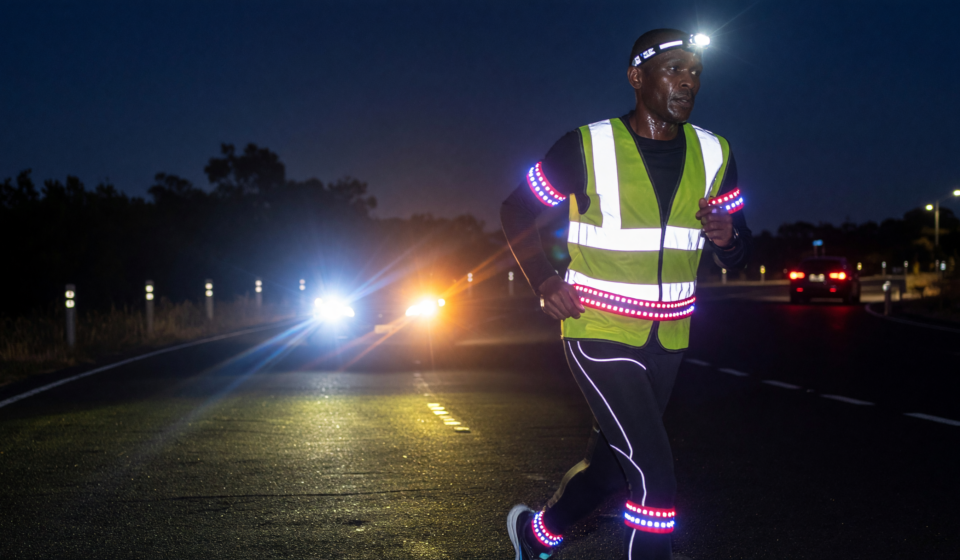
The human brain is exquisitely tuned to recognize other people by the way they move, a phenomenon researchers call biomotion. Put reflective strips on the parts of your body that swing as you run — ankles, wrists, knees — and a driver’s brain latches onto that distinctive up-and-down, back-and-forth motion and reads “person” almost instantly. In studies cited by Massive Science, drivers spotted pedestrians wearing retroreflective strips on their arms and legs at distances roughly ten times longer than the same pedestrians wearing only a reflective vest. Brooks’ work with 3M reached the same conclusion, concentrating reflectivity at the “critical motion zones” like the knees and ankles, in part because headlights point low and those joints ride right in the beam.
The practical takeaway is simple. A vest on its own is a bright blob. Add reflective ankle bands, wrist bands, or shoe clips and you transform from a blob into a recognizable, moving human. If you buy one upgrade after your vest, make it something that lives on a joint that moves.
High-Vis Color for Dawn and Dusk
Fluorescent yellow-green, blaze orange, hot pink — these colors have a real job, but it’s a narrower one than the packaging suggests. Fluorescent fabrics work by converting invisible ultraviolet light into visible light, which makes them glow with an intensity ordinary dyes can’t match. The Appalachian Mountain Club notes that fluorescent yellow-green is the most visible color in daylight because our eyes are most sensitive to that wavelength, while orange-red tends to read better as the light dims toward dusk.
The catch is that fluorescence needs ambient light to feed on. At golden hour, at dawn, and under overcast gloom, high-vis color is your best friend. In genuine darkness — a moonless road at nine at night — there’s no ultraviolet left to convert, and that neon shirt goes as dark as everything around it. Color is a dusk-and-dawn tool, not a true-nighttime one. When the sun is fully gone, reflectivity and active lighting do the heavy lifting, so don’t let a bright shirt lull you into leaving the lights and reflective bands at home.
Headlamps: Seeing the Path, Not Just Being Seen
Everything so far is about being seen. A headlamp is the one piece that also lets you see — the pothole, the raised curb, the off-leash dog, the patch of black ice you’d otherwise meet with your face. A good running headlamp or chest light throws a beam onto the path ahead so you can place your feet with confidence on unlit sections.
Look for a rechargeable model — you’ll actually keep it topped up instead of hunting for dead batteries — with enough output to light the ground a few strides ahead and a strap that doesn’t bounce. Chest-mounted lights sit lower and can throw better shadows across trail texture, while a headlamp follows wherever you look. Just remember that a headlamp aimed forward does little to make you visible to a car approaching from the side or the rear, which is exactly why it complements your reflective and active gear rather than replacing it.
👉 Shop rechargeable headlamp on Amazon (Ad — as an Amazon Associate, we earn from qualifying purchases.)
Building Your Layered Running Visibility Gear Setup
No single item does everything, so think in layers. A dependable running visibility gear setup stacks passive and active protection so you’re covered whether a car’s headlights are trained on you or you’re crossing a pitch-black park with no traffic at all.
- Base color layer: A fluorescent top or jacket for dawn, dusk, and gray, overcast days.
- Retroreflective core: A vest or sash with retroreflective panels that light up under headlights.
- Biomotion accents: Reflective ankle and wrist bands or shoe clips on your moving joints — the highest-value upgrade you can make.
- Active lighting: An LED clip light or two, white in front and red at the rear, plus a rechargeable headlamp for unlit stretches.
- Backup power: A fresh charge or spare batteries, checked before you step out the door.
You don’t need every layer every night. A well-lit neighborhood loop at dusk might call for nothing more than a fluorescent top and a couple of clip lights. A dark rural road with no shoulder demands the full stack. Match the kit to the darkness in front of you.
Smart Habits That Beat Any Gadget
Gear buys you margin, but how you run buys you more. The Road Runners Club of America and other running-safety groups converge on the same short list of habits, and none of them costs a cent.
- Face traffic: Run against the flow of vehicles so you can see what’s approaching and react in time, rather than trusting a car you can’t see.
- Be predictable: Hold your line, don’t dart across lanes, and make eye contact with drivers at crossings before you trust them to actually stop.
- Keep your ears open: Ditch loud headphones, or keep the volume low enough to hear a car, a bike, or a shouted warning. The RRCA specifically urges runners to stay aware of their surroundings.
- Vary routes and carry ID: Mix up your loops so your routine isn’t easy to predict, and carry identification or a Road ID with medical information.
- Assume you’re invisible: Treat every driver as if they haven’t seen you, because until your gear proves otherwise, there’s a good chance they haven’t.
The mindset that matters most. The safest runners assume they’re invisible and dress to prove themselves wrong. Gear earns you distance; defensive habits earn you the reaction time to actually use it.
Running With Your Dog? Light Them Up Too
If your training partner has four legs, they’re just as invisible as you are — arguably more so, since they sit low to the ground and off to the side, exactly where headlights barely reach. Clip a small LED light or a lighted collar onto your dog and choose a reflective leash so the whole team reads as one moving unit to an approaching driver.
Keep your dog on the inside, away from the traffic lane, and shorten the leash near roads so a sudden lunge can’t put either of you in the path of a car. The same principle that governs your own kit applies to theirs — passive reflectivity for when headlights hit, active lighting for all the moments they don’t.
The Bottom Line
Running after dark comes down to a numbers game about time and distance. Fluorescent color covers dawn and dusk; retroreflective material lights you up under headlights; active LEDs make you visible when no headlights are pointed your way; and reflective gear on your moving joints turns you from an object into a recognizable human the instant a beam finds you. Layer those together, add a headlamp so you can see your own footing, and back the whole thing with defensive road habits — face traffic, stay alert, assume you’re invisible. Do that, and you’ll spend the dark months logging miles instead of skipping them.
Disclaimer: This article is for general educational purposes only and is not professional safety advice. No gear guarantees you’ll be seen by a driver in every condition; run defensively, obey local traffic laws, and use your own judgment about routes, timing, and conditions.
Sources: Brooks Running and 3M vision-science research on biomotion and reflective placement; Massive Science reporting on retroreflection versus active lighting; the Appalachian Mountain Club on high-visibility color; and the Road Runners Club of America’s runner-safety guidance.