
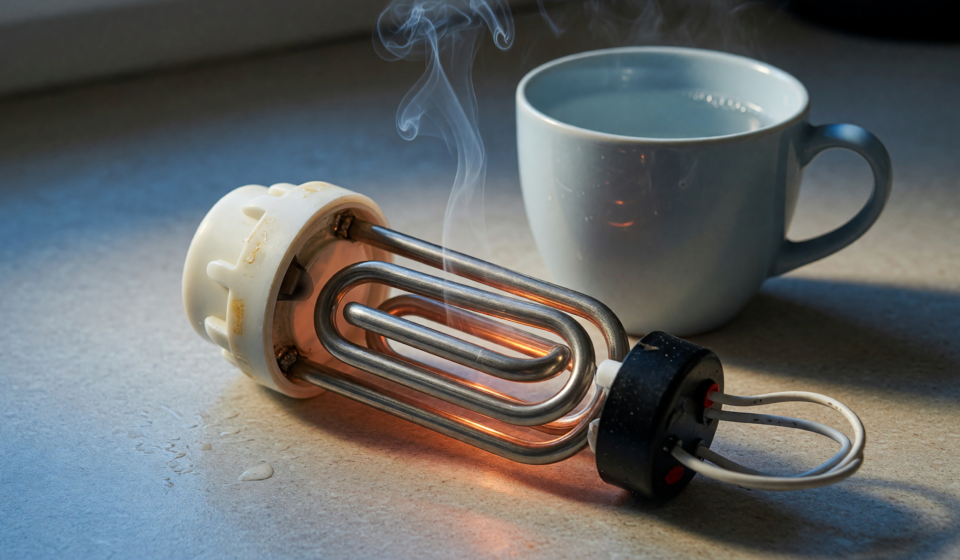
CPSC Invokes a Dormant Emergency Power to Halt Fire-Prone Immersion Water Heaters
On July 22, 2026, the U.S. Consumer Product Safety Commission did something it had not done in nearly four decades: it reached for its most forceful legal tool to pull a dangerous product off the market. Working through the Department of Justice, the agency filed an imminent hazard action against the makers and sellers of Lakkzoom immersion water heaters, and urged consumers to stop using them immediately. The move puts a spotlight on an immersion water heater fire hazard that regulators say has already sparked 235 reported fires — and it signals a more aggressive era of federal product-safety enforcement.
What happened
The CPSC announced that it had filed a complaint in federal court seeking to have certain Lakkzoom immersion water heaters — the small, plug-in metal coils people use to quickly heat a cup, bucket, or basin of water — declared “imminently hazardous” under Section 12 of the Consumer Product Safety Act. According to the agency, the heaters can ignite within minutes when they are partially or completely out of water, creating a serious risk of fire, severe injury, and death.
The numbers behind the action are striking. The CPSC says roughly 98,000 of the heaters were sold on Amazon.com and eBay.com between September 2022 and July 2026, and that it has received 235 reports of fires tied to the devices. Agency testing, according to the DOJ complaint, confirmed that the heaters can overheat and catch fire under realistic conditions of use. The heaters were manufactured by Cixi Miaojie Electrical Appliance Co. Ltd. and imported by Changsha Jiayi Tianzhuo Trading Co. Ltd., both based in China.
“Congress enacted Section 12 to ensure that the Commission could seek swift judicial relief when products present an imminent hazard,” said Acting Chairman Peter Feldman in the agency’s announcement. The government’s complaint asks the court for a declaration that the heaters are imminently hazardous, an injunction halting their sale and import, public and direct notification of the danger, and a mandatory recall with full refunds.
Why the immersion water heater fire hazard matters for safety
Immersion heaters are deceptively simple. You drop the coil into liquid, plug it in, and the element heats up fast. That speed is exactly what makes a failure so dangerous. If the element is energized while it is dry — because the water level drops, the coil is lifted out, or someone plugs it in before submerging it — there is nothing to carry the heat away. The temperature climbs in a matter of minutes, and nearby materials such as plastic, countertops, towels, or a tabletop can ignite. A well-designed heater guards against that scenario with thermal cutoffs and other protections; the CPSC’s action alleges these units do not reliably do so.
What sets this case apart from a routine recall is the legal machinery behind it. Section 12 is the CPSC’s emergency lever, reserved for products that pose an “imminent and unreasonable risk of death, serious illness, or severe personal injury.” The authority had lain dormant for almost 40 years — the last comparable use dates to the late 1980s — which tells you how seriously the agency views this particular hazard, and how unwilling it was to wait for a slower voluntary process.
Which heaters are affected
The CPSC’s warning describes the recalled Lakkzoom heaters in enough detail to help you check what is in your own home. Look for these features:
- Brand and models: Lakkzoom immersion water heaters marked 1500W, 2000W, HT1500W (also labeled MJ-R13), and HT2000W.
- Appearance: Metal tubes with circular or heart-shaped holes, capped with plastic endcaps in black, yellow, or pink.
- Where sold: Amazon.com and eBay.com, from September 2022 through July 2026.
- Quantity: About 98,000 units sold in the United States.
What you should do
The agency’s guidance here is unusually blunt. Because there is no repair kit or approved fix, the CPSC is telling owners to stop using the heaters and throw them away rather than pass them along or keep them in a drawer “just in case.”
What to do. Stop using any Lakkzoom immersion water heater immediately and dispose of it. Do not plug it in again, even briefly. Unplug it, let it cool, and discard it so it cannot be reused. Then report the product and any incident to the CPSC at SaferProducts.gov.
A few practical habits apply to any immersion or portable heating device, not just this brand. Never energize an immersion heater unless the element is fully submerged, and never leave one running unattended. Keep heaters away from flammable surfaces and materials, and unplug them the moment you are finished. If a heating product ever smells of burning plastic, discolors, or gets hot in places it should not, take it out of service. And if you are shopping for a replacement, favor devices that carry a recognized safety certification mark and that describe dry-run or overheat protection.
Context and what’s next
The Lakkzoom filing is being read by product-safety lawyers as a turning point. The CPSC has stood up a dedicated Section 12 task force and has signaled it will prioritize litigation and imminent hazard actions, particularly against firms unwilling to conduct a voluntary recall. That is notable given the broader backdrop: the Commission has been operating without a full quorum, yet still chose to dust off a rarely used emergency power. For importers and online sellers, the message is that the agency is prepared to go to court quickly when it believes lives are at risk.
For consumers, the near-term path runs through the federal court that is now weighing the government’s request. If the court agrees the heaters are imminently hazardous, it can order a mandatory recall with full refunds and require direct notice to buyers. In the meantime, the safest assumption is the simplest one: if you own one of these heaters, its useful life is over. Unplug it and throw it out.
Disclaimer: This article is for general safety information only and is not legal advice. Product details, model numbers, and remedies can change as the CPSC’s case proceeds. Always confirm the latest guidance directly with the CPSC before acting, and report any product-safety incident at SaferProducts.gov.
Sources: CPSC news release; CPSC consumer warning; Mondaq legal analysis of the Section 12 action.