Home Fire Extinguishers: The A-B-C Buyer’s Guide
In the first minute of a house fire, you have a chance. A small flame — a pan that flares up, a wastebasket that catches, an overloaded outlet that sparks — can often be knocked down with a few seconds of decisive action. But fire is merciless with time: it can roughly double in size every 30 seconds, and within a couple of minutes a manageable flame becomes an inferno that fills a room with deadly smoke. A fire extinguisher is the tool that lets you act in that narrow window — if you have the right one, it’s within reach, and you know how to use it.
The catch is that not all extinguishers fight all fires, and using the wrong one can make things dramatically worse — spraying water on a grease fire or an electrical fire can cause an explosion or electrocution. This guide decodes the letter classes and the numbers on the label, tells you exactly which extinguisher belongs in each room, where to mount them, and the simple PASS technique that turns panic into action.
The fire classes: what the letters mean
Fires are grouped into classes based on what’s burning, and extinguishers are labeled with the classes they can handle:
- Class A — ordinary combustibles: wood, paper, cloth, trash, most plastics. The everyday fire.
- Class B — flammable liquids and gases: gasoline, oil, grease, paint, propane.
- Class C — energized electrical equipment: wiring, outlets, appliances, panels. The “C” means the extinguishing agent is non-conductive and safe to use on live electricity.
- Class K — cooking oils and fats: the high-temperature grease fires of commercial kitchens (and increasingly recommended for serious home cooks).
- Class D — combustible metals: magnesium, titanium. Rare outside industrial settings.
For the home, the workhorse is a multipurpose ABC extinguisher, which handles the three fire types you’re most likely to face — ordinary materials, flammable liquids, and electrical. If you buy just one extinguisher, make it an ABC.
👉 Shop multipurpose ABC home fire extinguisher on Amazon (Ad — as an Amazon Associate, we earn from qualifying purchases.)
Reading the UL rating (the numbers)
Beyond the letters, extinguishers carry a UL rating like “3-A:40-B:C.” The numbers tell you the extinguishing capacity:
- The number before A indicates how much Class A firefighting capacity it has — each number roughly equals 1.25 gallons of water equivalent. A “3-A” has the equivalent of about 3.75 gallons.
- The number before B indicates the square footage of a flammable-liquid fire an average user can put out — a “40-B” is rated for about 40 square feet.
- C has no number — it simply confirms the agent is safe on electrical fires.
Bigger numbers mean more firefighting power — but also a heavier canister. The right size balances capacity against what each household member can actually lift and control (see below).
Which extinguisher for which room
The NFPA and fire departments recommend, at minimum, one extinguisher on every level of the home, plus targeted coverage in high-risk areas:
- Kitchen — the most common origin of home fires. Keep a Class K or a smaller ABC extinguisher near an exit route, not right next to the stove (you don’t want to reach through flames to grab it). For a small grease fire, remember the first move is often a lid to smother it — never water.
- Garage/workshop — flammable liquids and electrical tools make a full-size ABC essential.
- Bedrooms and living areas — a standard ABC per level, mounted near the door.
- Car — a small ABC extinguisher secured in the trunk is a smart addition.
A practical setup for most homes: a larger 2A:10-B:C or bigger unit for the garage and main level, and compact ABC units for the kitchen and upper floors.
Where and how to mount them
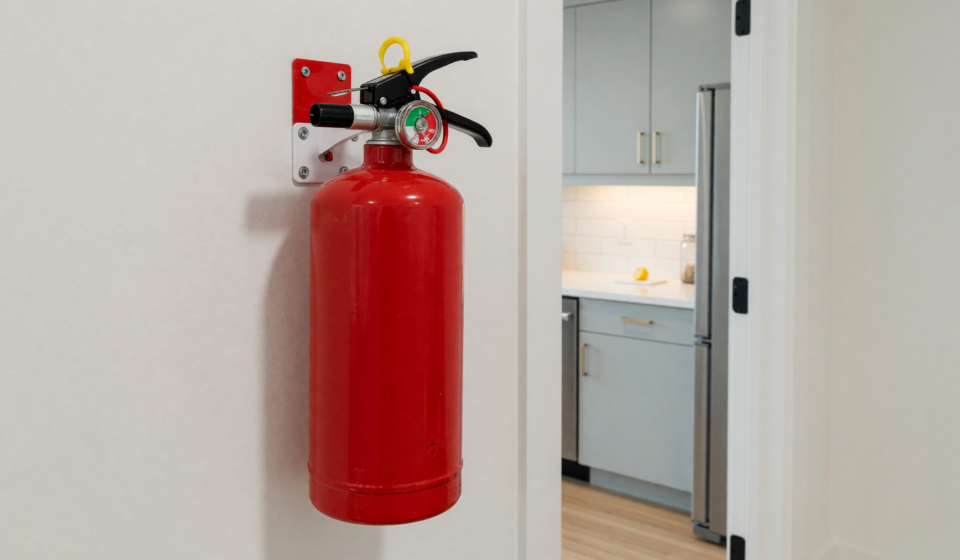
- Mount them visibly and within reach, using the bracket that comes with the unit — not loose on a shelf or buried in a closet where it slides behind boxes.
- Near exits, along escape routes. The goal is to fight the fire with your back to a way out, so you can retreat instantly if it grows.
- Off the floor (roughly 3.5 to 5 feet up) so it’s easy to grab and out of children’s reach.
- Everyone should know where they are. An extinguisher nobody can find in the dark is useless.
How to use one: remember PASS
In an emergency, adrenaline erases complex instructions. The industry-standard memory aid is PASS:
- P — Pull the safety pin, breaking the tamper seal.
- A — Aim the nozzle at the base of the fire, not the flames. You have to hit what’s actually burning.
- S — Squeeze the handle to release the agent.
- S — Sweep from side to side across the base until the fire is out, watching for re-ignition.
Know when to run instead. An extinguisher is for a small, contained fire in its early moments. If the fire is larger than a wastebasket, spreading, or between you and your exit — get out and call 911. Never let fighting a fire trap you. A typical home extinguisher discharges in just 10–20 seconds, so you get one attempt: if it isn’t working, leave immediately.
Maintenance and replacement
- Check the pressure gauge monthly — the needle should sit in the green. In the red, it won’t work.
- Give it a shake a couple of times a year if it’s a dry-chemical unit, so the powder doesn’t settle and cake at the bottom.
- Check for damage: dents, corrosion, a cracked hose, or a missing pin.
- Replace or recharge after any use — even a one-second burst partially depletes it and it won’t reseal.
- Mind the lifespan: disposable extinguishers generally last 10–12 years; check the manufacture date and replace expired units.
The bottom line
A fire extinguisher is a few seconds of control against a threat that grows by the second. Buy a multipurpose ABC for general use (with a Class K option for serious kitchens), put at least one on every level and in the garage, mount them near exits within easy reach, and teach everyone PASS. Check the gauge monthly, and know the hardest rule of all: if the fire is bigger than a wastebasket or blocking your way out, forget the extinguisher and get everyone outside. The right tool, in the right place, used in the right moment — that’s what turns a disaster back into a story you tell later.
Disclaimer: This article is for general educational purposes. Follow your extinguisher manufacturer’s instructions and local fire codes, and prioritize evacuation and calling 911 over fighting any fire that is not small and contained. Your local fire department can advise on the right equipment for your home.
Sources: National Fire Protection Association (NFPA 10, Standard for Portable Fire Extinguishers); U.S. Fire Administration home fire extinguisher guidance; UL fire extinguisher rating classifications.