Track Day Heat Management: Fireproof Layers, Hydration and Cool Suits
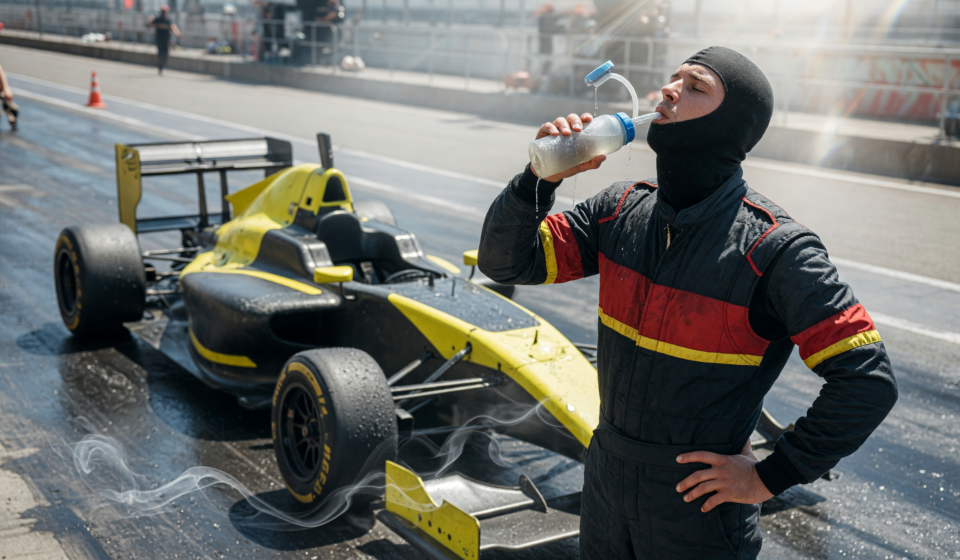
By lap three of a mid-August session, the cockpit of a closed car can feel like a sealed oven. Sun beats through the glass, the transmission tunnel radiates engine heat up through the seat, and a multi-layer fire suit traps every bit of it against your skin. Your heart rate climbs, your focus narrows, and the smooth, precise inputs you had in the morning start to get sloppy. Heat is not just uncomfortable on a track day; it quietly erodes the judgment and reaction time that keep you and everyone else on the circuit safe.
This guide walks through track day heat management from the skin outward. We will cover why fireproof layers like SFI-rated suits and Nomex underwear matter and how they interact with cooling, the role of smart hydration before and during a session, how cool suits and driver cooling systems actually work, and the warning signs of heat illness you should never ignore. The goal is simple: help you stay both protected from fire and protected from the heat that fire gear can trap.
Why track day heat is a safety problem, not just a comfort problem
Racing is physical work performed inside insulating gear, often in a hot, poorly ventilated cockpit. When your body cannot shed heat as fast as it produces it, your core temperature rises. According to the CDC and its National Institute for Occupational Safety and Health (NIOSH), that progression runs from heat cramps to heat exhaustion to heat stroke, a life-threatening emergency in which the body loses the ability to regulate its own temperature. Long before that point, though, elevated core temperature degrades concentration and coordination, which is exactly what you cannot afford at speed.
The takeaway is that heat management belongs in the same category as your helmet and harness. It is not a luxury for comfort; it is a factor in whether you drive well and finish the day safely.
Fireproof layers: understanding SFI and TPP ratings
In US motorsport, driver suits are commonly certified to the SFI Foundation’s Spec 3.2A. That specification rates a suit by its Thermal Protective Performance (TPP), a laboratory measure of how long the material resists a second-degree burn in a simulated gasoline fire. Racers usually shorten the label, so an “SFI-5” suit means SFI 3.2A/5. Higher numbers mean more protection time, generally achieved by adding layers.
- SFI 3.2A/1: An entry-level rating, typically a single-layer suit with a minimum TPP of 6, roughly three seconds of protection before a second-degree burn.
- SFI 3.2A/5: A common multi-layer club-racing rating with a minimum TPP of 19, in the range of about nine to ten seconds.
- SFI 3.2A/15 and /20: Higher-protection suits with minimum TPP values of 60 and 80, offering substantially longer burn resistance for professional and endurance use.
- The trade-off: More layers usually mean more thermal insulation, which also traps more of your own body heat, so the safest fire suit can be the hottest to wear.
Always check what your specific event or sanctioning body requires. Many track day and wheel-to-wheel organizations set a minimum SFI rating, and a suit’s certification only counts if it is current, undamaged, and worn as designed.
👉 Shop SFI 3.2A/5 multi-layer driving suit on Amazon (Ad — as an Amazon Associate, we earn from qualifying purchases.)
Base layers and Nomex: protection that also manages moisture
Fire-resistant underwear is one of the most overlooked pieces of the system. Nomex, an inherently flame-resistant meta-aramid fiber, is the industry standard for base layers, balaclavas, socks, and gloves. In many racing rulebooks, fire-resistant underwear is either required or strongly recommended because it adds burn-protection time and, critically, keeps a synthetic layer that could melt against your skin out of the equation.
Modern fire-resistant base layers are also engineered to move moisture away from the skin. That matters for heat because sweat that sits against your body cannot cool you efficiently. A good base layer wicks perspiration outward so evaporation can do its job, while still contributing to your overall fire rating.
- Cover the gaps: A balaclava, fire-resistant socks, and gloves protect the wrists, ankles, and neck where suits often leave skin exposed.
- Fit matters: Base layers should sit close but not compress; trapped air between layers is part of how the system slows heat transfer in a fire.
- Keep it clean: Oil, fuel, and heavy soiling can compromise flame resistance, so follow the manufacturer’s care instructions.
👉 Shop Nomex fire-resistant base layer set on Amazon (Ad — as an Amazon Associate, we earn from qualifying purchases.)
Hydration: the work starts before you buckle in
You cannot fix dehydration once a session is underway, so hydration is a pre-event discipline. General public-health guidance from the CDC and NIOSH for people working in the heat is to drink regularly rather than waiting until you feel thirsty, since thirst lags behind actual fluid loss. For sustained sweating, plain water alone may not be enough, and beverages that replace electrolytes and carbohydrates help maintain the balance your body needs.
- Start early: Arrive already hydrated. Chugging a bottle right before you strap in does not undo a morning of coffee and no water.
- Replace electrolytes: Heavy sweating loses salt as well as water; an electrolyte or sports drink can help during long, hot days.
- Watch your urine: Pale-yellow output is a simple, practical cue that you are keeping up; dark and infrequent is a warning.
- Drink between sessions: Use the downtime in the paddock to rehydrate deliberately, not just to talk about your laps.
An in-car hydration system with a bite valve lets you sip on straights and during cooldown laps, which is far better than trying to make up a large deficit all at once after you climb out.
👉 Shop in-car driver hydration system with bite valve on Amazon (Ad — as an Amazon Associate, we earn from qualifying purchases.)
Cool suits and driver cooling systems: how they work
A cool suit is a shirt or vest with a network of small tubes sewn into it. A pump circulates chilled liquid, usually water from an insulated reservoir packed with ice, through those tubes and against your torso. Because so much blood flow passes near the skin of the chest and back, cooling that area helps carry heat away from your core. Research groups, including a recent Michigan State University project studying cooling technology for Formula 1 drivers, continue to investigate how best to keep drivers’ core temperatures in check, a sign of how seriously the problem is taken at the top of the sport.
- Ice-reservoir cool suits: The most common approach; effective but limited by how long the ice lasts and how much space the cooler takes.
- Thermoelectric or refrigerated units: Use a powered chiller instead of ice, trading weight and power draw for longer, more consistent cooling.
- Forced-air helmet and cockpit blowers: Push ambient or filtered air to the head and face; helpful for airflow but they do not cool below ambient temperature the way a chilled-liquid suit can.
Wear the cool shirt as a mid-layer over your fire-resistant base and under your suit, following the manufacturer’s guidance. Remember that the system is a supplement to good hydration and pacing, not a substitute for them.
👉 Shop driver cool suit shirt and pump/cooler kit on Amazon (Ad — as an Amazon Associate, we earn from qualifying purchases.)
Cockpit airflow and small changes that add up
Not every fix requires a pump and a cooler. A surprising amount of cockpit heat can be managed with airflow and preparation, and these changes help whether or not you run a cool suit.
- Add ventilation: NACA ducts, window vents, or a helmet air hose can move fresh air to where you need it most.
- Shade the car: Parking in shade or using a windshield reflector between sessions keeps the cabin from soaking up heat while you wait.
- Pre-cool yourself: Getting out of the sun and lowering your body temperature before you belt in buys you time on track.
- Insulate hot spots: Heat shielding on the transmission tunnel and floor reduces radiant heat coming up into the cockpit.
Reading the warning signs of heat illness
Knowing when to stop is a safety skill. Per CDC and NIOSH guidance, heat exhaustion can show up as headache, nausea, dizziness, weakness, irritability, heavy sweating, and elevated body temperature. Heat stroke is a medical emergency and may include confusion, slurred speech, loss of consciousness, and either hot, dry skin or heavy sweating. If you or a fellow driver show signs of heat stroke, treat it as an emergency and seek medical help immediately.
Know your limit. If you feel dizzy, confused, or notice your inputs getting ragged, come in. A cooldown lap and a shortened session are always better than a heat-impaired mistake at speed. No lap time is worth pushing through heat stroke.
Basic first aid, again following CDC and NIOSH guidance, is to move the person to a cooler area, help them cool down, and give cool fluids to sip. When in doubt, err toward caution and involve event medical staff.
The Bottom Line
Managing heat on a track day is a layered problem with a layered solution. Start with certified fireproof gear that meets your event’s requirements, add fire-resistant base layers that also move moisture, and back that up with disciplined hydration that begins before you arrive. When conditions get brutal, a cool suit and better cockpit airflow can keep your core temperature and your judgment where they belong. Most important, learn the warning signs of heat illness and respect them. The fastest, safest driver at the end of a hot day is usually the one who managed heat as deliberately as they managed the racing line.
Disclaimer: This article is for general educational purposes only and is not medical or safety-certification advice. Product ratings, event requirements, and standards change over time; always confirm current SFI or sanctioning-body requirements for your specific event and follow manufacturer instructions. If you experience symptoms of heat illness, seek qualified medical help.
Sources: SFI Foundation (Specification 3.2A driver suit ratings and Thermal Protective Performance); ProFox Racing (SFI 3.2A rating and TPP explanation); U.S. Centers for Disease Control and Prevention / National Institute for Occupational Safety and Health (NIOSH) heat-related illness signs, prevention, and first aid; Michigan State University (MSUToday) research on driver cooling technology.