Gravel Riding Safety: Eye Protection, Tire Setup and Remote-Route Kit
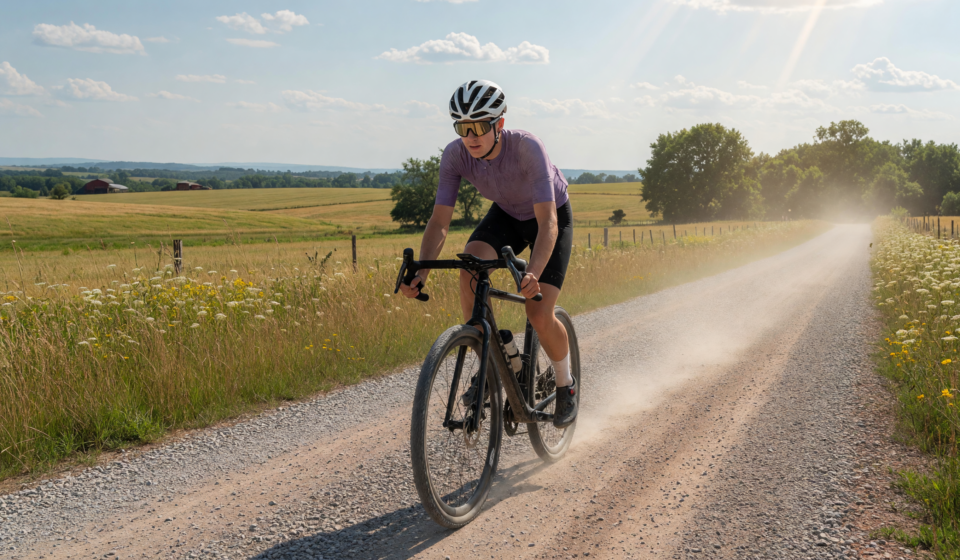
You are twelve miles into a dry forest-service road, the sun is low, and a truck ahead kicks up a rooster tail of grit that hangs in the air like fog. A pea-sized stone pings off your shoulder, then another taps your cheekbone a half-inch from your eye. Out here, there is no shoulder to pull onto, no bike shop around the bend, and often no cell signal at all. That mix of remoteness, loose surfaces, and flying debris is exactly why gravel riding safety deserves its own playbook rather than a hand-me-down checklist borrowed from road cycling.
This guide walks through the three areas where gravel punishes the unprepared: eye protection that can actually take a hit, tire setup that treats your contact patch as safety equipment, and the remote-route kit you carry for the moment things go sideways far from help. Along the way we lean on real US standards and agencies—the ANSI/ISEA Z87.1 eyewear standard, the Consumer Product Safety Commission (CPSC) helmet rule, and guidance from the National Weather Service and CDC—so you know why each recommendation exists, not just that someone said so.
Why Eye Protection Comes First on Gravel
On pavement, sunglasses are mostly about glare and comfort. On gravel, your lenses are a physical barrier between fast-moving debris and one of the few parts of your body you cannot armor with padding. Rocks flung by your own front tire, by riders ahead, and by passing vehicles travel with real energy, and a single strike to an unprotected eye can end far more than a ride. Good gravel riding safety starts by treating eyewear as protective gear rather than a fashion accessory.
The relevant US benchmark is ANSI/ISEA Z87.1, the eye and face protection standard published by the International Safety Equipment Association and approved by the American National Standards Institute. It is the same standard that governs safety glasses on job sites, and it defines how eyewear must perform when something hits it. Cycling-specific glasses are not always tested to it, so it pays to look for the markings rather than assume.
- Z87 vs. Z87+: A plain “Z87” mark indicates the basic impact level, while “Z87+” denotes the high-impact rating, which involves a more demanding high-velocity projectile test. For gravel, high-impact is the tier worth seeking.
- Coverage matters: Wraparound frames and larger lenses shield the sides and lower orbit, where roost tends to sneak in past narrow road-style shades.
- UV protection: Long, exposed backcountry miles mean serious sun exposure. Look for lenses rated to block UVA and UVB, marked with the standard’s “U” scale where available.
Reading Lenses: Tints, Clarity, and Changing Light
Impact rating is the floor, not the whole story. Gravel routes routinely plunge from open, blinding fields into dense tree cover, and a lens that is perfect in bright sun can leave you half-blind in the shade, hiding the very ruts and rocks you need to read. Because you cannot always stop to swap lenses on a technical descent, adaptability is a safety feature.
- Photochromic lenses: These darken and lighten automatically as light changes, which suits the sun-to-shade whiplash of forest gravel better than a single fixed tint.
- Contrast-enhancing tints: Rose, amber, and similar tints can sharpen the definition of terrain features in flat, overcast light, helping you spot hazards earlier.
- Clear or low-light lenses: For dawn starts, dusk finishes, or heavy canopy, a clear high-impact lens keeps protection on your face when a dark tint would be dangerous.
- Fit and retention: Grippy nose pads and temple tips keep glasses put over washboard, so they do not bounce down your nose at the worst moment.
👉 Shop impact-rated photochromic cycling glasses on Amazon (Ad — as an Amazon Associate, we earn from qualifying purchases.)
Tire Setup Is Safety Equipment, Not Just Speed
Nothing changes your odds on gravel more than the two patches of rubber touching the ground. The right setup controls grip, absorbs impacts that would otherwise pitch you off line, and dramatically lowers your chance of a stranding flat. Riders often frame tires as a performance choice, but on a remote route the difference between a self-sealing puncture and a walk-out is very much a safety choice.
This is why most experienced gravel riders run a tubeless setup. Without an inner tube, the tire relies on liquid sealant to plug small punctures automatically, and it can be run at lower pressures without the pinch-flat risk that haunts tubes. Lower pressure means a larger contact patch, more grip on loose surfaces, and a smoother ride that keeps the wheel tracking instead of skittering.
- Sealant, fresh and sufficient: Sealant dries out over time, so check and refresh it on a schedule; a tire with evaporated sealant is effectively a very heavy tube waiting to fail.
- Pressure, tuned to you: Start from the tire maker’s recommended range for your tire width and adjust for your weight and terrain—lower for grip and comfort on rough ground, higher to guard against rim strikes on rocky, fast sections.
- Casing and tread for the route: Wider, more protective casings and knurled or knobby tread shrug off sharp rock better than thin, fast-rolling road-leaning tires.
- Seat it properly: A tire that is not fully seated on the bead can burp air or roll under hard cornering, so confirm the bead is even all the way around before you ride.
Field-repair reality. Sealant handles the small stuff, but gravel serves up gashes it cannot close. Carry tubeless plugs, a spare tube, tire levers, and a pump or inflator—and know how to use them—because a repair kit in your bag does nothing if you have never practiced it in your driveway.
👉 Shop tubeless tire repair kit with plugs and inflator on Amazon (Ad — as an Amazon Associate, we earn from qualifying purchases.)
The Helmet Non-Negotiable: CPSC 16 CFR Part 1203
Eyewear and tires get the attention, but the helmet is the one item with the force of federal law behind it. In the United States, bicycle helmets sold to consumers must comply with the CPSC safety standard codified at 16 CFR Part 1203. A helmet that fails those requirements violates the Consumer Product Safety Act, so a compliant helmet is the baseline, not the upgrade.
The standard tests real-world failure modes: impact attenuation, where the peak acceleration transmitted in the test cannot exceed 300 g; a strap-retention test; positional stability so the helmet stays put in a fall; and a peripheral-vision requirement so it does not blind you to your sides. Every compliant helmet carries a certification label stating it meets the CPSC standard.
- Check the label: Look for the sticker certifying compliance with the CPSC bicycle helmet standard before you buy or borrow.
- Fit is protection: Level on your head, snug but comfortable, with the strap junction just below your ears and only a finger’s width under the chin.
- Retire after impact: Foam crushes once to absorb energy; replace any helmet that has taken a real hit, even if it looks intact.
- Consider added protection: Many modern helmets include rotational-impact systems, an extra worth weighing for the higher-speed potential of gravel descents.
👉 Shop CPSC-certified gravel cycling helmet on Amazon (Ad — as an Amazon Associate, we earn from qualifying purchases.)
The Remote-Route Kit: When Help Is Hours Away
The defining feature of great gravel is also its biggest hazard: you are often genuinely out there, beyond cell coverage and far from the nearest road a car can reach. A mechanical or a crash that would be a minor inconvenience in town becomes a survival problem when nobody knows where you are and your phone shows no bars. The remote-route kit exists to shrink that gap between trouble and help.
At the center of it is a satellite communicator. Devices like personal satellite messengers connect to orbiting networks rather than cell towers, letting you send two-way texts and trigger an SOS from places with no signal at all. When you press SOS, the alert routes to a professional emergency coordination center that works with local search-and-rescue to get help moving—something a dead cell phone simply cannot do.
- Two-way messaging: Being able to text “flat tire, running two hours late” prevents a worried contact from launching an unnecessary rescue—and lets you describe a real emergency.
- Share your plan: Leave a route and expected return time with someone at home, and set a check-in deadline so a missed message actually triggers a response.
- First aid you can use: A compact kit that handles road rash, deep cuts, and a sprain buys time; pack it for the injuries gravel actually produces.
- Power and navigation: A charged GPS or phone with offline maps plus a battery pack keeps you oriented when there are no signs and no signal.
👉 Shop handheld satellite communicator with SOS on Amazon (Ad — as an Amazon Associate, we earn from qualifying purchases.)
Be Seen: Lights, Reflectivity, and Road Sections
Most gravel routes stitch together dirt with stretches of paved road, and those transitions are where riders and drivers meet. Dust, low sun angles, and tree shadow all conspire to make a cyclist hard to spot, so conspicuity is a core part of gravel riding safety even when the day started in bright sun. The National Highway Traffic Safety Administration consistently urges cyclists to make themselves visible with lights and bright or reflective gear.
- Run lights in daylight: A blinking rear light and a front light help drivers pick you out against a busy, dusty background, not just after dark.
- Wear high-contrast colors: Bright, saturated clothing stands out against dirt and foliage far better than earth tones.
- Add reflectivity for low light: Reflective ankle bands and accents catch headlights on dawn, dusk, and canopy sections where timing can slip late.
- Know local rules: Many states legally require lights or reflectors for riding at night, so check the law where you ride.
Plan for Weather, Heat, and Water
Remote routes expose you to conditions with no easy bailout. A thunderstorm that would send a commuter indoors can strand you miles from shelter, and summer heat compounds fast when you are working hard with limited water. The National Weather Service and the CDC both stress planning ahead for heat and storms rather than reacting once you are in trouble.
- Check the forecast and the sky: Review the NWS forecast for your route window, and treat lightning as a hard stop—seek lower ground and shelter, not the high, exposed ridge.
- Carry more water than you think: Backcountry water sources are unreliable, and the CDC warns that heat illness climbs when you fall behind on fluids during exertion.
- Dress for the return, not the start: A packable shell and layers cover the temperature swing between a warm midday and a cold, shaded evening finish.
- Fuel steadily: Bonking far from help is a safety issue, not just a comfort one; carry more food than a comparable road ride.
The Bottom Line
Gravel rewards self-reliance, and that is exactly what makes preparation matter. Protect your eyes with high-impact eyewear built to the ANSI/ISEA Z87.1 standard, treat your tubeless tire setup as the safety system it truly is, wear a helmet that meets the CPSC standard, and carry a remote-route kit—anchored by a satellite communicator—that assumes help will not be close. None of it slows you down once it becomes routine, and every piece is there for the ride that does not go to plan. Set your bike and your kit up deliberately now, and you free yourself to enjoy the wide-open, off-the-grid riding that drew you to gravel in the first place.
Disclaimer: This article is for general educational purposes only and is not professional safety, medical, or legal advice. Standards, product ratings, and local laws change and vary by location; always follow the manufacturer’s instructions for your specific gear, verify current requirements for your area, and consult a qualified professional for guidance about your own situation.
Sources: International Safety Equipment Association / American National Standards Institute (ANSI/ISEA Z87.1 eye and face protection standard); U.S. Consumer Product Safety Commission (CPSC bicycle helmet standard, 16 CFR Part 1203); U.S. National Highway Traffic Safety Administration (NHTSA bicycle safety guidance); National Weather Service (NWS lightning and severe weather safety); U.S. Centers for Disease Control and Prevention (CDC heat and hydration guidance).