DUMOS Nine-Drawer Dressers Recalled Over Deadly Tip-Over Hazard
WASHINGTON — On August 13, 2026, the U.S. Consumer Product Safety Commission (CPSC) announced a dresser tip-over recall covering about 8,981 DUMOS nine-drawer fabric dressers sold on Amazon, warning that the units can tip over and trap or crush a child. The dressers fail the federal stability standard for clothing storage units and, like a growing list of low-cost dressers pulled this summer, are being recalled before anyone is hurt rather than after. If you bought one, the CPSC’s message is simple: stop using it now and keep it away from children.
What happened
The recall involves DUMOS nine-drawer fabric dressers, marketed as television stands, in white, black, gray, and brown. Each unit measures roughly 13.4 inches wide, 47 inches long, and 31.3 inches tall, weighs about 31.5 pounds, and includes LED lights along with built-in power outlets and charging ports on an attached cable. The recalled models carry the SKUs WMEDX-FC-TVK9CDC-RT, -GY, -BK, and -WT. They sold for about $54 on Amazon.com between December 2025 and June 2026.
According to the CPSC notice, the dressers are unstable when they are not anchored to a wall and can tip over, posing tip-over and entrapment hazards that can cause serious injury or death to children. The agency says the units violate the mandatory federal safety standard for clothing storage units enacted under the STURDY Act. The importer is Aosai Technology Ltd., doing business as DUMOS, of China, and the dressers were manufactured by Jiangsu Jiayubo Furniture Co., Ltd., also of China. No injuries or incidents had been reported at the time of the recall.
Why a dresser tip-over recall matters for safety
Furniture tip-overs are one of the most persistent hidden hazards in American homes, and they fall hardest on the youngest children. The CPSC estimates that dressers and clothing storage units tipping over cause an average of about 5,300 injuries every year, and the agency has said that roughly every 24 minutes a child in the United States is treated in an emergency room for a tip-over incident involving furniture or a television. In its review of clothing storage units, the CPSC documented 234 tip-over fatalities between January 2000 and April 2022, of which 199 were children.
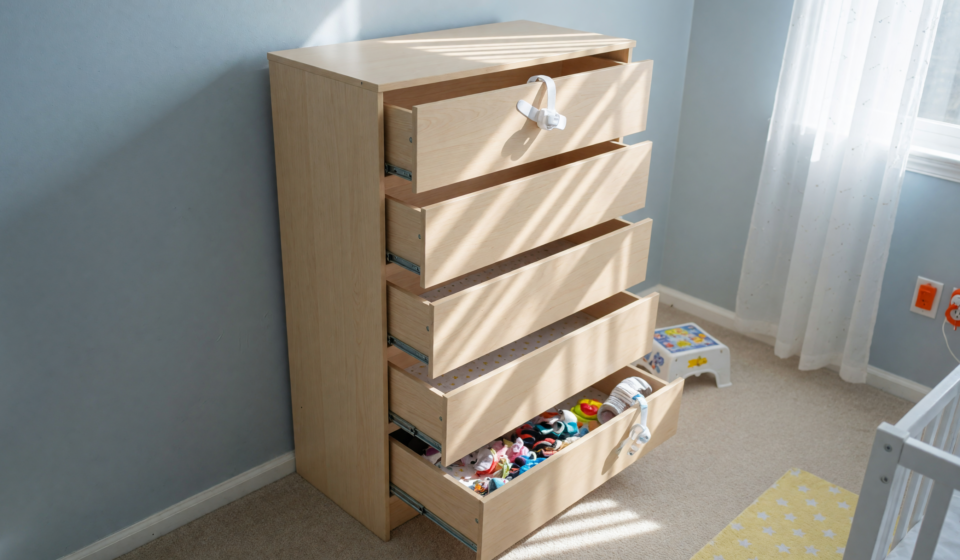
The mechanism is grimly predictable. A toddler opens a drawer, uses it as a step, or reaches for something on top, and the shift in weight is enough to bring the whole piece down. Tall, lightweight, or narrow dressers are especially prone to it, and an unanchored unit gives a small child almost no margin for error. That is why the CPSC treats an unstable dresser as a serious hazard even when, as here, no one has yet been hurt — the point of the standard is to prevent the first tragedy, not respond to it.
What you should do
If you own one of the recalled DUMOS dressers, take these steps:
- Stop using it immediately: Move the dresser to a location where children cannot reach it until you complete the recall process.
- Confirm the model: Check for the SKUs WMEDX-FC-TVK9CDC-RT, -GY, -BK, or -WT, and note the nine-drawer television-stand design with LED lights and built-in outlets.
- Claim your refund: The remedy is a full refund. The CPSC notice instructs owners to render the dresser unusable by cutting the drawers in half, writing “RECALLED” on it in permanent marker, photographing the destruction, and emailing the images to the importer to receive the refund before disposal.
- Do not resell or donate it: Passing a recalled dresser to someone else simply moves the hazard to another family.
What to do with any dresser. Anchor it. The CPSC’s long-running “Anchor It!” campaign urges families to secure dressers, bookcases, and televisions to the wall with anti-tip brackets or straps, and to place heavier items in lower drawers. Anchoring costs a few dollars and takes minutes, and it protects children regardless of whether a particular piece of furniture has been recalled.
Context and what’s next
The DUMOS recall is not an isolated event. It landed in the same mid-August batch of CPSC actions as a separate recall of Fitueyes Laziza dressers sold on Wayfair, also for failing the clothing storage unit standard, and it follows a steady run of tip-over recalls aimed at inexpensive, imported dressers sold through large online marketplaces. Together they show federal regulators actively enforcing the stability rule against products that reach American homes through e-commerce.
That rule exists because of years of advocacy. The STURDY Act — short for Stop Tip-overs of Unstable, Risky Dressers on Youth — was the legislative push behind a mandatory federal stability standard for clothing storage units, a requirement that manufacturers had long resisted in favor of voluntary guidelines. The recalls now citing that standard are, in effect, the standard doing its job: dressers that cannot pass a real-world stability test are being identified and pulled from the market.
For consumers, the practical takeaway extends well beyond one brand. When shopping for a dresser, look for products that meet the current clothing storage unit stability standard and that ship with a wall-anchoring kit — and then actually install it. Registering furniture with the manufacturer where possible also means you are more likely to be notified directly if a recall is issued. The safest dresser is one that is both built to the standard and bolted to the wall.
Disclaimer. This article is for general safety information only and is not legal, medical, or professional advice. Product details, unit counts, and remedy instructions are drawn from the CPSC recall notice as published and may be updated by the agency or the company; always confirm the current recall terms and eligibility directly with the CPSC and the manufacturer before acting.
Sources: CPSC: DUMOS Nine-Drawer Dressers Recall; CPSC: Fitueyes Laziza Dressers Recall; Good Morning America: CPSC federal furniture safety standard; CPSC Recalls & Product Safety Warnings.