Bouldering Crash Pads: Placement, Spotting and Landing Zones
Every boulderer remembers the fall that taught them respect. You top out a move, your foot skates, and for a split second you are simply cargo in the air. What happens next is decided long before you leave the ground: by where the pads sit, how your spotter reads your body, and whether you land like a paratrooper or a folding chair. Good bouldering crash pads do not make you invincible, but they turn a potential ankle-shattering event into a story you laugh about later. The pad is the last line of defense in a sport with no rope, no harness, and no second chances on a bad landing.
This guide walks through the whole landing system in plain English: what is actually inside a crash pad and why the foam layers matter, how to read a fall zone before you pull on, how to arrange pads to eliminate gaps, how to spot a partner without getting hurt yourself, and how to fall in a way that spreads impact instead of concentrating it. We will lean on guidance from US groups like the Climbing Wall Association (CWA) and USA Climbing, and on how manufacturers engineer foam, so you understand the why behind each habit, not just the rule.
What Is Actually Inside a Crash Pad
A crash pad is not just a mattress. Most quality pads use a deliberate sandwich of two very different foams, and understanding the pairing tells you why a pad protects you and when it will not. Each foam does a job the other cannot.
- Closed-cell foam (the top layer): A firm, dense layer with sealed cells that barely compress. Its job is to spread your impact across a wide area so a heel or hip does not punch straight through to the ground.
- Open-cell foam (the base layer): A softer, spongier layer that collapses on impact and releases air, absorbing the energy the firm top layer just distributed. It is what makes the landing feel cushioned rather than like hitting plywood.
- Why the order matters: Flip a pad so the soft foam is up and you will “bottom out,” compressing the sponge fully and slamming the hard ground beneath. Firm-over-soft is the design, not an accident.
- Thickness and layering: Thicker pads and three-layer builds (firm-soft-firm) handle bigger falls, which is why highball and outdoor pads run deeper than a thin gym add-on.
The outer shell matters too. A tough fabric bottom resists abrasion on rock and dirt, while the fold design, hinged or taco style, changes how flat the pad lies. Hinged pads fold cleanly but leave a seam; taco pads have no seam but fight you when they are new.
👉 Shop full-size layered bouldering crash pad on Amazon (Ad — as an Amazon Associate, we earn from qualifying purchases.)
Reading the Fall Zone Before You Pull On
The most important pad placement happens in your head, before anyone climbs. Walk the problem and picture where your body actually goes if you blow each move, not just where you hope to stick. Falls are rarely straight down; you swing, you pitch backward off a lip, you get spat sideways off a dyno.
- Map the crux, not the start: Identify the moves most likely to eject you and where momentum will throw you when they do.
- Account for direction: An overhang tends to drop you feet-first and backward; a slab can slide you down the wall. Place pads for the fall you will take, not the fall you want.
- Find the hazards: Outdoors, note rocks, roots, tree stumps, and sloping or uneven ground inside the fall zone. These are what break ankles, and they hide under fallen leaves.
- Think about the edges: Landing on the seam between pad and dirt, or on a folded corner, rolls ankles as surely as bare ground does.
Placing Your Bouldering Crash Pads to Cover the Landing Zone
Once you know where you will land, the goal is a continuous, gap-free surface under every likely fall. One pad rarely covers a real outdoor problem, and the seams between pads are the enemy. A foot that drops between two pads, or into the hinge of one, is a classic mechanism for a sprain or worse.
- Overlap, do not abut: Lay pad edges over one another rather than butting them together, so there is no channel for a heel to punch through.
- Cover the hinges: Position a smaller pad over the fold line or seam of a larger one, which is exactly where the foam is thinnest and weakest.
- Prioritize the primary impact point: Put your thickest, best pad directly under the crux fall and use lesser pads to extend the zone outward.
- Level the surface: On sloping ground, stuff the low side or stack pads so the landing surface sits as flat as possible.
- Reset between attempts: Pads creep and bunch as people fall on them. Nudge them back into place before every serious go.
👉 Shop slider or secondary gap-filler crash pad on Amazon (Ad — as an Amazon Associate, we earn from qualifying purchases.)
Spotting: The Human Half of the System
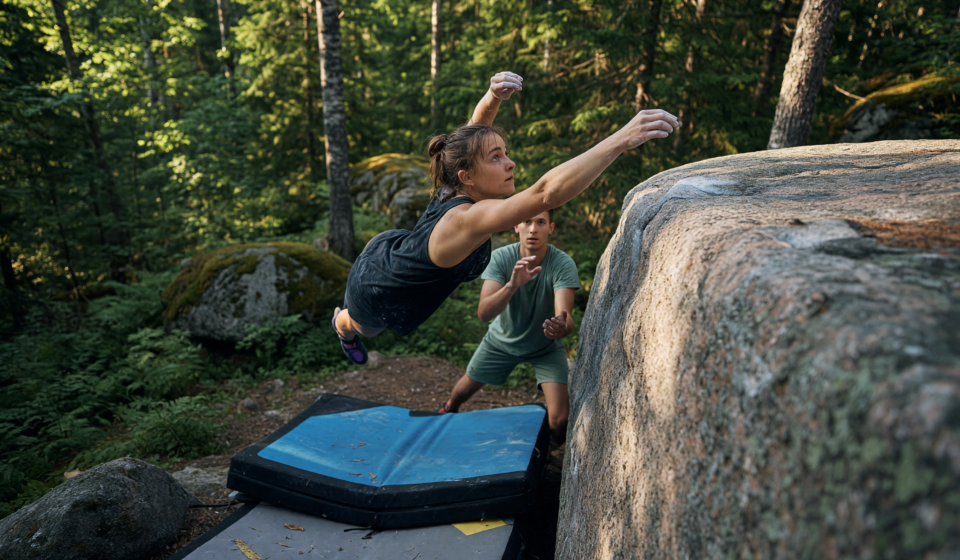
A spotter’s job is widely misunderstood. You are not there to catch a falling climber like a sack of potatoes, that is how spotters break wrists and climbers land on their heads anyway. Your real job is to protect the head, neck, and spine and to steer the falling body onto the middle of the pad.
- Hands ready, thumbs tucked: Keep hands up near the climber’s hips or core with fingers together and thumbs tucked in. Splayed thumbs get jammed and broken.
- Guide, do not grab: Aim to redirect the climber’s momentum toward the center of the pad and keep them upright, not to arrest the fall entirely.
- Protect the head first: Your one non-negotiable job is keeping the climber’s head and spine from hitting rock, ground, or a pad edge.
- Stance and focus: Stand in an athletic, offset position with soft knees, eyes on the climber, phone away. A distracted spotter is worse than none.
- Talk first: Agree on the plan before the climb. A simple “Climbing” and “Spot on” confirms everyone is ready.
Reality check. A pad and a spotter are risk-reduction tools, not guarantees. Serious injuries happen even with perfect setups. Treat every fall as real, climb within your control, and never let good gear talk you into a highball you would not otherwise attempt.
Falling Well: Technique That Protects You
Even the best pad only helps if you meet it correctly. How you land often matters more than what you land on, and falling is a skill you can practice deliberately from low heights until it becomes reflex.
- Bend and absorb: Land on both feet with knees soft and let them flex to soak up the impact. Stiff legs send force straight into your joints and spine.
- Roll it out: For bigger falls, continue the motion into a backward roll to spread the energy across your body instead of stopping it dead.
- Protect your wrists: Resist the instinct to slap a straight arm down behind you. Wrists and elbows are fragile; tuck them in.
- Stay loose: A tense body transmits impact; a relaxed one dissipates it. Avoid trying to fight or reverse a fall once it starts.
- Do not down-climb into danger: If you are pumped, controlled falling onto a good pad is often safer than a desperate, uncontrolled slip.
Indoors vs. Outdoors: Same Physics, Different Rules
Modern bouldering gyms build the landing into the facility, with thick, wall-to-wall floor padding engineered for repeated falls. In the US, the Climbing Wall Association publishes industry standards and operational guidance that many gyms follow, and USA Climbing sets rules for sanctioned competition. That built-in flooring changes your job, but it does not remove it.
- Indoors, watch other people: The floor is covered, so the real hazard is landing on, or being landed on by, another climber. Look before you drop and never sit or walk under someone climbing.
- Indoors, fall clean: Padding is uniform, so the same bent-knee, rolling technique still applies. Uncontrolled backward falls onto your head hurt on any surface.
- Outdoors, you are the safety system: There is no facility, no staff, and no engineered floor. Every pad, spotter, and decision is on you and your crew.
- Outdoors, conditions shift: Wet rock, cold foam, and hidden ground hazards all raise the stakes in ways an indoor session never will.
Care, Inspection, and When to Retire a Pad
Foam does not last forever. Every landing compresses it a little, and a pad that has “packed out” quietly loses the shock absorption you are counting on. Because the failure is invisible from the outside, inspection has to be deliberate.
- Press-test the foam: If the pad feels flat, hard, or bottoms out easily under your knee, its protective life is fading.
- Check the shell and hinges: Blown seams, failed buckles, or a floppy hinge all compromise how the pad performs when it matters.
- Store it dry and flat: Persistent moisture breaks down foam and grows mold. Let a wet pad dry fully before folding it away.
- Retire honestly: A pad that no longer protects is not a bargain. When the foam is spent, replace it rather than trusting your ankles to memory of how it used to feel.
👉 Shop highball or three-layer crash pad for outdoor bouldering on Amazon (Ad — as an Amazon Associate, we earn from qualifying purchases.)
The Bottom Line
Bouldering strips climbing down to its essentials, which is exactly why the landing deserves as much attention as the moves. A crash pad works because of engineered foam layers, but it only works if you place it under the fall you will actually take, close the gaps, spot to protect the head and spine, and land with soft, absorbing knees. None of it is complicated, and none of it is optional. Treat the pad as one part of a system that includes your eyes, your spotter, and your falling technique, and inspect your gear honestly before you trust your ankles to it. Do that consistently, and the fall that could have ended your season becomes just another attempt on the way to the send.
Disclaimer: This article is for general educational purposes only and is not professional safety, medical, or instructional advice. Bouldering carries an inherent risk of serious injury or death even with crash pads and spotters. Seek qualified instruction, follow manufacturer guidance and facility rules, and use your own judgment before climbing.
Sources: Climbing Wall Association (CWA) industry standards and guidance; USA Climbing competition rules; Alpkit foam construction guide (open-cell vs. closed-cell); Climbing magazine and Rock Climbing Realms bouldering safety and spotting guides.