
Via Ferrata Safety: Certified Lanyards, Helmets and Fall Factors
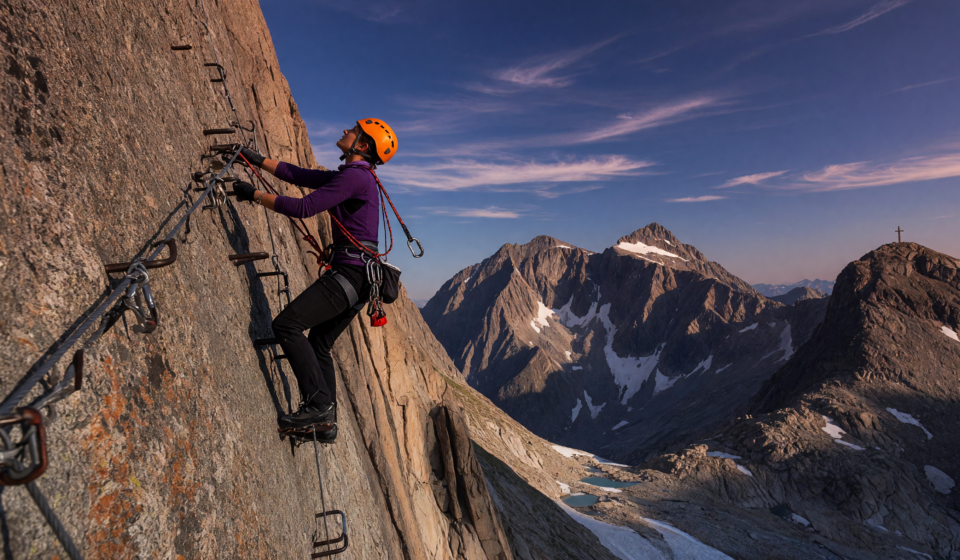
Picture yourself clipped to a steel cable a few hundred feet above a valley floor, one gloved hand on an iron rung, the wind pushing at your pack. A via ferrata lets ordinary hikers travel terrain that would otherwise demand ropes and rock skills, and that is exactly what makes it seductive and, if you cut corners, dangerous. Unlike roped climbing, where a partner and a belay device catch you, on the “iron path” your survival rests almost entirely on a small kit you wear yourself. Good via ferrata safety is not about being brave on the exposed sections; it is about wearing the right certified equipment and understanding, honestly, how much force a real fall can generate.
This guide walks through the gear that keeps you alive on the cable and, just as important, the reasoning behind it. We will cover the energy-absorbing lanyard (the single most misunderstood piece of the system), the climbing helmet and why a bike helmet will not do, the specialized via ferrata carabiners that clip the cable, the harness that ties it all together, and the concept of the fall factor that explains why via ferrata falls are uniquely violent. Along the way we will point to the actual standards and organizations behind the certifications so you can read a product label and know what you are buying.
What Makes a Via Ferrata Fall Different
On a normal climb, the rope stretches and the belayer feeds slack, so the energy of a fall is spread out and absorbed gradually. A via ferrata has none of that. You clip two short arms to a fixed steel cable that runs between anchor bolts. If you slip, you drop until your carabiners jam against the next lower anchor, then stop against a cable and a lanyard that barely stretch at all. There is no elastic rope and no partner to soften the catch. The result is a sudden, high-force jolt, sometimes worse than anything a roped climber will ever feel, delivered directly to your body and harness.
That is the whole reason the sport has its own dedicated gear category. The equipment is engineered not to prevent the fall, but to keep the peak force of the catch below the threshold that injures a human body. Understanding why that force gets so high is the key to respecting the gear.
Fall Factors: The Physics You Cannot Ignore
The fall factor is a simple idea: it is the distance you fall divided by the length of rope or lanyard available to absorb the energy. In roped climbing, the fall factor rarely exceeds a value of about two because the rope in the system grows as you climb. On a via ferrata, the math is brutal. Your lanyard arms are short, but you can fall the full distance between two widely spaced anchors before anything stops you. That means the fall distance can be large while the absorbing length stays tiny, producing fall factors far higher than roped climbing ever sees.
Here is what that translates to in practice, and why every element of the system matters:
- Short lanyard, long fall: A fall onto a static sling with no energy absorber can generate forces high enough to injure your spine or internal organs, and in extreme cases to damage the gear itself.
- Anchor spacing works against you: The farther apart the bolts, the farther you can drop before the carabiner catches, and the higher the impact.
- Position above the anchor: Climbing above your last clip-in point, common on a via ferrata, is what sets up the highest-factor falls.
- Body weight changes the equation: Both very light and very heavy climbers are affected differently, which is precisely why modern lanyards are rated for a defined weight range.
Via Ferrata Safety Starts With a Certified Lanyard
The heart of the system is the energy-absorbing lanyard, sometimes sold as a “via ferrata set.” It is a Y-shaped device with two elastic arms, two large carabiners, and, crucially, an energy absorber that tears or pays out webbing in a controlled way to bleed off the force of a fall. In Europe, and by extension almost everywhere these sets are sold in the United States, this equipment is governed by the standard EN 958, published under the European Committee for Standardization. There is no separate U.S. federal consumer standard specific to via ferrata lanyards, so reputable gear you find at American retailers carries this CE/EN certification, often alongside a UIAA safety label.
The current generation of the standard tightened the rules considerably compared with older sets. Rather than designing around a single reference weight, EN 958 now requires the absorber to protect users across a defined body-weight range while keeping the peak impact force below a set limit, with special provisions for lighter users whose lower mass may not deploy an absorber as readily. This is why you should never improvise a lanyard from slings and carabiners, and why a set built to the older, narrower design should be retired. The certification is not a marketing sticker; it is a promise about the maximum force the device will let reach your body.
Check the weight rating. A certified via ferrata lanyard is designed for a specific body-weight range including clothing and pack. If you fall outside that range, on either end, talk to the manufacturer before you climb. Children and very light adults in particular need equipment specifically rated for them, not a shortened adult set.
👉 Shop certified EN 958 via ferrata lanyard set on Amazon (Ad — as an Amazon Associate, we earn from qualifying purchases.)
Helmets: Why a Climbing Helmet, Not a Bike Helmet
People often show up to a via ferrata with a cycling or skateboard helmet, reasoning that any hard shell is better than nothing. That logic misses how the hazards differ. On the cable your two biggest head risks are rockfall from climbers above and a sideways or backward impact if you swing into the wall during a fall. A mountaineering helmet is built and tested for exactly those threats. The relevant standards are EN 12492, the European climbing-helmet standard, and UIAA 106, the parallel specification from the International Climbing and Mountaineering Federation (UIAA). Many quality helmets carry both.
The testing philosophy is what sets these apart from a bike helmet:
- Top impact and penetration: Climbing helmets are tested with a mass dropped onto a stationary helmet and with a pointed striker, simulating falling rock and debris.
- Multi-directional protection: EN 12492 and UIAA 106 include front, side, and rear impacts, not just a single crown hit, because a falling climber can strike the rock from any angle.
- Retention that stays put: The chin-strap and buckle are tested so the helmet does not fly off mid-fall, and the strap is designed to hold under load rather than release like some bike systems.
- Different test method entirely: Bicycle standards typically swing the helmet into an anvil to mimic a rider hitting the ground; climbing standards hold the helmet still and drop weight onto it, matching the rockfall hazard you actually face.
👉 Shop EN 12492 / UIAA 106 certified climbing helmet on Amazon (Ad — as an Amazon Associate, we earn from qualifying purchases.)
Carabiners and Connectors: Look for Type K
The two carabiners on a via ferrata lanyard are not ordinary climbing gates. They are a specific category defined in the connector standard EN 12275 as “Type K,” where the K stands for klettersteig, the German word for via ferrata. These carabiners are built with features tuned to the sport, and knowing what they are supposed to do helps you inspect your own set with a critical eye.
- Large gate opening: The wide mouth lets you clip fat steel cables and iron rungs quickly, even with gloves on.
- Self-locking gates: Type K connectors close and lock automatically so you cannot accidentally leave one open, and they typically require two or three deliberate actions to open.
- Palm-operated release: Many designs let you open the gate with the same hand that grips the carabiner, so you always keep one arm attached while you move the other past an anchor.
- High strength ratings: The standard sets minimum breaking loads for the closed gate to survive the high forces a via ferrata fall can produce.
The golden rule of movement follows directly from this hardware: always keep at least one carabiner clipped to the cable. Move them one at a time past each anchor so you are never fully detached, even for a second.
The Harness and the Rest of the System
Your lanyard is only as good as what it is attached to. A climbing harness certified to EN 12277 completes the load path from the cable to your body. For most adults a standard sit harness is appropriate, but there is an important exception. Children, and adults carrying a heavy pack with a high center of gravity, may be at risk of flipping upside down in a fall. In those cases a full-body harness or a chest-harness combination keeps the wearer upright and protects the spine.
- Connect the lanyard correctly: The set attaches to the harness belay loop or tie-in points exactly as the manufacturer specifies, never to a gear loop.
- Add a resting leash if you want one: A separate short lanyard with a carabiner lets you clip in to rest without unclipping your two main safety arms, but it is a positioning aid, not a fall-arrest device.
- Gloves protect your hands: Fingerless or full climbing gloves guard against burrs and frayed strands in the steel cable, which are common on well-used routes.
- Sturdy footwear matters: Approach shoes or boots with sticky rubber give you the friction to trust your feet on polished rock and metal rungs.
👉 Shop EN 12277 certified climbing harness on Amazon (Ad — as an Amazon Associate, we earn from qualifying purchases.)
Inspection, Retirement, and What Happens After a Fall
The most sobering fact about an energy-absorbing lanyard is that it is often a single-use safety device. The absorber works by tearing or paying out webbing to dissipate energy, so once it has arrested a serious fall, it may be partly or fully spent and must be retired even if it looks intact. Do not assume a set that “held” is ready for the next climb. When in doubt, follow the manufacturer’s instructions to the letter and replace it.
Beyond the aftermath of a fall, a simple habit of inspection keeps you safe:
- Before every outing: Check the webbing for cuts, fuzzing, or a partially deployed absorber, and confirm both gates snap shut and lock cleanly.
- Watch the calendar: Textile gear like lanyards and harnesses has a manufacturer-defined lifespan and should be retired at that age regardless of use, because ultraviolet light and time degrade the fibers.
- Respect recalls: In the United States the Consumer Product Safety Commission publishes recalls on outdoor equipment, so register your gear and check notices if a manufacturer flags a defect.
- Store it right: Keep gear cool, dry, and away from sunlight and chemicals, all of which quietly weaken synthetic fibers.
Grounding, Guides, and Knowing Your Limits
Even perfect gear cannot rewrite geometry. On the lower sections of many routes, a fall can still send you to the ground or a ledge before the lanyard has any distance to work with, a hazard sometimes called grounding. No energy absorber can help if there is nothing but air and then rock beneath you. This is why route choice, honest self-assessment, and moving deliberately matter as much as any certification. If you are new to the sport, hiring a certified guide for your first outings is the single best investment you can make in your own safety, and it is far cheaper than an accident.
Weather deserves the same respect. Steel cables and iron rungs are lightning magnets, and an exposed ridge is the last place you want to be in a storm. Check the forecast, start early, and be willing to turn around. The mountain will still be there next weekend.
The Bottom Line
Via ferrata rewards you with alpine terrain that would otherwise be far out of reach, but it asks for discipline in return. Buy a lanyard certified to EN 958 and confirm it fits your body weight, wear a real climbing helmet built to EN 12492 or UIAA 106 rather than a bike lid, clip in with Type K carabiners on an EN 12277 harness, and never leave the cable unclipped for even a moment. Understand that the short lanyard and high fall factors mean the forces are unforgiving, so inspect your gear, retire it on schedule and after any hard fall, and match the route to your experience. Do those things and the iron path becomes what it should be: one of the most thrilling and accessible ways to stand somewhere spectacular.
Disclaimer: This article is provided for general educational purposes only and is not a substitute for professional instruction, the manufacturer’s instructions for your specific equipment, or a qualified guide. Via ferrata climbing carries inherent risks of serious injury or death. Always read and follow the documentation supplied with your gear, seek hands-on training, and make your own judgments about conditions and your abilities.
Sources: European Committee for Standardization (CEN), EN 958 energy-absorbing systems for via ferrata; EN 12492 climbing-helmet standard; EN 12275 connectors, Type K; EN 12277 climbing harnesses; International Climbing and Mountaineering Federation (UIAA) safety standards, including UIAA 106 for helmets; U.S. Consumer Product Safety Commission (CPSC) recall information.