Flying With Sports Gear: TSA Rules for Bikes, Bats and CO2 Cartridges
Every summer, a security officer somewhere pulls a tiny silver cartridge out of a cyclist’s saddlebag and drops it into the bin of surrendered items. The traveler is stunned. It is just a bike tire inflator, after all, the same one that has ridden in their jersey pocket for a thousand miles. But at the checkpoint, that little canister is compressed gas, and the rules change fast. Flying with gear is one of the most misunderstood corners of air travel, because the equipment we treat as harmless at the trailhead gets reclassified the moment it enters an airport.
This guide walks through the practical, US-specific rules for moving three very different kinds of equipment: bicycles, bats and other long rigid gear, and CO2 cartridges. We will explain who actually sets the rules, why a carry-on versus checked bag decision matters so much, and where the real risk of a confiscated item or a denied boarding hides. The goal is not to memorize a rulebook but to understand the logic behind it, so you can pack once, pack right, and spend your energy on the trip instead of the terminal.
Who Actually Makes the Rules
Three different authorities have a say in what rides with you, and confusing them is where most travelers go wrong. The Transportation Security Administration (TSA) screens you and your bags at the checkpoint and has the final word on what passes through. The Federal Aviation Administration (FAA) writes the hazardous materials rules that govern dangerous goods like compressed gas and lithium batteries. Your airline sits on top of both, setting its own size, weight, packaging, and fee policies for oversized sporting equipment.
- TSA: Decides whether an item clears the security checkpoint. The officer on duty has discretion, even when an item is generally allowed.
- FAA: Publishes the “PackSafe” hazardous materials guidance that dictates whether things like gas cartridges and batteries can fly at all, and in which bag.
- Your airline: Controls the checked-baggage logistics, including bike box dimensions, weight caps, oversize fees, and whether a battery-powered item is accepted.
The takeaway is simple: an item can be legal under FAA rules, refused by a TSA officer, and still barred by your airline’s baggage desk. Clearing all three is the real bar you have to meet.
Flying With Gear Starts With Carry-On vs. Checked
Almost every decision about flying with gear comes down to a single question: does this belong in the cabin or in the hold? The instinct many travelers have is backward. We assume valuable or fragile items are safest in our laps, and that anything bulky and rugged should be checked. For hazardous materials, the logic often flips, because the concern is not damage to your gear but risk to the aircraft.
- Lithium batteries: Generally must travel in the cabin, not the hold, so a crew can respond if one overheats. This affects e-bikes, electric pumps, and battery-powered accessories.
- Sharp or bludgeon-style objects: Bats, clubs, and similar long rigid gear are barred from the cabin and belong in checked baggage.
- Compressed gas: The most restricted category of all, and the one where “just put it in checked” is frequently the wrong answer.
Get this cabin-versus-hold call right and most of the rest falls into place. Get it wrong and you are repacking at the counter, or worse, watching gear go into a surrender bin.
Bikes: Big, Boxed, and Airline-Dependent
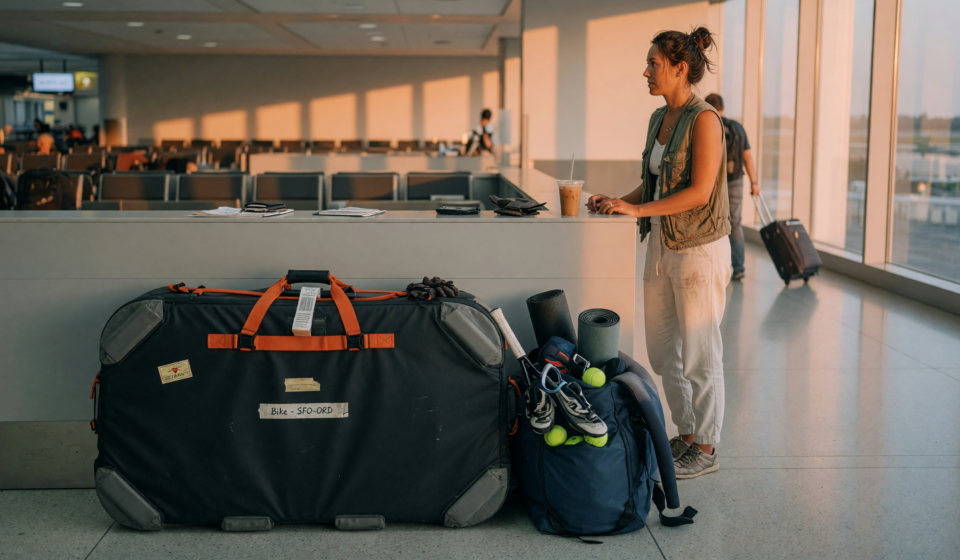
A bicycle itself is not a security problem. TSA allows bikes, and the checkpoint is rarely the obstacle. The real gatekeeper is your airline’s checked-baggage policy, because a boxed bike is large, heavy, and expensive to move. Historically, US carriers charged steep oversize fees for bikes, but many have shifted toward treating a properly packed bike as standard checked luggage, subject to the usual weight limits. Policies vary by airline and change often, so confirming yours before you pay for anything is the single most valuable step.
- Pack it down: Remove or turn the handlebars, take off the pedals, and lower or remove the seat post so the box stays within the airline’s size envelope.
- Protect the frame: Use foam, pipe insulation, or a hardshell case around the tubes and derailleur, the parts most likely to take a hit in transit.
- Mind tire pressure: Many travelers partially deflate tires as a precaution; check your airline’s specific guidance rather than guessing.
- Weigh the box at home: Overweight fees can dwarf the base baggage charge, and a bathroom scale saves you a nasty surprise.
A padded, rigid case is the difference between a bike that arrives ride-ready and one that arrives with a bent hanger. If you fly with your bike more than once or twice a year, a dedicated travel case pays for itself quickly.
👉 Shop hardshell bicycle travel case on Amazon (Ad — as an Amazon Associate, we earn from qualifying purchases.)
E-Bikes and Lithium Batteries: The One That Trips People Up
An electric bike introduces a problem a regular bike does not: a large lithium-ion battery. Under FAA hazardous materials guidance, lithium batteries are a fire risk, and the larger ones common in e-bikes are frequently restricted or outright prohibited on passenger aircraft. This is not an airline being difficult; it is a safety rule rooted in how lithium cells behave when they fail. Even where a battery is allowed, it typically must ride in the cabin so the crew can act if it overheats, and there are watt-hour limits that most e-bike packs exceed.
Check before you commit. Large e-bike batteries are commonly banned from passenger flights entirely. If you are traveling with an electric bike, confirm your airline’s lithium-battery policy in writing before you book, and have a ground-shipping backup plan for the battery.
- Never pack spare lithium batteries in checked bags: Loose cells and power banks belong in the cabin, where a fire can be seen and stopped.
- Know your watt-hours: Batteries above the common thresholds usually need airline approval, and the biggest packs may be refused at any size.
- Consider shipping the battery separately: A ground carrier that handles hazardous materials is often the only realistic way to move a full-size e-bike battery.
Bats, Clubs, and Long Rigid Gear
Baseball and softball bats sit in a clear category. TSA does not allow them in carry-on bags, because anything that can be swung as a club is treated as a potential weapon in the cabin. In checked baggage, they are fine. The same logic extends to hockey sticks, ski poles, golf clubs, and lacrosse sticks: rigid, swingable, and cabin-restricted, but perfectly acceptable in the hold.
- Bats belong in checked bags: Do not try to carry one on, even a lightweight youth model or a souvenir mini bat, as size is not the deciding factor.
- Protect the barrel and knob: A padded bat sleeve or a hard tube keeps composite bats from cracking under the weight of shifting luggage.
- Group your long gear: A dedicated equipment bag consolidates bats, gloves, and cleats into one checked item and cuts down on oversize surprises.
👉 Shop padded baseball bat bag or hard case on Amazon (Ad — as an Amazon Associate, we earn from qualifying purchases.)
CO2 Cartridges: The Small Item That Causes Big Headaches
This is the one that catches experienced travelers off guard. Those small CO2 cartridges used to inflate a bike tire, top off a ball, or power a small device are compressed gas, and TSA’s position is strict: filled compressed gas cartridges are generally not permitted in either carry-on or checked baggage. Only an empty cylinder, clearly visible to the officer as empty, is allowed through. The FAA’s PackSafe guidance reinforces this, noting that TSA security rules bar compressed gas cartridges except when empty, even where hazardous materials rules might otherwise allow a small one.
There is a narrow, important exception. CO2 cartridges built into a self-inflating life vest are allowed, with a common limit of up to two cartridges installed in the vest plus two spares, but only when they accompany the associated life vest. You cannot bring loose cartridges on their own under this rule. A separate exception covers gas cartridges used in mechanical limbs. For the average cyclist, the practical answer is blunt: leave the tire-inflator cartridges at home and buy them at your destination.
- Do not pack bike inflator cartridges: They are compressed gas and are routinely surrendered at the checkpoint, in checked bags as well as carry-ons.
- The life vest exemption is specific: Cartridges must be part of, or spares for, an actual self-inflating life vest to qualify.
- Plan to resupply on arrival: Bike shops and sporting-goods stores near your destination sell cartridges cheaply, so pack a mini pump for the ride and buy gas locally.
- A hand pump is your friend: A compact frame or mini pump has no gas at all and sails through security every time.
👉 Shop compact hand pump / mini bike pump on Amazon (Ad — as an Amazon Associate, we earn from qualifying purchases.)
Packing and Documentation That Save You at the Checkpoint
Most gear problems are avoidable with a little front-loading. The travelers who breeze through are the ones who checked their airline’s policy, packed to the rules rather than to habit, and left the borderline items at home. A few disciplined habits carry almost every sport.
- Read your airline’s sporting-equipment page: Fees, size limits, and battery policies live there, and they change, so confirm close to your travel date.
- Use TSA-recognized locks: They let officers inspect a checked bag without cutting your lock off, which matters for expensive gear.
- Photograph your gear before you fly: A quick set of photos documents condition in case you need to file a damage claim.
- Arrive early with oversize items: Bikes and long bags often route through a separate oversize belt that takes extra time.
- When in doubt, ask first: A quick call to the airline beats a surrendered item, and TSA’s own resources answer most gray-area questions.
👉 Shop TSA-approved luggage locks on Amazon (Ad — as an Amazon Associate, we earn from qualifying purchases.)
The Bottom Line
Flying with sports gear is rarely hard once you understand the logic behind the rules. Bikes are welcome as checked baggage, so your job is to pack them well and confirm your airline’s size, weight, and fee policy. Bats and other swingable gear are cabin-banned but perfectly fine in the hold. CO2 cartridges are the real trap: treat them as the compressed gas they are, leave them home, and buy replacements when you land. Sort out the cabin-versus-hold question for each item, check your airline’s policy before you pack, and let TSA and FAA guidance settle the gray areas. Do that, and the hardest part of your trip will be the ride, the game, or the climb, exactly as it should be.
Disclaimer: This article is for general educational purposes only and does not constitute legal, safety, or travel advice. Rules set by the TSA, FAA, and individual airlines change frequently and are applied at the discretion of officers and staff. Always confirm current requirements with the relevant agency and your airline before you travel.
Sources: Transportation Security Administration (TSA) “What Can I Bring?” guidance on CO2 cartridges, CO2 cartridges for life vests, baseball bats, and bicycles; Federal Aviation Administration (FAA) PackSafe guidance on small compressed gas cylinders and lithium batteries; 49 CFR 175.10 hazardous materials exceptions for passengers.