Summer Camp Gear Checklist: Helmets, Sunscreen and Water Bottles
The morning bus pulls up, a dozen kids climb aboard with backpacks half-zipped, and somewhere in the shuffle a bike helmet is left dangling from a hook by the front door. It happens in households all over the country every June, and it is exactly the kind of small gap that turns an ordinary afternoon into an emergency-room visit. Good summer camp safety is rarely about heroics. It is about the boring stuff you pack the night before: the helmet that actually fits, the sunscreen that actually works, and the water bottle that actually gets refilled.
This guide walks through the three pieces of gear that do the heaviest lifting during camp season: helmets, sunscreen, and water bottles. For each one, we explain what to look for, which U.S. standards and agencies back up the advice, and how to spot the difference between a product that meets a real safety benchmark and one that just looks the part. Think of it as the checklist you wish someone had handed you before drop-off day.
Start With the Helmet: The One Item You Never Improvise
If a camp involves bikes, scooters, skateboards, or anything with wheels and speed, a helmet is non-negotiable. In the United States, bicycle helmets are not just a good idea; they are regulated. Under the Consumer Product Safety Commission (CPSC), every bicycle helmet sold in the country must meet a federal safety standard codified as 16 CFR Part 1203, which has been mandatory since March 10, 1999. That standard is why a compliant helmet carries a label stating it “Complies with U.S. CPSC Safety Standard for Bicycle Helmets.”
What does that label actually buy you? The CPSC standard requires helmets to pass a battery of performance tests before they can be sold. Those include impact attenuation, positional stability, retention-system strength, and a peripheral-vision requirement so the helmet does not blind a rider to traffic at the edges. In plain English: the helmet has to cushion a real crash, stay put on the head, keep its straps from failing, and let the child see where they are going.
- Look for the CPSC label: A genuine bicycle helmet carries a sticker referencing the U.S. CPSC standard. No label, no purchase.
- Match the helmet to the activity: CPSC guidance (“Which Helmet for Which Activity?”) stresses that a bike helmet is not automatically the right choice for skateboarding, inline skating, or other sports, which may call for a differently rated helmet.
- Replace after a crash: Helmet foam is designed to absorb one significant impact. After a real hit, retire it even if it looks fine.
- Check the age, not just the look: Foam and straps degrade over years of heat and sweat; a hand-me-down that is a decade old may no longer perform.
👉 Shop CPSC-certified youth bike helmets on Amazon (Ad — as an Amazon Associate, we earn from qualifying purchases.)
Fit Is the Other Half of the Job
A certified helmet that sits crooked or slides around does only a fraction of its job. The CPSC standard tests for positional stability precisely because a helmet that rolls off the forehead on impact cannot protect the part of the skull that matters most. Fit is where parents have the most control, and it takes about two minutes to check.
- Level on the head: The helmet should sit flat, with the front edge roughly one to two finger-widths above the eyebrows, not tipped back like a cap.
- Snug but not painful: With the chin strap unbuckled, the helmet should not rock forward, back, or side to side. Use the fit pads or the rear dial to dial it in.
- The “V” around the ears: Side straps should meet in a Y just below each ear.
- Two-finger chin check: Buckled, you should be able to slip only a finger or two between strap and chin. Ask the child to open their mouth wide; the helmet should press down slightly.
Kids grow fast, and a helmet that fit perfectly last summer may ride high this year. Re-check the fit at the start of every camp season, and let the child feel involved in the adjustment so they are more likely to keep wearing it correctly when no adult is watching.
Sunscreen: Read the Label the Way the FDA Wants You To
Camp means hours outdoors, often during the strongest part of the day. The U.S. Food and Drug Administration (FDA) regulates sunscreen as an over-the-counter drug, which means the label carries real, tested meaning. The FDA recommends choosing a broad-spectrum sunscreen with an SPF of 15 or higher; broad spectrum is the key phrase, because it indicates protection against both UVA and UVB rays, and not every product qualifies.
A few label details are worth teaching kids and counselors alike. The FDA is explicit that there is no such thing as “waterproof” sunscreen. Products can only be labeled water resistant for either 40 or 80 minutes, based on testing, after which they must be reapplied. And regardless of the number, sunscreen should go on about 15 minutes before sun exposure and be reapplied at least every two hours, and more often after swimming or heavy sweating.
- Broad spectrum, SPF 15+: Per FDA guidance, this is the baseline; many dermatology groups suggest going higher for extended outdoor play.
- Water resistant is temporary: A 40- or 80-minute label is a reapplication timer, not a free pass for the whole afternoon.
- Reapply every two hours: Send a labeled bottle in the camp bag and make reapplication a routine, not an afterthought.
- Infants under six months: The FDA does not recommend sunscreen for babies this young; shade and protective clothing come first, and a pediatrician should weigh in.
Label check. “Waterproof” and “sweatproof” are not permitted claims under FDA rules. If a bottle uses them, treat it as marketing rather than a measure of protection, and lean on the tested “water resistant (40 or 80 minutes)” wording instead.
Sunscreen also is not the whole strategy. Wide-brimmed hats, UPF-rated clothing, sunglasses, and simply seeking shade during the peak hours of roughly 10 a.m. to 2 p.m. all stack on top of a good sunscreen routine. The goal is layered protection, so a single missed reapplication does not leave a child exposed.
👉 Shop broad-spectrum kids sunscreen and UPF sun-protective clothing on Amazon (Ad — as an Amazon Associate, we earn from qualifying purchases.)
Water Bottles and Staying Ahead of Dehydration
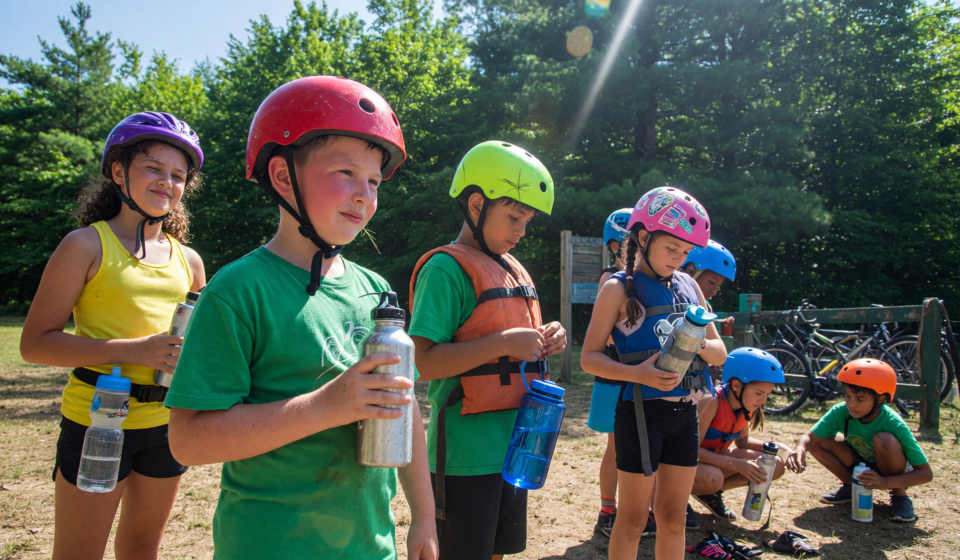
Children do not always notice they are thirsty until they are already behind, and a hot, active camp day pushes fluid needs higher than most kids will voluntarily meet. The American Academy of Pediatrics, through its HealthyChildren.org guidance, encourages regular water and snack breaks and even suggests sending chilled or frozen water bottles to help kids keep drinking through the day.
The bottle itself matters less than the habit, but a few features make the habit easier. An insulated, leak-resistant bottle keeps water cold enough to be appealing, and a size the child can actually carry means it comes along instead of getting left at the picnic table. When shopping, it is reasonable to look for bottles labeled to indicate they are made without BPA; the FDA continues to review food-contact materials, and reputable manufacturers now widely offer BPA-free options.
- Right-sized and easy to open: A bottle a child can carry and drink from independently gets used far more often.
- Insulated and leak-resistant: Cold water is more appealing, and a bottle that does not soak the backpack survives the whole day.
- Labeled and refillable: Write the child’s name on it, and plan for refills; one bottle rarely covers a full active day in the heat.
- Build the routine: Pair drinking with natural break points, since the AAP notes younger kids may simply forget to hydrate on their own.
👉 Shop insulated kids water bottles on Amazon (Ad — as an Amazon Associate, we earn from qualifying purchases.)
Beating the Heat: Recognizing Trouble Early
Hydration and heat safety are two sides of the same coin. The Centers for Disease Control and Prevention (CDC) flags young athletes and active kids as a group at elevated risk during hot weather, and the AAP offers concrete thresholds parents and camps can use. Its guidance suggests using caution as the heat index climbs and curtailing strenuous outdoor activity when conditions become extreme, while allowing the body time to adjust to heat gradually over one to two weeks at the start of a season.
Just as important is knowing what heat illness looks like, because early recognition is what prevents a scary situation from becoming a dangerous one. The warning signs the AAP describes include muscle cramps, dizziness, headache, nausea, and cold, clammy skin. Confusion, loss of coordination, or a very high body temperature signal a medical emergency that calls for immediate help.
- Acclimatize gradually: The AAP recommends easing into hot-weather activity over roughly 7 to 14 days rather than going all-out on day one.
- Mind the heat index: Dial back intensity as conditions heat up, and treat extreme readings as a reason to move indoors or into shade.
- Know the red flags: Cramps, dizziness, and nausea mean stop and cool down; confusion or collapse means call for emergency help.
- Cool and hydrate first: Move the child to shade, offer fluids, and cool the skin while getting help for anything beyond mild symptoms.
Building a Summer Camp Safety Kit That Covers the Bases
Once the big three are handled, a short supporting kit rounds out the day. None of these items are exotic, but packing them consistently is what separates a smooth camp season from a string of small mishaps. Keep a checklist taped inside a cabinet door and run it every morning until it becomes muscle memory.
- CPSC-certified helmet, fitted: Checked for the label and re-fitted at the start of the season.
- Broad-spectrum sunscreen, SPF 15+: Applied before drop-off, with a labeled bottle in the bag for reapplication.
- Insulated water bottle, filled: Named, leak-tested, and paired with a refill plan.
- Sun-protective extras: A wide-brimmed hat, sunglasses, and light, breathable clothing for peak-sun hours.
- Closed-toe shoes and basic first aid: Bandages and any personal medications the camp is cleared to store.
👉 Shop kids sun hats and sunglasses on Amazon (Ad — as an Amazon Associate, we earn from qualifying purchases.)
The Bottom Line
Camp season rewards preparation you cannot see once it is working. A helmet that carries a real CPSC certification and actually fits, a broad-spectrum sunscreen used the way the FDA describes, and a water bottle that keeps a child drinking through a hot afternoon are not glamorous purchases, but together they head off the most common and most preventable camp injuries. Build the checklist once, run it every morning, and let the boring gear do its quiet, essential job while the kids do the fun part.
Disclaimer: This article is provided for general educational purposes only and does not constitute medical, safety, or professional advice. Product standards, regulations, and health guidance can change over time. Always follow manufacturer instructions, your camp’s policies, and the advice of a qualified pediatrician or medical professional for your child’s specific needs.
Sources: U.S. Consumer Product Safety Commission (CPSC) — Safety Standard for Bicycle Helmets, 16 CFR Part 1203, and “Which Helmet for Which Activity?”; U.S. Food and Drug Administration (FDA) — “Sunscreen: How to Help Protect Your Skin from the Sun”; American Academy of Pediatrics (HealthyChildren.org) — exercise-related heat illness and hydration guidance; U.S. Centers for Disease Control and Prevention (CDC) — Heat and Athletes.