
School Bus Safety for Drivers: Stopping Laws and the Danger Zone
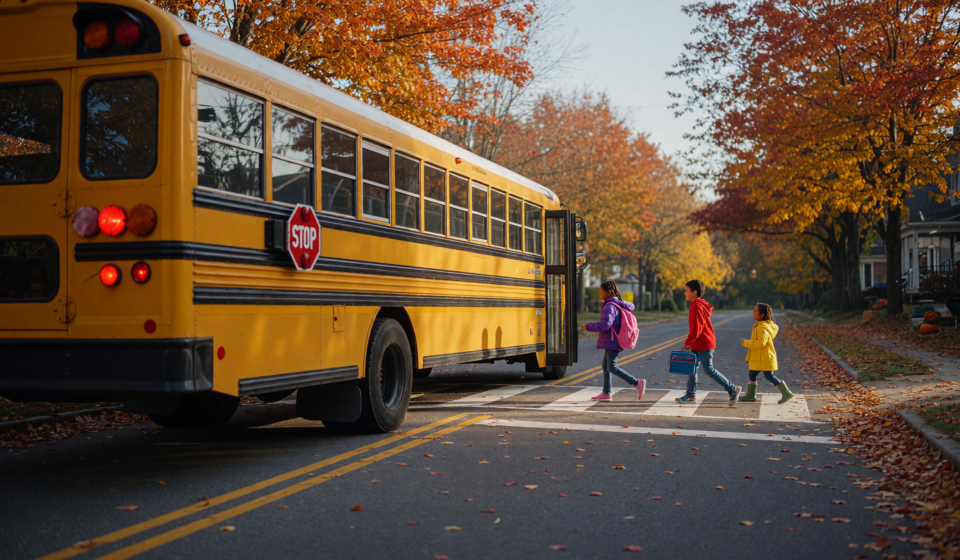
It happens in the space of a heartbeat. A yellow bus eases toward a curb, its lights begin to blink, and a child you cannot yet see is already stepping off the bottom step. The most dangerous moment of any school day is not the ride itself — buses are among the safest vehicles on the road — but the few seconds when kids are on foot, close to a large vehicle, in traffic that is often moving too fast to stop. Good school bus safety is really about what the drivers around that bus do in those seconds.
This guide is written for the person behind the wheel of a car, pickup, or work truck — not the bus driver. We will walk through the danger zone around a stopped bus, how to read yellow and red flashing lights, when you are legally required to stop, how the stop arm and crossing gate work, and why so many kids still get hit despite decades of law. We will also cover the high-visibility gear that keeps crossing guards and roadside workers seen. The goal is simple: help you understand the why behind the rules so they stick.
Why the Danger Zone Is the Deadliest Place on the Route
The National Highway Traffic Safety Administration (NHTSA) calls the area immediately around a school bus the “danger zone.” It is the ring of pavement closest to the bus on all four sides, and it is where children are hardest for a driver — the bus driver or a passing motorist — to see. A child standing near the front bumper, along the side, or directly behind the bus can drop below the driver’s line of sight entirely. NHTSA teaches kids to stay at least ten feet away — “five giant steps” — from the bus for exactly this reason.
What makes the danger zone so unforgiving is a combination of size, blind spots, and small children who behave unpredictably. Here is what is happening in that space:
- Blind spots wrap the bus: The area directly in front, along both sides, and behind the bus can hide a child from the driver seated high in the cab.
- Kids double back: A dropped backpack, glove, or phone sends a child darting back toward or under the bus — the single most common way children are struck by their own bus.
- Crossing in front is routine: Children who live across the street must cross in front of the bus, walking through the exact blind spot NHTSA warns about.
- Passing traffic is the other threat: When a child clears the bus, the next hazard is a car that failed to stop in the opposing or adjacent lane.
School Bus Safety Starts With Reading the Lights
Every school bus in the United States uses the same two-stage warning system, and understanding it is the foundation of school bus safety for drivers. The lights are not decoration — they are a legal signal that changes what you are required to do.
- Yellow (amber) flashing lights: The bus is preparing to stop. NHTSA’s guidance is to “slow down and prepare to stop.” Treat amber the way you would a yellow traffic signal that is about to turn red — do not try to beat it.
- Red flashing lights: The bus has stopped and children are getting on or off. You must stop and stay stopped until the red lights turn off, the stop arm folds back in, and the bus starts moving again.
- The stop arm: The extended arm on the driver’s side is a physical, legal barrier. Passing a bus while the stop arm is out and the red lights are flashing is illegal in every state.
Remember this. Amber means get ready; red means stopped for good. The moment red lights and the stop arm appear, assume a child is about to step into your lane — even if you cannot see one yet.
When You Must Stop — and the Divided-Highway Question
The core rule is consistent nationwide: when a bus displays red flashing lights and extends its stop arm, traffic approaching from both directions on an undivided road must stop. Where the details differ from state to state is on divided highways — roads split by a median, barrier, or physical separation.
- Two-lane roads: Everyone stops, both directions. No exceptions.
- Multi-lane roads without a divider: In most states, all lanes in both directions must stop, because a child may cross the whole road.
- Divided highways with a median or barrier: Many states do not require traffic on the opposite side of a physical divider to stop — but the rule varies, and the safest habit is to slow and be ready regardless.
- When in doubt, stop: Learning your own state’s statute is part of being a responsible driver. NHTSA specifically urges motorists to know their state school bus laws.
The Stop Arm, Crossing Gate, and Why Kids Still Get Hit
Modern buses layer several devices to force children out into a visible path and to warn traffic. The stop arm swings out on the driver’s side. Many buses also have a crossing gate — a bar that extends from the front bumper — that pushes departing children forward and away from the bus, out of the front blind spot, so the driver can see them. These systems work, but they only protect a child if the traffic around the bus actually stops.
The stubborn problem is illegal passing. Pupil-transportation agencies that survey bus drivers report that motorists illegally pass stopped buses an enormous number of times on a single ordinary day — drivers who blow past the red lights, swing around on the shoulder, or misjudge the amber. That is why the layers matter, and why your discipline as a driver is the last line of defense.
👉 Shop reflective handheld STOP/SLOW paddle for crossing guards on Amazon (Ad — as an Amazon Associate, we earn from qualifying purchases.)
Stop-Arm Cameras and Automated Enforcement
Because a bus driver cannot chase down a violator, a growing number of states authorize stop-arm cameras — automated systems that photograph vehicles passing a bus with its red lights on and stop arm extended. The footage supports a citation mailed to the registered owner, much like a red-light or speed camera. The programs are meant to change behavior at the stops where enforcement is otherwise impossible.
- They capture what officers cannot: Most illegal passes happen with no patrol car nearby; cameras fill that gap.
- Rules vary by state: Whether cameras are allowed, and how citations are issued, depends on state law — another reason to know your local statute.
- The point is deterrence: The goal is not revenue but getting drivers to stop reliably, every time, at every bus.
How the Bus Itself Protects the Kids Inside
School buses are engineered to be one of the safest ways for children to travel, and that is not an accident. Federal Motor Vehicle Safety Standards set specific construction requirements: rollover protection, body-joint strength, and — most famously — occupant protection through “compartmentalization.” Instead of relying only on belts, buses surround riders with closely spaced, high-backed, energy-absorbing seats that cushion them like eggs in a carton. The bus’s height, weight, and bright yellow paint add another layer of passive protection and visibility.
The takeaway for a driver sharing the road: the riskiest moments are outside the bus, not inside it. The vehicle does an excellent job protecting seated passengers. It is the loading and unloading — the danger zone — where the safety burden shifts to everyone else on the road.
Gear That Keeps Crossing Guards and Drivers Seen
Visibility is the other half of the safety equation. Crossing guards, bus aides, and anyone working near a school route in low light depends on high-visibility apparel that meets the ANSI/ISEA 107 standard for high-visibility safety apparel. That standard defines fluorescent background colors and retroreflective striping, and it sorts garments into performance classes — with higher classes providing more visible material and coverage for higher-speed or lower-light environments. There is also a public-safety design type intended for first responders and roadside personnel.
For the practical work of guiding children across a street, the gear that earns its keep is straightforward:
- A compliant high-visibility vest: An ANSI/ISEA 107 garment in an appropriate class makes a crossing guard visible to approaching drivers well before they reach the stop.
- A handheld STOP paddle: The octagonal paddle mirrors a traffic sign and gives drivers a clear, unmistakable command to halt.
- Retroreflective trim and lighting: In dawn, dusk, rain, and winter darkness, retroreflective striping and add-on LED lighting return a vehicle’s headlights straight back to the driver.
- Weather-ready layers: A guard who is warm and dry stays at the post and stays alert — comfort is a safety feature.
👉 Shop ANSI/ISEA 107 Class 2 high-visibility crossing guard vest on Amazon (Ad — as an Amazon Associate, we earn from qualifying purchases.)
Drivers benefit from visibility gear too. If you ever have to step out near a stopped bus — helping a child, dealing with a breakdown, or working a school event — a vest and a light make you part of the solution instead of another hazard in the danger zone.
👉 Shop clip-on LED safety light for low-light visibility on Amazon (Ad — as an Amazon Associate, we earn from qualifying purchases.)
The Bottom Line
School buses are built to protect the children inside them, but no engineering can protect a child on foot from a driver who does not stop. When you see amber, slow down and get ready. When you see red and a stop arm, stop completely and stay stopped until the bus rolls again — and assume a child is crossing in that ten-foot danger zone even if you cannot see one. Learn your state’s stopping law, respect the stop-arm cameras that back it up, and give crossing guards the visibility they need to do their job. Those few seconds of patience at a bus stop are the cheapest, most powerful safety measure any driver will ever make. Slow down. Stop. Let them cross.
Disclaimer: This article is for general educational purposes only and does not constitute legal advice or a substitute for your state’s traffic laws. School bus stopping requirements, divided-highway exceptions, and automated-enforcement rules vary by state — always follow your local statutes and the direction of law enforcement and crossing guards. Verify that any safety equipment meets the applicable standard for your intended use.
Sources: National Highway Traffic Safety Administration (NHTSA), School Bus Safety; U.S. Federal Motor Vehicle Safety Standards (FMVSS 220, 221, 222) for school bus construction and occupant protection; National Association of State Directors of Pupil Transportation Services (NASDPTS), illegal-passing survey; ANSI/ISEA 107 American National Standard for High-Visibility Safety Apparel (International Safety Equipment Association); Manual on Uniform Traffic Control Devices (MUTCD) for crossing-guard signing devices.


