
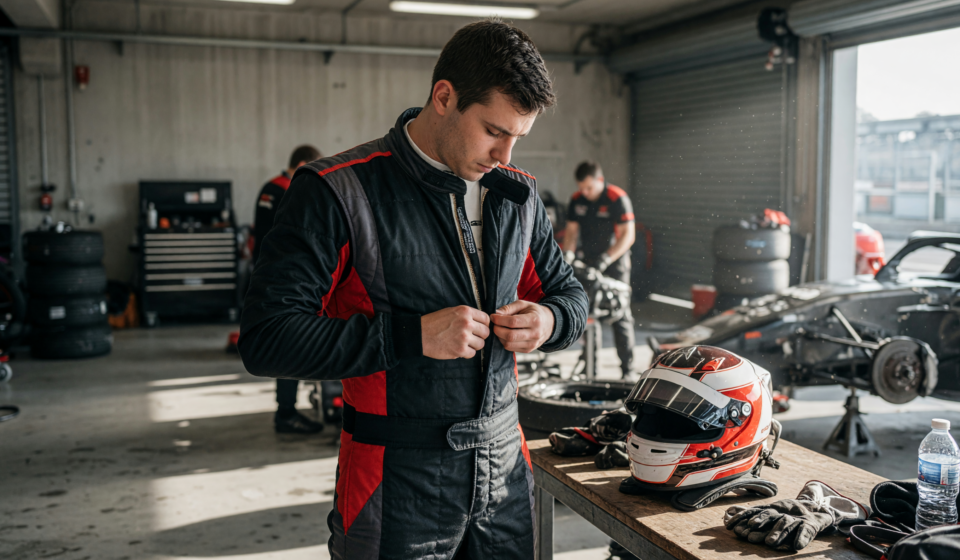
Racing Suits and SFI Ratings: Fire Protection for Track Days
A fuel fire does not wait for you to react. When gasoline or oil finds an ignition source in a crashed car, flames can wrap the cockpit in seconds, and the only thing standing between your skin and that heat is the clothing you chose that morning. That is exactly why understanding your racing suit SFI rating matters long before you ever roll onto the grid. A driving suit is not a costume or a sponsor billboard first and foremost, it is timed thermal insulation you wear on your body, and the difference between an entry-level suit and a top-tier one can be measured in the extra seconds you have to get out.
This guide breaks down how fire protection is actually rated in American motorsport. We will explain the SFI Foundation and its SFI 3.2A driver-suit specification, how the Thermal Protective Performance (TPP) test works, what those slash numbers like 3.2A/1 and 3.2A/5 really mean, and how the international FIA standards fit alongside them. You will also learn why a suit is only one piece of a layered system, and how to match a racing suit SFI rating to the kind of driving you actually do, from a relaxed HPDE lapping day to wheel-to-wheel competition.
Why Fire Is Still the Threat on Track Day
Modern race cars are safer than ever, with fuel cells, cutoff switches, and onboard extinguishers, but the basic ingredients of a fire are always present when you drive: fuel, heat, and oxygen. A hard impact can rupture a fuel line, crack a cell, or spray oil onto a red-hot exhaust or turbocharger. Electrical shorts add another ignition path. Once a fire starts, your job is to survive long enough to release your belts, find the door or window, and get clear, and a well-designed suit buys you that window of time.
Here is the part many new drivers miss: a suit does not make you fireproof. It is designed to delay the transfer of heat to your skin so you can escape before you suffer serious burns. Think of it as a countdown clock. The better the suit and the more complete the system, the more time is on that clock.
Who Sets the Standard: The SFI Foundation
In the United States, the organization that writes and administers most motorsport safety-gear specifications is the SFI Foundation, a nonprofit that issues standards for everything from harnesses and window nets to bellhousings and, yes, driver suits. Sanctioning bodies such as NHRA, NASCAR, IndyCar, and many road-racing clubs reference SFI specs in their rulebooks, which is why you will see an SFI patch or label sewn into approved gear.
The spec that governs full driving suits is SFI 3.2A. When a manufacturer builds a suit to that specification and it passes the required testing, the suit carries a label showing the spec and its performance rating. That label is your shortcut: it tells you the garment was tested to a recognized method rather than simply marketed as “fire resistant.”
- SFI 3.2A: The specification for one-piece and two-piece driver fire suits.
- Accessory specs: SFI publishes separate specifications covering driver accessories such as gloves, shoes, and head socks, so those items are rated on their own.
- The label matters: A genuine, current SFI label is what tech inspectors look for, and an expired or missing label can keep you off the track.
How TPP Testing Actually Works
The engine behind the SFI 3.2A rating is a lab test called Thermal Protective Performance, or TPP. The concept, originally developed by DuPont, is straightforward: a sample of the suit material is exposed to a combination of direct flame and radiant heat, and instruments measure how long it takes before the heat passing through the fabric would cause a second-degree burn on human skin. More time equals more protection.
What drives that number up is not magic, it is construction. Flame-resistant fibers such as meta-aramid (widely known by the DuPont brand name Nomex) do not melt and drip the way ordinary nylon or polyester does. Instead, when exposed to flame the fibers char and thicken, forming an insulating carbon barrier. Stack multiple layers of that fabric, add quilting, and trap pockets of air between them, and you slow heat transfer dramatically. That is why a bulky multi-layer suit protects far longer than a thin single-layer one.
Key idea. A racing suit rating is a measure of time, not a promise of invincibility. It estimates how many seconds the material can hold back a second-degree burn, which is precisely the time you need to unbuckle and get out.
What a Racing Suit SFI Rating Actually Tells You
On an SFI 3.2A label you will see the spec followed by a slash and a number, for example 3.2A/1, 3.2A/3, 3.2A/5, 3.2A/15, or 3.2A/20. That trailing number is the performance rating tied to the suit’s TPP result. In plain terms, the higher the number, the longer the material is rated to protect you from a second-degree burn. A 3.2A/1 suit sits at the entry level, while a 3.2A/20 suit is built for the most extreme fire environments, such as nitro drag racing.
- 3.2A/1: Entry-level protection, typically a lighter single-layer suit. Common minimum for many club and lapping applications.
- 3.2A/5: A meaningful step up, usually a multi-layer suit offering noticeably more escape time.
- 3.2A/15 and 3.2A/20: High-end protection for high-risk disciplines where fuel loads and fire potential are greatest.
- Higher is not always required: The right rating depends on your car, your fuel, and your sanctioning body’s rules, not on buying the biggest number you can find.
One practical trade-off: more layers usually mean more protection but also more bulk, weight, and heat retention while you drive. That is a comfort and mobility consideration, especially in a hot cockpit on a summer weekend, so the goal is the right rating for your risk, not simply the thickest suit on the shelf.
👉 Shop SFI 3.2A rated multi-layer racing suit on Amazon (Ad — as an Amazon Associate, we earn from qualifying purchases.)
SFI and FIA: Two Systems, One Goal
If you shop for suits or read international rulebooks, you will run into a second set of standards from the FIA, motorsport’s global governing body. FIA-homologated suits are tested to specifications such as FIA 8856-2000 and the newer FIA 8856-2018, and they carry their own labels. These are the standards you typically see in professional road racing and international competition.
The two systems use different test methods and labeling, but they share the same purpose: verifying that a suit delays heat transfer long enough to protect the driver during an escape. Which one you need comes down to where you race. Many US-based clubs and drag racing bodies write their rules around SFI, while FIA homologation is often required for international and many professional road-racing series. Some premium suits are dual-certified to satisfy both.
- SFI 3.2A: The dominant driver-suit standard in US club, oval, and drag racing.
- FIA 8856-2000 / 8856-2018: International homologation standards common in professional road racing.
- Always check your rulebook: Your sanctioning body, not the salesperson, defines the minimum acceptable certification.
A Suit Is Only Part of the System
Here is something experienced drivers understand and beginners often overlook: the suit works as part of a head-to-toe system, and its rating assumes the rest of you is covered too. Bare skin at the wrists, ankles, or neck is a weak point, and ordinary underwear made from synthetic fibers can melt against your skin under heat, undermining even a great suit.
Flame-resistant base layers, worn under the suit, add insulating layers exactly where a single-layer suit needs help, and they are frequently the difference between an adequate setup and a genuinely safe one. Gloves, shoes, and a head sock or balaclava close the remaining gaps around your hands, feet, and face. Each of these accessories can carry its own rating, so treat them as real safety equipment rather than afterthoughts.
- Base layers: Flame-resistant top and bottoms add protection time and cover skin the suit cannot.
- Gloves and shoes: Protect the extremities you need to release belts and open a door.
- Head sock: A balaclava protects the neck and face and improves helmet hygiene as a bonus.
- No synthetics underneath: Avoid meltable everyday fabrics against the skin under your suit.
👉 Shop fire-resistant Nomex base layers and head sock on Amazon (Ad — as an Amazon Associate, we earn from qualifying purchases.)
Choosing the Right Rating for Your Track Day
So what should you actually buy? Start with your event’s rulebook, because the sanctioning body sets the floor. Many open-track and HPDE programs run with cars close to street trim and may specify a modest minimum, while wheel-to-wheel competition and higher-risk disciplines demand more. Once you know the minimum, weigh your own risk tolerance, your car’s fuel system, and how hot your cockpit runs.
- Read the rules first: Confirm the required SFI or FIA certification for your specific event before spending a dollar.
- Match risk to rating: A dedicated race car with a full fuel cell justifies more protection than a lightly modified street car on a lapping day.
- Do not forget fit: A suit that binds at the shoulders or bunches at the waist slows your escape, so mobility is a safety feature.
- Buy the system: Budget for base layers, gloves, shoes, and a head sock alongside the suit itself.
👉 Shop SFI rated racing gloves and shoes on Amazon (Ad — as an Amazon Associate, we earn from qualifying purchases.)
Care, Inspection, and When to Retire a Suit
A suit’s protection depends on the fabric doing what it was tested to do, and abuse degrades that. Ground-in oil, fuel, and grease can act as fuel themselves, and harsh chemicals or aggressive washing can break down the material and any protective finishes. Follow the manufacturer’s cleaning instructions, keep the suit clean and dry, and store it out of direct sunlight.
- Clean per the maker’s guidance: Use recommended products and avoid harsh bleaches or solvents that can degrade the fabric.
- Inspect before every event: Look for tears, thin spots, damaged seams, broken zippers, and heavy staining.
- Mind the label: Check your certification for currency, since some specs and sanctioning bodies enforce recertification or expiration timelines.
- Retire when in doubt: A suit that has been through a fire, or is worn out, has done its job, and its protection may be compromised.
👉 Shop motorsport-safe fire suit wash and gear bag on Amazon (Ad — as an Amazon Associate, we earn from qualifying purchases.)
The Bottom Line
Fire is the one threat on a race track that your own equipment can directly hold back, second by second, and the rating printed on your suit is the honest measure of how long it will do that. Learn to read the SFI 3.2A label, understand that the number is a timed measure of protection rather than a marketing gimmick, and remember that the suit only performs as well as the base layers, gloves, shoes, and head sock you pair with it. Start with your rulebook, match the rating to your real-world risk, keep the whole system clean and inspected, and you will show up on track day protected by gear you actually understand. That knowledge is what turns a bundle of Nomex into genuine peace of mind.
Disclaimer: This article is provided for general educational purposes only and does not constitute safety, legal, or professional advice. Fire protection needs vary by vehicle, discipline, and event. Always follow the requirements of your sanctioning body and the instructions of the equipment manufacturer, and consult qualified officials when selecting and inspecting safety gear.
Sources: SFI Foundation, Inc. (driver suit specification SFI 3.2A and Thermal Protective Performance testing); Fédération Internationale de l’Automobile (FIA), homologation standards FIA 8856-2000 and FIA 8856-2018; DuPont (Nomex meta-aramid fiber and TPP test method). Specification details and event requirements change over time, so verify current standards with each governing body and your sanctioning organization.


