
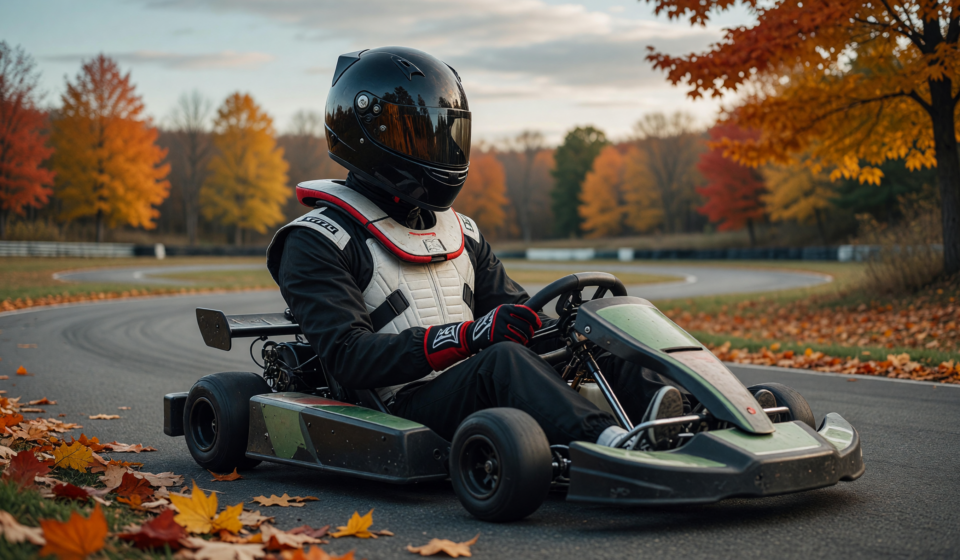
Karting Safety Gear: Helmets, Rib Protectors and Neck Support
A go-kart sits inches off the pavement, has no suspension, no crumple zone, and no roll cage, yet a shifter kart can carry a driver through corners at speeds that rival a sports car. That combination is exactly why karting safety gear matters more than newcomers expect: the chassis is rigid, the seat is bolted solid, and every bump and impact travels straight into the driver’s body. The good news is that the right equipment, chosen well and fitted correctly, absorbs an enormous amount of that punishment before it ever reaches you.
This guide walks through the three pieces that protect the areas most at risk on a kart: the helmet, the rib protector, and neck support. We will explain what the major US certification standards actually mean, why a purpose-built kart helmet differs from an auto-racing lid, how a rib vest prevents one of the sport’s most common injuries, and where the rulebooks of leagues like SKUSA and WKA draw hard lines. Along the way we will keep the focus on the “why,” so you can make smart calls whether you are outfitting a first-time cadet or upgrading your own kit.
Why Karting Punishes the Body Differently
Most people assume a low-slung kart is gentler than a full-size race car. In practice, the lack of suspension and the extremely low center of gravity generate high lateral loads through corners, and the driver’s torso is what resists them. There is no seatbelt in most karting classes by design; drivers need to move and brace, so the body itself does the work of staying planted. That is precisely why injuries in karting tend to cluster around the head, neck, and rib cage rather than the limbs.
- No restraint system: Without a harness, your core muscles and protective gear manage cornering forces, not a belt.
- Rigid seat and chassis: Vibration and side loading transfer directly into the ribs where the seat meets the torso.
- Exposed position: The head sits high and unshielded, making a certified helmet non-negotiable.
- Fatigue factor: A tired driver braces poorly, which is when rib and neck strains most often occur.
The Helmet: Your Single Most Important Purchase
If you buy one serious piece of karting safety gear, make it the helmet. In the United States, the reference point is the Snell Memorial Foundation, a nonprofit that writes helmet standards and independently tests samples against them. Snell publishes a dedicated karting standard, the “K” series, which it updates roughly every five years. Kart-specific helmets are engineered to be lighter and better ventilated than closed-cockpit auto helmets, because a kart driver’s head is out in the open airflow and works hard through a long race.
A full-face design with a sturdy, clear shield is the baseline every major US league expects. The shell should sit level, the cheek pads should hug your face without pressing painfully, and the helmet should not rock forward or twist when you shake your head. A loose helmet is a false sense of security; a properly fitted one stays put when it matters.
👉 Shop Snell K-rated full-face karting helmet on Amazon (Ad — as an Amazon Associate, we earn from qualifying purchases.)
Understanding Snell K, SA and CMR Ratings
The alphabet soup of helmet ratings trips up a lot of new racers, so here is the plain-English version. Each standard is tied to a certification year, and organizations retire older ones on a published schedule, so always confirm the current rating in your league’s rulebook before buying.
- Snell K-series (for example K2020, K2025): The karting-specific standard. These helmets skip the heavy fire-resistant lining of auto helmets in favor of lighter weight and more airflow.
- Snell SA-series (for example SA2020, SA2025): Built for auto racing with fire-resistant materials and roll-bar impact testing. Some karting classes accept them, but they are heavier and warmer.
- Snell CMR2016: The “Children’s Motorsport Restricted” standard, designed specifically for young drivers. It caps helmet mass to reduce strain on a child’s developing neck, which is why many leagues require it for cadet and junior classes.
- FIA homologation: Helmets certified to FIA standards are also widely accepted and are the path if you plan to race internationally.
Rulebook first, wallet second. A helmet’s Snell or FIA certification has an expiration date in competition, and the accepted standards vary by class and age group. A perfectly good SA-rated auto helmet may be disallowed for a junior class that mandates a CMR lid. Check your specific league and class rules before you spend a dollar.
Rib Protectors: The Gear Nobody Talks About Until It’s Too Late
Ask experienced karters about their worst injuries and rib bruising comes up again and again. Because the driver sits in a stiff seat with the torso wedged against its sides, hard cornering drives the lower ribs against the seat edge lap after lap. The result ranges from deep bruising to cracked ribs, and once a rib is injured it can take weeks to heal and makes every subsequent session miserable. A rib protector spreads and cushions that load so the seat edge no longer concentrates force on a single spot.
Quality matters here. In the US, rib and chest protectors are commonly certified to SFI Foundation spec 20.1 or to FIA homologation, and several major series require a certified protector for their youngest drivers rather than a generic foam vest. The SFI Foundation is an organization that establishes and administers standards for motorsports equipment, and a spec number on the label tells you the piece was built and tested to a defined benchmark.
- Fit is protection: A rib vest should be snug enough that it cannot ride up or shift under load, since a protector that slides exposes the ribs it is meant to guard.
- Rigid shell versus soft foam: Hard-shell protectors spread impact more aggressively; padded vests trade some protection for comfort and flexibility.
- Certification for the young: Leagues such as SKUSA and USPKS require an SFI 20.1 or FIA-rated protector for their youngest age groups.
- Replace when compressed: Foam that has packed down or a shell that is cracked no longer performs; treat visible wear as a reason to retire it.
👉 Shop SFI 20.1 or FIA-rated karting rib protector vest on Amazon (Ad — as an Amazon Associate, we earn from qualifying purchases.)
Neck Support: Small Piece, Big Job
A helmet adds weight to the top of a lever that your neck controls. Under braking, cornering, and especially in a sudden stop, that added mass multiplies the load on the cervical spine. A karting neck brace, often a padded foam collar, does two useful things: it limits how far the head can snap in a hard event, and it gives the helmet’s rim something to contact other than the base of the skull. For young drivers whose neck muscles are still developing, this support is particularly valuable, which is why many US leagues require neck braces for junior classes even when they leave the choice to adults in senior ranks.
Comfort drives compliance here. A collar that pinches or forces the chin up will get left in the trailer, so look for one that sits evenly on the shoulders, clears the helmet through your full range of motion, and stays cool. The best neck support is the one a driver will actually wear every session.
👉 Shop padded karting neck brace collar on Amazon (Ad — as an Amazon Associate, we earn from qualifying purchases.)
Gloves, Suits, and the Rest of the Kit
Head, ribs, and neck get the headlines, but a complete setup covers skin and extremities too. Karting produces abrasion injuries in a spill because the driver can contact hot pavement at speed, so the outer layers are about slide protection as much as anything.
- Racing gloves: They protect the palms in a fall and improve grip on the wheel, and most leagues require them.
- Abrasion-resistant suit or jacket: SKUSA is among the strictest and calls for a full CIK-FIA level suit, while series like WKA and USPKS may allow an abrasion-resistant jacket paired with racing pants.
- Closed-toe shoes: Laced or buckled shoes worn with socks are standard; open footwear is universally banned near a running kart.
- Full leg coverage: Long pants or a suit that covers the legs and ankles are the minimum when seated in the kart.
👉 Shop karting gloves and abrasion-resistant suit on Amazon (Ad — as an Amazon Associate, we earn from qualifying purchases.)
Fit, Replacement, and Reading the Rulebook
Certification gets gear onto the grid, but fit and condition are what keep it protective. A helmet that has taken a significant impact should be retired even if it looks fine, because the energy-absorbing liner is designed to crush once. Certifications also age out of competition on a set schedule, so a lid that was legal last season may not pass tech this year. The same discipline applies to rib protectors and collars: compressed foam and cracked shells do not do their job.
Above all, buy for the class you actually race. Cadet and junior categories frequently carry stricter requirements than senior classes, especially around CMR helmets, certified rib protection, and mandatory neck braces. When a rulebook and a salesperson disagree, the rulebook wins at tech inspection.
The Bottom Line
Karting rewards precision, and so does protecting yourself. Start with a properly fitted, currently certified helmet in the standard your class demands, add a rib protector that will not slide, and use neck support that a driver will wear lap after lap. Layer on gloves, a suitable suit, and closed shoes, then keep every piece in good condition and legal for the season. Do that, and you get to focus on the thing you came to the track for: driving fast with confidence that the equipment behind you is doing its job.
Disclaimer: This article is provided for general educational purposes only and does not constitute safety, medical, or regulatory advice. Certification standards, expiration dates, and equipment requirements change and vary by league, class, and age group. Always confirm current rules with your sanctioning body and follow manufacturer instructions before competing.
Sources: Snell Memorial Foundation (helmet standards, including K-series and CMR2016); SFI Foundation (spec 20.1 for rib/chest protectors); FIA and CIK-FIA (helmet and suit homologation); and published US karting league equipment rules from SKUSA, WKA, USPKS, and AKRA.


