Hurricane & Severe-Weather Prep: The Complete Home Emergency Kit
When a named storm spins up in the Atlantic and the forecast cone starts drifting toward your coastline, the difference between a stressful week and a genuine emergency almost always comes down to what you did before the first band of rain arrived. Solid hurricane preparedness is not about panic-buying bottled water the night before landfall alongside everyone else in town. It is about building a calm, well-stocked home emergency kit on a quiet weekend, so that when the National Hurricane Center issues a warning for your area, you are checking supplies instead of scrambling for them.
This complete guide walks you through everything that belongs in a serious severe-weather kit and, just as important, why each item earns its place. We cover the Saffir-Simpson Hurricane Wind Scale so you can decode the category numbers on the news, the critical difference between a watch and a warning, and how to stock water, food, power, light, medications, and documents. We finish with the go-bag and evacuation planning, special considerations for kids, seniors, pets, and anyone with medical needs, and the often-overlooked hazards that show up after the storm passes, when flooding and generator misuse cause some of the deadliest incidents of the entire event.
Understanding the Threat: The Saffir-Simpson Scale
Before you can prepare intelligently, it helps to understand what you are preparing for. The National Weather Service and National Hurricane Center rate hurricanes using the Saffir-Simpson Hurricane Wind Scale, a 1-to-5 rating based on a storm’s maximum sustained wind speed. The scale estimates potential property damage from wind alone. It does not account for rainfall, flooding, or storm surge, which are frequently the deadliest parts of a hurricane, so a “low-category” storm can still be catastrophic.
- Category 1 (74-95 mph): Very dangerous winds will produce some damage to roofs, siding, and trees, with possible power outages.
- Category 2 (96-110 mph): Extremely dangerous winds cause extensive damage; near-total, longer power loss is likely.
- Category 3 (111-129 mph): Devastating damage. This is the first “major hurricane” tier, with a high risk of structural damage and long outages.
- Category 4 (130-156 mph): Catastrophic damage; severe structural harm to well-built homes and areas left uninhabitable for weeks or months.
- Category 5 (157 mph and higher): Catastrophic damage, including total roof failure and wall collapse across a wide area.
Categories 3, 4, and 5 are classified as major hurricanes because they are capable of devastating to catastrophic damage and significant loss of life. The practical takeaway: never let a “only a Category 1” mindset lull you into skipping preparation. Water is the number-one killer in these storms, and it does not read the wind scale.
This is why meteorologists urge you to focus on hazards, not headlines. Storm surge, the wall of ocean water a hurricane pushes inland, and torrential rainfall flooding routinely cause more deaths than wind, and they are only loosely related to the category number. A slow-moving Category 1 that stalls over your county can dump more rain and cause worse flooding than a fast Category 3 that races through. Track the specific surge, rainfall, and evacuation guidance issued for your area rather than fixating on the single-digit rating on the graphic.
Watches vs. Warnings: Reading the Clock
Two words on the forecast carry very different meanings, and confusing them costs precious hours. A hurricane watch means hurricane conditions are possible in your area, and it is typically issued about 48 hours before the anticipated onset of tropical-storm-force winds. A watch is your signal to review your evacuation plan, fill your car with fuel, charge your devices, and finish topping off your supplies.
A hurricane warning is more urgent: it means hurricane conditions are expected, and it is generally issued about 36 hours in advance so you still have time to act. When a warning is issued for your location, complete your preparations immediately and evacuate without delay if local officials tell you to go. Because dangerous tropical-storm-force winds arrive before the hurricane’s core, the clock on both alerts is set to those earlier winds, not the eye. In short: a watch says get ready; a warning says finish now.
Key point. The single most reliable way to receive these alerts when the power and cell networks fail is a battery-powered or hand-crank NOAA Weather Radio with a tone alert. Do not rely on your phone alone during a hurricane.
👉 Shop NOAA weather radio (hand-crank/battery, tone alert) on Amazon (Ad — as an Amazon Associate, we earn from qualifying purchases.)
Water: Your Number-One Priority
If you remember only one thing from this guide, make it water. FEMA and Ready.gov recommend storing at least one gallon of water per person, per day. Plan for a minimum of three days for an evacuation kit and, ideally, a two-week supply for sheltering at home, since municipal water can be contaminated or cut off for extended periods after a major storm. Do not forget your pets, who need their own daily allotment.
That one-gallon figure is not just for drinking. It also covers basic food preparation and hygiene. Hot climates, physical exertion, illness, and pregnancy all increase individual needs, so round generously rather than cutting it close. Store commercially bottled water in its original sealed containers, keep it somewhere cool and dark, and note any expiration dates. If you bottle your own, use clean, food-grade containers and rotate the supply every six months.
- Drinking and cooking: One gallon per person per day, minimum, for at least three days.
- Home supply target: Two weeks per person when space allows.
- Backup purification: Unscented household chlorine bleach, water purification tablets, or a quality filter for when stored water runs low.
- Fill before landfall: Clean bathtubs and large containers with tap water for washing and flushing once a warning is issued.
👉 Shop emergency water and food kit (long-shelf-life) on Amazon (Ad — as an Amazon Associate, we earn from qualifying purchases.)
Food: Non-Perishable and Ready to Eat
Stock at least a several-day supply of non-perishable food that requires no refrigeration, little or no cooking, and minimal water. Assume the power will be out and your stove may be unusable. The goal is calories your household will actually eat, so balance shelf life against real preferences, especially for children.
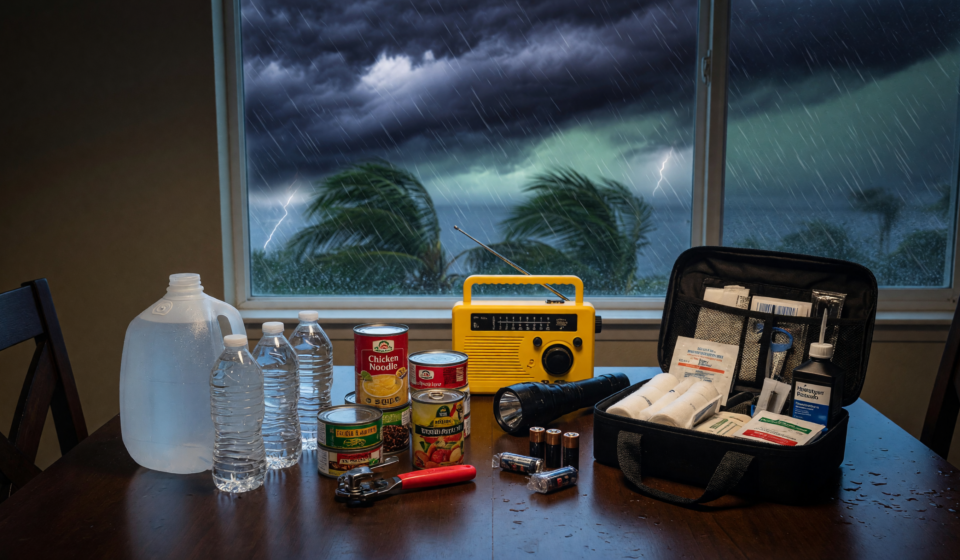
- Canned goods: Vegetables, beans, soups, tuna, chicken, and fruit, paired with a reliable manual can opener.
- Ready-to-eat staples: Peanut butter, crackers, granola and protein bars, dried fruit, nuts, and trail mix.
- Comfort and morale: A few familiar snacks and treats go a long way during a stressful, boring stretch indoors.
- Special diets: Infant formula and baby food, plus anything required for allergies or medical dietary needs.
Keep a manual can opener with the food; an electric one is useless in an outage. If you own a grill or camp stove, only ever operate it outdoors and well away from windows, never inside the home or garage. Eat the most perishable refrigerated items first, then move to the freezer, and only then into your shelf-stable stores.
The Core Kit Checklist
Beyond food and water, FEMA’s basic disaster supply kit is built from a short list of high-value items. Assemble these in a sturdy, easy-to-carry container such as a plastic bin or duffel, and store it somewhere everyone in the household can reach in the dark.
- First-aid kit: A well-stocked kit plus any personal supplies your family uses regularly.
- Flashlights: One per person, with extra batteries; avoid candles, which are a fire hazard.
- NOAA Weather Radio: Battery-powered or hand-crank, with a tone alert to wake you for overnight warnings.
- Extra batteries: In every size your devices require, stored separately and checked yearly.
- Whistle: To signal for help if you become trapped, without exhausting your voice.
- Dust masks, plastic sheeting, and duct tape: For filtering air or sheltering in place.
- Sanitation supplies: Moist towelettes, garbage bags, and plastic ties for personal hygiene when plumbing fails.
- Wrench or pliers: To shut off utilities such as gas or water if instructed.
- Manual can opener, local maps, and sturdy shoes and gloves for cleanup.
Once a year, ideally at the start of hurricane season on June 1, pull the whole kit out, replace expired food, water, and medications, test every light and radio, and swap batteries. A kit you never maintain is a kit that fails you at the worst possible moment.
👉 Shop comprehensive first-aid kit on Amazon (Ad — as an Amazon Associate, we earn from qualifying purchases.)
Power, Light, and Communication
Extended outages are the norm after a strong hurricane, so plan to run without the grid for days. Reliable light and a way to keep essential electronics charged are not luxuries. They keep you informed, connected to family, and able to power small medical devices.
- Lighting: LED flashlights and headlamps, battery lanterns, and glow sticks; keep candles out of the plan.
- Phone power: Fully charged power banks plus car chargers, topped off before landfall.
- Portable power station: A battery-based station can run a phone, a small fan, or a CPAP for hours without fumes, unlike a gas generator, which must always stay outdoors.
- Communication plan: A written list of emergency contacts and an out-of-town relative everyone can check in with if local lines are jammed.
Text messages often get through when calls will not, so conserve battery by texting. Keep one phone powered down as a reserve. Write down important numbers on paper, because a dead phone is also a dead contact list.
If you rely on a portable power station, learn its real-world runtime before the storm rather than during it. Match capacity to your must-run devices: a phone and a lantern draw very little, while a refrigerator, a medical device, or a window fan draw far more and will drain a small unit quickly. Recharge it fully before landfall, and consider a folding solar panel so you can top it back up during the long, sunny days that often follow a passing hurricane. Whatever your power plan, keep fuel and batteries stored safely and never refuel a hot generator.
👉 Shop portable power station / rechargeable flashlight on Amazon (Ad — as an Amazon Associate, we earn from qualifying purchases.)
Medications, Documents, and Cash
The supplies that are hardest to replace after a disaster are often the ones people forget. Pharmacies may be closed, ATMs and card readers may be down, and water-damaged paperwork can complicate insurance claims for months. A little organization now prevents a great deal of hardship later.
- Medications: At least a week’s supply of prescriptions, plus over-the-counter basics, spare eyeglasses, and any medical devices.
- Documents: Copies of IDs, insurance policies, deeds, medical records, and prescriptions in a waterproof, portable container, with digital backups in the cloud.
- Cash: Small bills in a range of denominations, since card systems and ATMs frequently fail during outages.
- Contact and account info: A written record of insurance, bank, and utility numbers you would otherwise look up online.
Photograph your home and valuables before the season starts. Time-stamped photos stored in the cloud make insurance claims far smoother if you sustain damage.
The Go-Bag and Your Evacuation Plan
A home kit is for sheltering in place; a go-bag is for leaving fast. If you live in an evacuation zone, keep a lightweight, grab-and-go version of your supplies packed and ready, because when an evacuation order comes, you may have only minutes. Know your zone and your route before the season begins, and never wait to be told twice.
- Three days of essentials: Water, ready-to-eat food, medications, first-aid supplies, and a flashlight per person.
- Documents and cash: Your waterproof document pouch and emergency cash, ready to grab.
- Comfort items: A change of clothes, sturdy shoes, rain gear, a blanket, and hygiene basics.
- Chargers and radio: Power banks, cables, and your NOAA Weather Radio.
Fuel your vehicle early, agree on a family meeting point and an out-of-area contact, and identify a shelter or the home of friends or relatives inland. If authorities issue a mandatory evacuation, leave immediately. Roads clog quickly, and low-lying routes flood, so an early departure is a safer departure.
Keep the go-bag physically separate from your larger home kit so it is never half-unpacked when you need it. Store it near the door you would actually use to leave, and pack a printed map of your evacuation route in case navigation apps fail or the roads are rerouted. If anyone in your household does not drive, arrange transportation well ahead of time, and check whether your community offers assisted evacuation for residents with disabilities or medical needs. A plan that exists only in your head is not a plan your family can execute without you.
Special Needs: Kids, Seniors, Pets, and Medical
A one-size-fits-all kit rarely fits a real household. Build outward from a solid base to cover the specific people and animals who depend on you, and involve older children in the planning so they know what to do if you are separated.
- Infants and children: Formula, bottles, diapers, wipes, and a few familiar comfort toys, books, or games to ease anxiety.
- Older adults: Extra medications, hearing-aid batteries, mobility aids, and a written medical summary; check on neighbors who live alone.
- Medical dependence on power: A plan and backup power for oxygen concentrators, CPAP machines, or refrigerated medicines, and early registration with your utility if available.
- Pets: Several days of food and water, a carrier, leash, vaccination records, and identification, since many shelters require proof.
Not every emergency shelter accepts pets, so identify pet-friendly shelters or lodging along your route in advance. Never leave an animal chained or locked outside during a storm.
After the Storm: Flooding, Generators, and Carbon Monoxide
Some of the most tragic hurricane injuries and deaths happen after the winds die down, when people let their guard drop. Two hazards deserve special respect: floodwater and carbon monoxide. Both are silent, and both are preventable.
- Never drive or walk through floodwater: Just six inches of moving water can knock you down, and a foot can float a car. Turn around, do not drown.
- Assume water is contaminated: Floodwater can carry sewage, chemicals, and debris, and hide downed power lines that make it electrically live.
- Run generators outdoors only: Keep any gas generator at least 20 feet from the home, away from windows and doors. Never operate one indoors, in a garage, or on a porch.
- Install carbon monoxide alarms: Battery-backed CO alarms are essential wherever a generator or fuel-burning device is used; the gas is invisible and odorless.
When you return home, watch for structural damage, gas leaks, and wildlife displaced by the flood. Wear sturdy boots and gloves during cleanup, and photograph damage before you remove anything for your insurance claim. If in doubt about safety, wait for official clearance before entering.
The Bottom Line
Hurricanes are among the few major disasters that give you days of warning, and that lead time is a gift only if you have already done the work. Store your gallon-per-person-per-day of water, stock non-perishable food, keep a NOAA Weather Radio and reliable light and power on hand, protect your medications, documents, and cash, and pack a go-bag if you live in an evacuation zone. Then respect the hazards that linger after landfall, especially floodwater and carbon monoxide. Build your kit on a calm day, maintain it once a year, and you will trade last-minute panic for quiet confidence when the next storm has your name on the map.
Disclaimer: This article is provided for general educational purposes only and does not constitute emergency, medical, or professional advice. Conditions vary by storm and location, and product needs differ by household. Always follow official orders and guidance from your local authorities, emergency managers, FEMA, and the National Weather Service, and evacuate immediately when instructed to do so.
Sources: FEMA/Ready.gov (Build A Kit, water and food guidance); NOAA National Weather Service and National Hurricane Center (Saffir-Simpson Hurricane Wind Scale, hurricane watch and warning definitions); American Red Cross (home and evacuation preparedness); U.S. Consumer Product Safety Commission and CDC (generator and carbon monoxide safety).