Bike Helmets Explained: MIPS, CPSC Certification and Proper Fit
A bicycle helmet is one of the few pieces of safety gear that has to do its entire job in the space of a few milliseconds, and it only gets one chance to get it right. That is why bike helmet safety is less about spending the most money and more about understanding three things: whether the helmet is certified, whether it manages the kind of forces that actually cause brain injuries, and whether it fits your head the way it is designed to. Get those right and an inexpensive helmet will protect you well. Get them wrong and even a premium lid can leave you exposed.
This guide walks through everything a rider in the United States needs to know. We will cover how a helmet physically absorbs a crash, what the CPSC certification sticker legally guarantees (and what it does not), how MIPS and other rotational systems work, and the step-by-step method for dialing in a proper fit. We will also look at independent lab ratings, when it is time to replace a helmet, what changes for kids, and the common mistakes that quietly undermine an otherwise good helmet. No hype, just the practical details that matter when your head meets the pavement.
Why Helmets Matter and How They Actually Work
A helmet has one core job: to slow your head down more gradually than the ground would. When your head stops suddenly, your brain keeps moving for an instant and strikes the inside of your skull. The goal of a helmet is to stretch that stop out over a few extra milliseconds and to spread the force across a wider area, dramatically lowering the peak forces that reach your brain.
It does this with a layer of crushable expanded polystyrene (EPS) foam, the same family of material as a foam cooler. In a crash, that foam permanently crushes and compresses, absorbing energy as it collapses. The hard outer shell spreads the impact and lets the helmet slide rather than snag on the road. This is also the single most important thing to understand about helmets: the protective foam is designed for one significant impact. Once it has crushed, that section has spent its protection, even if the helmet still looks perfectly fine from the outside.
The CPSC Certification Sticker: Your Legal Baseline
In the U.S., every bicycle helmet sold is legally required to meet the Consumer Product Safety Commission (CPSC) standard, codified as 16 CFR Part 1203. This is not optional or a marketing badge. A helmet that fails the standard violates the Consumer Product Safety Act, so if you buy a genuine bike helmet from a reputable retailer, it has already cleared a meaningful bar.
The standard tests helmets by dropping them onto anvils and measuring the force transmitted; a helmet fails if peak acceleration exceeds 300 g. It also checks that the retention system (the straps and buckle) holds the helmet in place during an impact and does not stretch excessively, that the helmet stays positioned on the head, and that it does not block peripheral vision. To verify compliance, look for a label inside the helmet stating that it meets the CPSC safety standard for bicycle helmets.
- What it covers: A baseline of straight-on impact protection, strap strength, stable positioning, and clear side vision.
- What it does not cover: Rotational forces from angled impacts, real-world fit on your specific head, or how the helmet ranks against others that also pass. Certification is a floor, not a ceiling.
- Watch out for: Novelty or “bike-style” helmets sold as costume or scooter accessories that never carry a CPSC label. If you cannot find the sticker, treat it as uncertified.
👉 Shop certified bike helmet on Amazon (Ad — as an Amazon Associate, we earn from qualifying purchases.)
MIPS and the Case for Rotational Protection
CPSC testing focuses largely on straight-on, linear impacts. But real crashes are rarely that clean. When you fall, your head almost always strikes the ground at an angle, and that angled hit twists the head. Those rotational forces are strongly associated with concussions and more serious brain injuries, and they are exactly what a certification sticker does not directly address.
MIPS, which stands for Multi-directional Impact Protection System, is the best-known technology built to tackle this. It adds a low-friction layer inside the helmet that lets the shell rotate slightly, roughly 10 to 15 millimeters, relative to your head during an angled impact. That small amount of controlled sliding is designed to redirect rotational energy away from your brain, loosely mimicking the way your brain can move within cerebrospinal fluid inside your skull. MIPS is not the only system doing this (other brands have their own rotational designs), but it is the most widely available.
Worth knowing. MIPS is an added layer of protection, not a substitute for certification or fit. A well-fitted CPSC helmet without MIPS still protects you; a MIPS helmet worn loose or tilted back does not deliver on its promise. Think of rotational protection as a valuable upgrade once the fundamentals are handled.
👉 Shop MIPS helmet on Amazon (Ad — as an Amazon Associate, we earn from qualifying purchases.)
How to Get the Right Fit: The Eyes, Ears, Mouth Check
A helmet only works if it is on your head correctly at the moment of impact. Fit is the part of bike helmet safety you control completely, and it costs nothing. The NHTSA and safety educators teach a simple, memorable routine built around three checkpoints: your eyes, your ears, and your mouth.
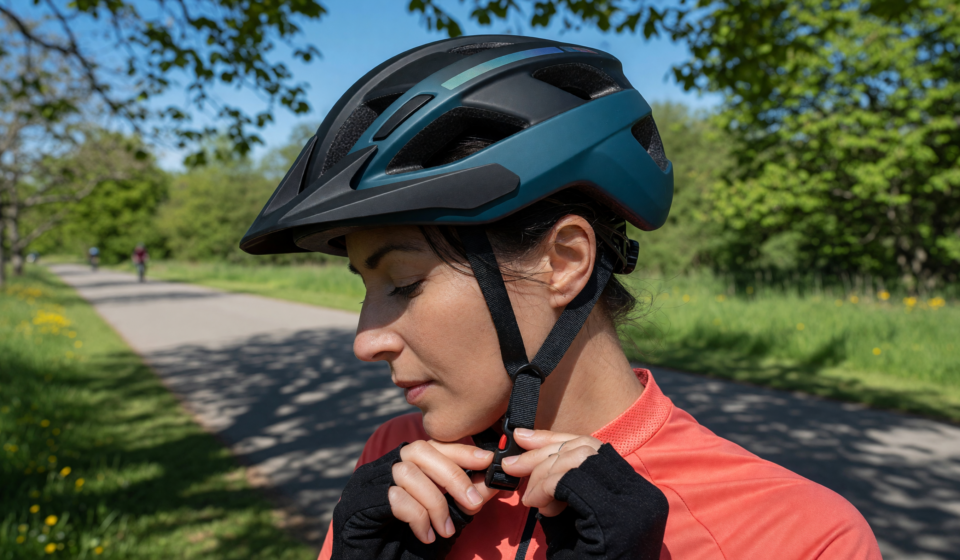
- Eyes (position): The helmet should sit level and flat on your head, not tipped back like a cap. Place two fingers flat above your eyebrows; the front rim should rest just above them, about two finger-widths from your brows. Look up and you should see the front edge.
- Ears (side straps): The side straps should form a snug V that meets just below and slightly in front of each ear. Adjust the sliders until the point of the V sits right under the earlobe.
- Mouth (chin strap): Buckle the chin strap and tighten it until only about one to two fingers fit between the strap and your chin. Now open your mouth wide as if yawning; a properly snug helmet will pull down gently on the top of your head.
Before every ride, do a quick shake test: with the straps fastened, nod and shake your head. A well-fitted helmet moves with your skin rather than sliding around. If it rocks forward, backward, or side to side, adjust the fit pads, dial, or straps until it stays put. Most modern helmets include a rear adjustment wheel that makes this easy to fine-tune.
Reading Independent Safety Ratings
Because CPSC certification is a pass/fail floor, it cannot tell you which certified helmet performs better than another. That is where independent testing helps. The best-known resource is the Virginia Tech Helmet Lab, which runs helmets through impacts at multiple locations and speeds, measures both linear and rotational forces, and publishes a STAR score along with a one-to-five-star rating.
- How to read it: More stars is better, and a lower STAR score reflects lower predicted injury risk. Five-star helmets are the top performers in the lab’s testing.
- Use it as a filter: Ratings are a great way to shortlist helmets, but they are one input. A four- or five-star helmet that fits your head is a better real-world choice than a five-star model that fits poorly.
- Cross-reference: Confirm any highly rated helmet still carries its CPSC label, then prioritize the models available in your size and shape.
When to Replace a Helmet
The clearest rule is the most important one: replace your helmet after any crash in which your head hit the ground, even if there is no visible damage. The protective foam is engineered to crush once, and after it has done so it can no longer offer the same protection. When in doubt, retire it. A new helmet is far cheaper than a head injury.
Absent a crash, general guidance is more relaxed than helmet marketing suggests. Many manufacturers recommend replacing a helmet every three to five years, largely to account for wear from sweat, sunlight, and handling, and to keep you on current technology. Independent testing has found that undamaged foam holds up well over many years, so the age clock is a guideline rather than a hard deadline. Inspect your helmet regularly and replace it sooner if you see cracked foam, a damaged shell, frayed straps, a failing buckle, or crushed internal padding.
Helmets for Kids
The same rules apply to children, with a few added considerations. Buy a helmet that fits now, not one they will grow into; a helmet perched on the back of the head or wobbling loose offers little protection. Look for the CPSC label, use the same eyes-ears-mouth fit check, and make sure the chin strap is snug enough that the helmet does not shift when they play.
- Fit the head, not the age: Measure the child’s head circumference and use the manufacturer’s sizing rather than a birthday.
- Check it often: Kids grow fast and are hard on gear, so re-check the fit every couple of months and after any tumble.
- Remove helmets off the bike: Children should take helmets off for playground equipment and climbing, where a buckled strap can become a strangulation hazard.
👉 Shop kids’ helmet on Amazon (Ad — as an Amazon Associate, we earn from qualifying purchases.)
Common Mistakes to Avoid
- Wearing it tilted back: A helmet pushed back off the forehead leaves your face and forehead exposed. Keep the front rim two finger-widths above your brows.
- Loose or twisted straps: If the chin strap is slack or the side straps do not form a clean V, the helmet can shift or come off in a crash.
- Keeping a crashed helmet: “It still looks fine” is not a safety standard. Once the foam has taken an impact, retire it.
- Buying by looks alone: Vents and colors matter less than certification, ratings, and fit. Choose a helmet that scores well and fits, then worry about style.
- Trusting a helmet without a label: No CPSC sticker means no guarantee. Skip novelty helmets that were never built to the standard.
The Bottom Line
A good helmet decision comes down to a short checklist. Start with a CPSC-certified helmet so you know it clears the legal safety floor. Favor models that score well in independent testing like the Virginia Tech ratings, and consider MIPS or another rotational system for added protection against the angled impacts that cause most real-world head injuries. Then spend a few minutes getting the fit right using the eyes, ears, and mouth check, and replace the helmet after any crash. Do those things and you have handled the parts of bike helmet safety that genuinely change outcomes, no matter your budget.
Disclaimer: This article is for general educational purposes only and is not medical or safety-engineering advice. No helmet can prevent all injuries, and wearing one does not guarantee protection in any given crash. Always follow the fit, use, and replacement instructions provided by your helmet’s manufacturer, and consult a qualified professional for guidance specific to your situation.
Sources: U.S. CPSC bicycle helmet standard (16 CFR Part 1203); U.S. Consumer Product Safety Commission (CPSC.gov) Bicycle Helmets guidance; Virginia Tech Helmet Lab bicycle helmet STAR ratings; National Highway Traffic Safety Administration (NHTSA) helmet fitting guide; Bicycle Helmet Safety Institute (helmets.org); MIPS (mipsprotection.com).