Whitewater Rafting Safety: Helmets, PFDs and Swiftwater Signals
The rapid you cannot hear yet is often the one that teaches you the most. On a fast, cold river, a swim that lasts only a few seconds can flip from a good story into a genuine emergency, and the difference usually comes down to gear that was chosen well and a crew that knows how to talk without shouting. That is what real whitewater rafting safety looks like: not luck, but a stacked set of small, deliberate decisions made before anyone touches the water.
This guide walks through the three pillars that keep rafters upright and accounted for: the helmet that guards your head against rock, the personal flotation device (PFD) that keeps your airway above the surface, and the swiftwater signals—hand, paddle, and whistle—that let a team coordinate over the roar of moving water. We will explain the why behind each choice in plain English, lean on U.S. standards and the agencies that set them, and point out where a piece of equipment earns its place in your kit.
Why Whitewater Demands Different Gear
Flat-water paddling and whitewater are not the same sport wearing different hats. Moving water carries force that a calm lake never will, and it hides its hazards under the surface: undercut rocks, strainers, and recirculating holes. The gear you wear has to do two jobs at once—keep you floating and let you swim aggressively toward safety. That is why a bulky offshore life vest, excellent for staying put and waiting for rescue, is the wrong tool on a river where self-rescue is the plan.
- Cold shock: Sudden immersion in cold water triggers an involuntary gasp and rapid breathing, which is exactly why keeping your head up matters so much in the first seconds of a swim.
- Current, not depth: Most river close calls involve entrapment or being pushed against an obstacle, not simply sinking—so mobility and impact protection carry real weight.
- Distance and noise: Rapids drown out voices, and boats spread out fast, which makes a shared signaling system essential rather than optional.
Helmets: Guarding Your Most Vulnerable Target
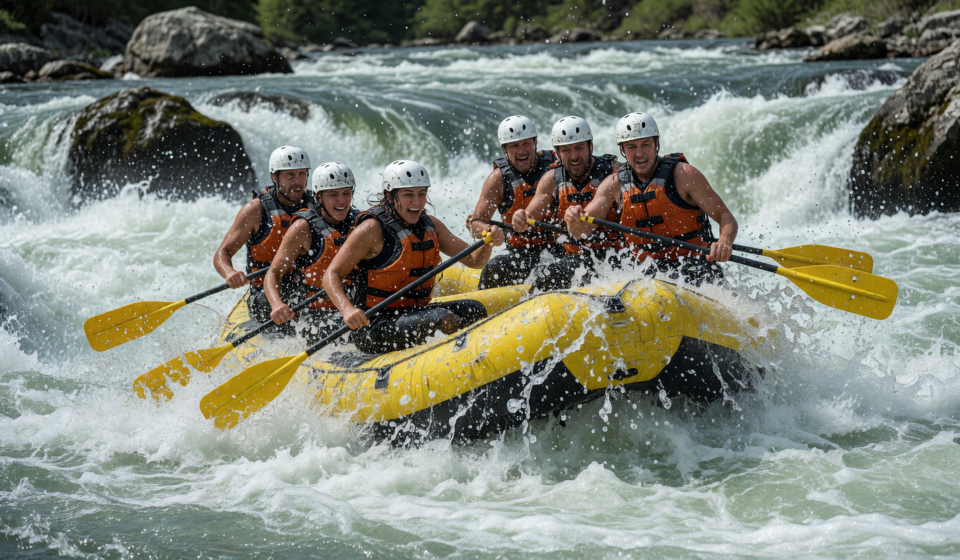
In whitewater, your head meets rock more often than any other part of your body during a flush or a flip. A proper river helmet is built to take repeated, glancing impacts and to shed water quickly so it does not turn into a bucket. Unlike bike or climbing helmets, whitewater helmets are designed to be worn wet, submerged, and knocked around, then to keep protecting on the next hit rather than being a single-impact shell.
There is no single mandatory U.S. federal helmet standard for whitewater the way there is for PFDs, so most quality river helmets are certified to the European standard EN 1385, which covers helmets for canoeing and white-water sports and tests coverage, retention, and impact. When you shop, treat EN 1385 certification as a meaningful baseline and prioritize fit above everything else—an uncertified or loose helmet protects far less than the label suggests.
- Coverage: Look for protection low on the back of the head and around the temples, the areas most exposed when you are swept downstream feet-first.
- Retention: A secure chin strap and adjustable cradle keep the helmet from shifting or peeling off in current—a helmet that slides is a helmet that fails.
- Drainage: Vents and ear openings should let water flow through so the helmet does not drag or trap water against your ears.
- Fit check: With the strap done up, the helmet should not rock forward past your eyebrows or tip back off your forehead.
👉 Shop EN 1385-certified whitewater helmet on Amazon (Ad — as an Amazon Associate, we earn from qualifying purchases.)
PFDs: Your Personal Flotation Lifeline
The PFD is the single most important item you wear on a river, and in the United States it must be Coast Guard–approved. The U.S. Coast Guard historically labeled life jackets by numbered Types—a Type III flotation aid, for example, is built for conscious users in inland water where quick rescue is likely, which describes most whitewater paddling. The Coast Guard has been transitioning to a simpler label system built around performance icons and buoyancy levels rather than the old Type numbers, but the underlying requirement is unchanged: wear an approved, properly fitted device, and actually buckle it.
For whitewater, paddlers generally choose a snug vest-style PFD with enough buoyancy to bring the head up quickly. Industry guidance from outfitters like NRS points to roughly 16 to 18 pounds of flotation as a common range for whitewater swimmers, above the Coast Guard minimum for an approved adult device. The exact number matters less than the fundamentals—approval, fit, and the discipline to wear it snugly every time you are on moving water.
- Coast Guard approval: Only a U.S. Coast Guard–approved PFD counts for legal and practical purposes—check the label before you trust it.
- Snug fit: Cinch the side straps so the vest cannot ride up over your face when you are hauled up by the shoulders—lift-test it on shore.
- Freedom to paddle: A whitewater cut leaves your arms and shoulders unrestricted so you can paddle and swim hard.
- Condition matters: Sun, salt, and abrasion degrade foam and straps over time, so retire a vest that is faded, torn, or waterlogged.
👉 Shop USCG-approved whitewater PFD (Type III) on Amazon (Ad — as an Amazon Associate, we earn from qualifying purchases.)
Rescue PFDs and the Quick-Release Harness
Guides and trained rescuers often step up to a rescue PFD—classified under the Coast Guard’s special-use category—which adds a chest harness with a quick-release buckle. That harness lets a rescuer clip into a rope system to reach a pinned swimmer or run a live-bait rescue, and the release lets them shed the rope instantly if the current loads it dangerously. It is a genuine force multiplier, and also a genuine hazard in untrained hands.
Train before you clip in. A quick-release rescue harness is only as safe as the swiftwater rescue course behind it. Clipping a rope to your body in current without hands-on training can turn a rescuer into a second victim—get certified before you rely on one.
If you are new to the sport, you do not need a rescue PFD on day one—you need a well-fitted flotation aid and the humility to let trained people run rescues. As you progress, a swiftwater rescue certification from a reputable provider is what unlocks the harness, not the purchase itself.
Reading the River: Swiftwater Hand Signals
Once boats spread out, voices are useless. American Whitewater publishes a widely adopted set of river signals in its Safety Code, and learning them is a core part of whitewater rafting safety because they let a whole group act on the same information at once. The beauty of the system is that it is visual, simple, and works at a distance—every paddler on the trip should know the same vocabulary before launch.
- All clear / go: A paddle or arm held straight up vertically means the way is open. Angling it left or right points toward the preferred line, never toward the hazard.
- Stop: Arms or a paddle held out horizontally to form a bar means hold your position; pumping the bar up and down adds urgency.
- Are you okay / I’m okay: Patting the top of the head is both the question and the answer that a person is safe.
- Point positive: Point toward the safe route or the direction of travel—never point directly at the obstacle you are trying to avoid.
- Swimmer / eddy out: Freestyle swimming motions flag a person in the water; a swirling motion followed by a point directs boats into a safe eddy.
The Whistle: Sound Signals When Words Fail
A pealess rescue whistle pierces through rapids far better than a shout, and it belongs on every PFD. Sound signals pair with the visual ones so a paddler can grab attention first, then communicate with hands. The convention most river runners follow is simple enough to remember under stress: one blast to get attention, and three to signal an emergency.
- One blast: “Attention” or “look at me”—used to draw eyes so a hand signal can follow.
- Three blasts: The widely recognized distress call meaning emergency or help—typically paired with arms waved in a crossing motion overhead.
- Keep it accessible: Clip the whistle where you can reach it with a gloved hand, not buried in a pocket.
- Brief everyone: Confirm the group agrees on what the blasts mean before launch, since local variations exist.
👉 Shop pealess rescue whistle and throw bag on Amazon (Ad — as an Amazon Associate, we earn from qualifying purchases.)
Building a Team Safety Culture
Gear and signals only work inside a culture that uses them. The strongest crews run a pre-launch briefing every single trip, no matter how familiar the run, so that newcomers and veterans share the same plan. That briefing is where you confirm signals, set the order of boats, identify who carries rescue gear, and agree on what happens if someone swims.
- Scout the unknown: When you cannot see the bottom of a rapid, get out and look before you commit—the American Whitewater Safety Code treats scouting as a normal, expected practice.
- Never boat alone: A second boat is your primary rescue resource; solo whitewater removes your best safety net.
- Know your limit: Match the river’s difficulty to the group’s honest skill level, and be willing to portage anything beyond it.
- Practice rescues: Throw-bag drills and swim practice in safe water build the reflexes you will need when it counts.
The Bottom Line
Whitewater rewards preparation more than nerve. A helmet certified to a recognized standard, a Coast Guard–approved PFD that actually fits, a whistle within reach, and a crew that shares one signaling language—these are the layers that turn a swim into a footnote instead of a headline. None of it is expensive relative to what it protects, and none of it works if it stays in the gear bag. Choose your equipment with intention, learn the signals cold, train before you take on a rescue role, and let the river be the thrill it is meant to be—because the paddler who plans for the worst rapid is the one who gets to enjoy all the rest.
Disclaimer: This article is for general educational purposes only and is not a substitute for hands-on instruction, a certified swiftwater rescue course, or the guidance of a qualified river professional. Standards, product designs, and regulations change over time; always verify current requirements and read manufacturer instructions before relying on any piece of safety equipment.
Sources: U.S. Coast Guard (PFD approval and labeling); American Whitewater (Safety Code and River Signals); EN 1385 (European standard for canoeing and white-water sport helmets); NRS (whitewater PFD buoyancy and PFD approval guidance).