
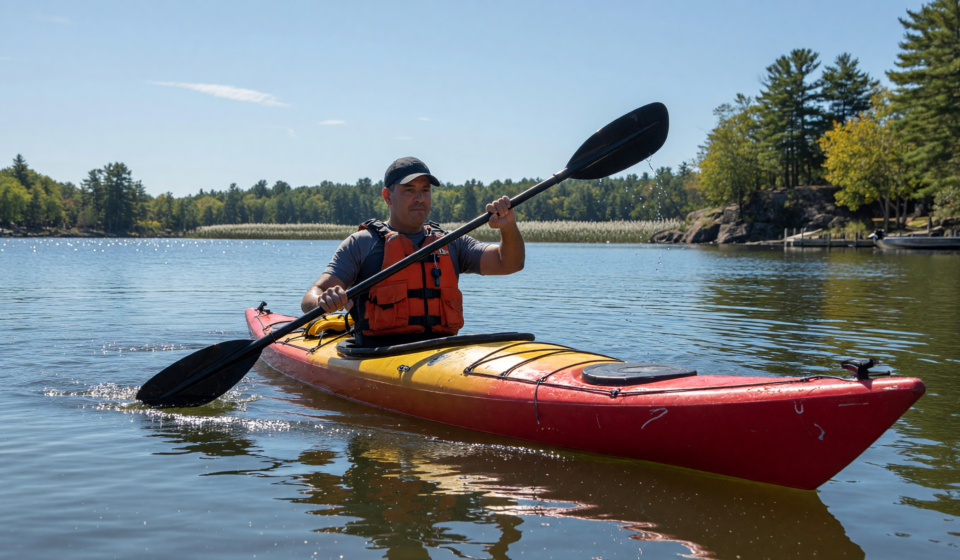
Kayak Safety Gear: PFDs, Bilge Pumps and Cold-Shock Awareness
A calm morning on flat water can turn on you in seconds. One unexpected wave, a slick rock, a gust that catches your paddle, and suddenly you are in the drink instead of on it. That single moment is exactly why kayak safety gear exists, and it is why the paddlers who make it home wet and laughing are almost always the ones who geared up before they ever pushed off the bank. Kayaking is one of the most accessible ways to get on the water in America, but that accessibility hides a hard truth: the water does not care how experienced you are, and the U.S. Coast Guard consistently reports that the overwhelming majority of drowning victims owned a life jacket and simply were not wearing it.
This guide walks through the equipment that genuinely earns its place in your cockpit and on your body. We will cover the personal flotation device (PFD) and the new labeling system now rolling out under Coast Guard rules, the humble but critical bilge pump, self-rescue tools like paddle floats and spray skirts, signaling and visibility gear, and how to dress for the water temperature instead of the air. Most of all, we will spend real time on cold-shock awareness, because cold water is the hazard that catches confident paddlers off guard more than any other. The goal here is not to scare you off the water. It is to help you understand the why behind each item so you make smart choices for your own paddling.
Start With the PFD: Your Most Important Piece of Kayak Safety Gear
If you buy one thing before your next trip, buy a life jacket that fits and commit to wearing it every single time. Under U.S. Coast Guard regulations, every kayak and canoe must carry a wearable, Coast Guard-approved PFD for each person aboard. Carrying one is the law, but wearing one is what saves your life. A PFD keeps your airway above the surface even when you are exhausted, disoriented, or unable to swim, and as you will see below, cold water can rob you of the ability to swim almost instantly.
Fit is everything. A jacket that rides up over your ears when you are in the water is worse than useless because it is not doing its job when you need it most. Look for these features when you shop:
- Snug but not restrictive: You should be able to take a full breath and rotate your torso to paddle, but the jacket should not slide up when a friend tugs the shoulders.
- Paddling-specific cut: Kayak PFDs use higher armholes and thinner foam at the shoulders so the jacket does not fight your stroke.
- Bright, visible color: High-visibility shells make you far easier to spot from another boat or from shore if something goes wrong.
- Pockets and attachment points: A place for your whistle, a knife, or a small signaling device keeps essentials on your body, not floating away with your boat.
👉 Shop paddling-specific PFD / life jacket on Amazon (Ad — as an Amazon Associate, we earn from qualifying purchases.)
Understanding the New PFD Labels
If you have shopped for a life jacket recently, you may have noticed the labeling is changing. For decades, the Coast Guard classified PFDs by “Type” (Type I through Type V), and a Type III flotation aid was the traditional pick for recreational kayaking. That system is being harmonized with international performance standards. Under the Coast Guard’s lifejacket approval harmonization final rule, which took effect in early 2025, new devices are approved against ANSI/CAN/UL 12402 standards and described by performance level rather than by the old Type numbers.
Here is what that means for you in practice:
- Your existing PFD is still fine: The Coast Guard has stated that previously approved life jackets remain legal to own and use, so you do not need to throw out a jacket you already trust.
- Performance levels describe buoyancy: New labels reference levels such as 50, 70, and 100, which broadly indicate how much flotation and turning support a device provides, from minimal-bulk aids to higher-buoyancy jackets.
- Match the device to the activity: A lower-bulk, higher-mobility PFD suits calm, warm, near-shore paddling; more buoyant designs make sense for rougher or colder water.
- Check for the approval statement: Whatever the label style, confirm the jacket is U.S. Coast Guard-approved and appropriate for your body weight and chest size.
Do not overthink the terminology. The best PFD is the one that fits you, suits your water, and is comfortable enough that you will actually keep it on.
Cold-Shock Awareness: The First Minute Is the Danger Zone
This is the section that matters most, and it is the one paddlers skip the most. Cold water does not have to be freezing to be deadly. According to the National Center for Cold Water Safety, cold-shock response becomes a serious risk in water below roughly 60 degrees Fahrenheit, and that describes a huge number of American lakes, rivers, and coastal waters well into spring and again in fall, even on warm, sunny days.
When you hit cold water unexpectedly, your body reacts before your mind can catch up. The first involuntary response is a sudden, deep gasp, followed by rapid, uncontrolled hyperventilation. If your head is underwater during that gasp, you can inhale water and drown almost immediately. At the same time, cold water triggers a sharp spike in heart rate and blood pressure that is dangerous in its own right. The National Weather Service and cold-water safety experts note that this initial phase, not long-term hypothermia, is what kills most people who fall into cold water.
Why the PFD is non-negotiable in cold water. During cold shock you cannot hold your breath, and hyperventilation makes it nearly impossible to swim even a few feet. A life jacket that is already on your body keeps your face out of the water while you fight to get your breathing back under control. Trying to don a PFD after you are already in cold water is not a realistic plan.
Cold-shock awareness comes down to a few practical habits:
- Know the water temperature, not just the air: A 75-degree afternoon over 52-degree water is cold-shock territory. Check conditions before you launch.
- Wear your PFD from the moment you launch: It is your only reliable insurance during the gasp-reflex phase.
- If you go in, do not panic: Grab your boat or another floating object, keep your airway up, and give your breathing time to settle before you try anything else.
- Dress for immersion: Insulation buys you time to self-rescue while your body is still working against you.
Bilge Pumps and Keeping Water Out of Your Boat
A kayak full of water is heavy, unstable, and hard to control, and a swamped boat is one of the most common ways a manageable situation turns into an emergency. A hand-operated bilge pump lets you evacuate water quickly after a wet exit, a breaking wave over the deck, or a sloppy re-entry. For sit-inside kayaks especially, a pump is standard safety gear, not an optional extra.
When choosing and stowing a pump, keep a few things in mind:
- Buoyant by design: Most paddling bilge pumps float, so a dropped pump does not sink to the bottom of the lake.
- Reachable, not buried: Stow it under a deck bungee or clipped where you can grab it one-handed, because you may be bracing with the other hand.
- Practice with it: Pumping out a cockpit while bobbing in waves is harder than it looks. Try it in calm, shallow water first.
- Pair it with a sponge: A big sponge mops up the last few inches of water a pump cannot reach.
👉 Shop floating hand bilge pump on Amazon (Ad — as an Amazon Associate, we earn from qualifying purchases.)
Self-Rescue Tools: Paddle Floats, Spray Skirts, and Practice
Gear that gets you back into your boat is just as important as gear that keeps you afloat. If you paddle a sit-inside kayak on open water, a paddle float turns your paddle into an outrigger that stabilizes the boat while you climb back into the cockpit. Combined with a bilge pump, it is the backbone of a solo self-rescue. A spray skirt, meanwhile, keeps waves and rain out of the cockpit in the first place, though it does add a skill requirement: you must be comfortable releasing it and wet-exiting under control.
- Paddle float: Inflatable or foam, it supports your weight during re-entry. Rehearse the technique before you rely on it.
- Spray skirt: Match it to your cockpit size, and always know how to find and pull the grab loop.
- Tow line or rescue belt: Useful for assisting a tired paddling partner back to shore.
- Practice, then practice again: Self-rescue is a perishable skill. Rehearse wet exits and re-entries every season, ideally in a class or with a group.
Signaling and Visibility Gear
Being seen and heard is a safety function in its own right. The Coast Guard requires kayaks and canoes to carry an efficient sound-producing device, which for most paddlers means a simple pealess whistle attached to the PFD. On coastal waters and the Great Lakes, visual distress signal requirements come into play, and if you paddle between sunset and sunrise you are required to have a means of displaying a white light in time to prevent a collision.
- Whistle: Cheap, effective, and required. Clip it to your life jacket where you can reach it, not inside a dry bag.
- White light: A headlamp or a mounted all-around white light covers you for low-light and night paddling.
- Visual distress signals: Know your local rules; coastal and Great Lakes paddlers may need approved day and night signals.
- Communication: A waterproof VHF radio or a phone in a waterproof case adds a way to call for help when it counts.
👉 Shop pealess safety whistle and white paddling light on Amazon (Ad — as an Amazon Associate, we earn from qualifying purchases.)
Dressing for the Water, Not the Weather
The clothing you wear is safety gear too, and it is the piece most people get wrong. On a warm day it is tempting to paddle in shorts and a T-shirt, but if the water is cold, that outfit offers no protection during the critical minutes after an unexpected swim. Dressing for immersion means choosing insulation based on how the water feels, not how the air feels.
- Wetsuit: A neoprene wetsuit traps a thin layer of water your body warms, buying time in cool conditions.
- Drysuit: For genuinely cold water, a drysuit worn over insulating layers keeps you dry and dramatically extends your survival window.
- Avoid cotton: Cotton holds cold water against your skin. Choose synthetic or wool base layers instead.
- Protect the extremities: Neoprene gloves, booties, and a warm hat matter more than you would expect once you are wet.
👉 Shop paddling wetsuit or drysuit on Amazon (Ad — as an Amazon Associate, we earn from qualifying purchases.)
Float Plans and Checking Conditions
The best safety equipment is the plan you make before you leave. A float plan is simply telling a reliable person where you are going and when you expect to be back, so someone knows to raise the alarm if you do not return. It costs nothing and it shrinks the time between “something went wrong” and “help is on the way.”
- Leave a float plan: Share your launch site, route, and expected return time with someone on shore.
- Check wind and weather: Offshore winds and building conditions can push a tired paddler away from safety fast.
- Respect your limits: Match the trip to your skill, your fitness, and the day’s conditions, and be willing to turn back.
- Paddle with others when you can: A group can assist with rescues that are difficult or impossible alone.
The Bottom Line
Kayaking rewards preparation, and the good news is that the gear that keeps you safe is neither expensive nor complicated. Wear a well-fitting, Coast Guard-approved PFD every time. Carry a bilge pump and know how to use it. Respect cold water for the fast, physical threat it is, and dress for immersion rather than for the forecast. Keep a whistle and a light on your body, leave a float plan, and practice your self-rescue before you need it. None of these habits will slow down a good day on the water, but any one of them could be the difference on the day that goes sideways. Gear up, check your conditions, and go enjoy the paddle.
Disclaimer: This article is for general educational purposes only and does not constitute safety, legal, or professional advice. Equipment requirements vary by state and by body of water, and regulations change over time. Always confirm current U.S. Coast Guard and state boating requirements, follow manufacturer instructions for any safety equipment, and seek qualified instruction before relying on self-rescue techniques.
Sources: U.S. Coast Guard, Office of Design and Engineering Standards (CG-ENG-4), PFD Selection, Use, Wear & Care; U.S. Coast Guard, Lifejacket Approval Harmonization Final Rule (effective January 6, 2025), referencing ANSI/CAN/UL 12402 standards; National Center for Cold Water Safety (coldwatersafety.org), Cold Shock; National Weather Service, Cold Water Hazards and Safety; BoatUS Foundation, USCG Equipment Requirements.