Ventilated Riding Helmets: Staying Cool Without Losing Protection
It is the middle of July, the arena has turned into a frying pan, and by your third rail your scalp feels like it is wrapped in a wet wool blanket. Anyone who has schooled a green horse in August knows the feeling: sweat stinging your eyes, a foggy head, and the very real temptation to leave the helmet on the fence rail for “just one lap.” That temptation is exactly why a good ventilated riding helmet matters. The goal is not to choose between comfort and safety, but to find headgear that keeps you cool enough to stay focused and, just as importantly, cool enough that you keep it on.
This guide walks through how ventilation actually works inside a riding helmet, whether those airy channels and vents compromise the shell’s ability to protect you, and what the US safety standards do and do not require. We will cover ASTM F1163, SEI certification, the role of MIPS and rotational impact protection, the independent Virginia Tech star ratings, and the everyday details of fit, care, and replacement. By the end you should be able to walk into a tack shop and read a helmet’s spec sheet with a clear head, no pun intended.
Why Heat Is a Genuine Safety Issue in the Saddle
Riders sometimes treat heat as a comfort problem and protection as a separate, more serious concern. In practice they are tangled together. Your brain is the most heat-sensitive organ you own, and a large share of body heat escapes through the head. Trap that heat under a snug foam-and-plastic dome for an hour and your body has to work harder to stay regulated. The result can be fatigue, slower reaction time, and lapses in concentration, none of which you want while sitting on a thousand-pound animal with its own opinions.
There is also the honest human factor. A helmet that bakes your head is a helmet you are tempted to take off, push back, or skip on a “quick” hack. The safest helmet in the world protects nothing on a fence post. Ventilation, then, is not a luxury add-on. It is part of what keeps the protective gear on your head where it belongs.
- Concentration: Overheating dulls focus and reaction time, which matters most in unpredictable moments.
- Compliance: A comfortable helmet is one you actually wear on every ride, not just in the show ring.
- Endurance: Staying cooler helps you ride longer and school more effectively without wilting.
How a Ventilated Riding Helmet Actually Keeps You Cool
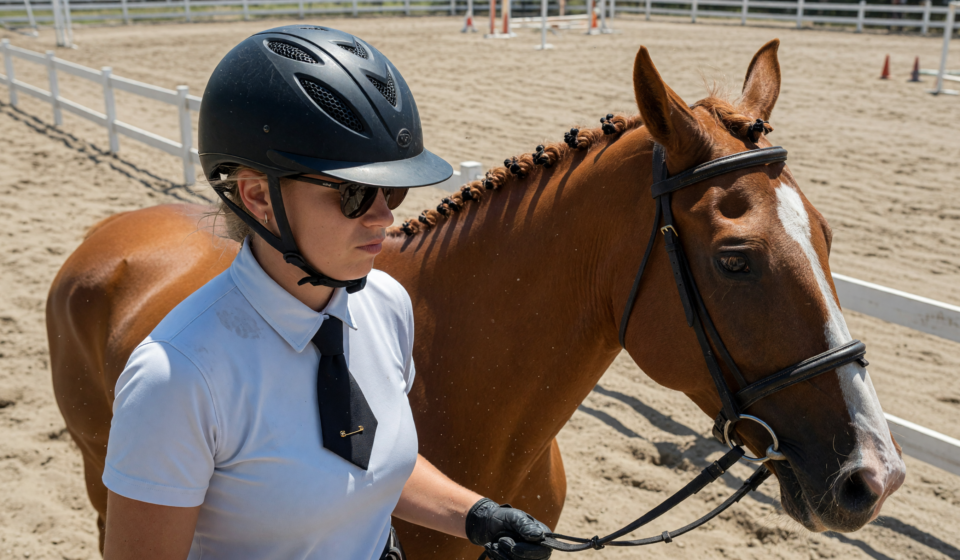
A well-designed ventilated riding helmet is not simply a shell with holes punched in it. The engineering goal is airflow: pulling cooler air in through front vents, channeling it across the scalp through molded grooves in the foam liner, and pushing warm, moist air out through rear exhaust ports. This “in the front, out the back” pattern uses the pressure difference created as you move to keep a light breeze circulating against your head.
The moisture-wicking padding matters just as much as the vents themselves. Removable, washable liners draw sweat away from your skin so it can evaporate rather than pool. Some helmets add antimicrobial treatments to keep odor down over a long season. When shopping, look at how the whole system works together rather than counting vent holes like they are a horsepower rating.
- Intake vents: Usually low on the front to catch air as you ride forward.
- Internal channels: Grooves molded into the foam liner that guide air across the scalp.
- Exhaust ports: Rear openings that let hot, humid air escape rather than sitting against your head.
- Wicking liner: Removable, washable padding that moves sweat off the skin to evaporate.
👉 Shop highly ventilated schooling helmet on Amazon (Ad — as an Amazon Associate, we earn from qualifying purchases.)
The US Standard That Matters: ASTM F1163 and SEI
In the United States, the benchmark for equestrian headgear is ASTM F1163, a standard developed by ASTM International specifically for protective headgear used in horse sports and horseback riding. A helmet meeting this standard has been designed and tested to absorb the kind of impact energy a rider’s head might experience in a fall from a horse. It is worth noting that bicycle, ski, or general sport helmets are engineered for different impacts and are not substitutes for a certified riding helmet.
The letters that give the standard teeth are SEI, the Safety Equipment Institute. SEI is an independent, third-party organization that tests and certifies that a manufacturer’s helmets actually comply with ASTM F1163, then continues to audit production. That combination, ASTM/SEI certification, is what US governing bodies rely on. The United States Equestrian Federation and the United States Pony Club require ASTM/SEI-certified helmets for the activities they oversee. When you see both marks on the label, you know an outside lab, not just the brand, has vouched for the helmet.
- ASTM F1163: The US performance standard written specifically for horseback riding impacts.
- SEI: The independent institute that certifies compliance and audits manufacturing.
- Look for both: A certified helmet carries a label or sticker naming ASTM F1163 and SEI certification.
- Not interchangeable: Bike and ski helmets meet other standards and do not satisfy equestrian requirements.
Do Vents Weaken Protection? What the Testing Says
This is the question that stops riders in the tack aisle: if I buy the airy helmet with big vents, am I trading away safety? The reassuring answer is that a properly certified ventilated helmet still has to pass the same ASTM F1163 impact and retention requirements as a solid-looking one. Certification testing also conditions helmets through temperature and moisture exposure before impact tests, so vented models are evaluated after being subjected to real-world hot and wet conditions, not just in a pristine state.
There is one honest nuance worth understanding. The ASTM/SEI protocol for riding helmets centers on impact absorption and the harness holding the helmet in place; it does not require a penetration or deformation test the way some other helmet standards do. That is part of why manufacturers can build in generous vents without failing certification. The takeaway is not that vents are dangerous, but that certification is the floor you should never go below, and vent placement is an engineering choice made within those rules.
Bottom line on vents. A ventilated helmet that carries current ASTM F1163 and SEI certification has met the same core impact and retention requirements as a less-vented one. Cooling and certification are not a trade-off. Skipping certification is.
Rotational Forces, MIPS, and the Virginia Tech Ratings
Certification confirms a helmet clears a defined safety bar, but it does not rank one certified helmet against another. That is where two newer developments come in. The first is technology aimed at rotational impact. Many falls twist the head rather than striking it straight on, and that rotation is strongly associated with concussion. Systems such as MIPS (the Multi-directional Impact Protection System) add a low-friction layer inside the helmet designed to let the shell rotate slightly relative to the head, redirecting some of that twisting energy.
The second development is independent rating. The Virginia Tech Helmet Lab publishes a star rating for equestrian helmets, using impact tests to measure how well each model reduces both linear and rotational acceleration, then awarding zero to five stars. It is a helpful comparison tool for shoppers, though it complements rather than replaces ASTM/SEI certification. Use certification as your non-negotiable baseline and the star ratings as a way to compare among helmets that already clear it.
- Rotational protection: Technologies like MIPS target the twisting forces linked to concussion.
- Virginia Tech stars: An independent zero-to-five scale comparing certified helmets on impact performance.
- Order of priority: Certification first as a floor, then star ratings and rotational features to compare.
👉 Shop MIPS-equipped ventilated riding helmet on Amazon (Ad — as an Amazon Associate, we earn from qualifying purchases.)
Fit Comes First, Airflow Second
Here is the part riders skip at their peril: the most advanced ventilated helmet on the market does nothing for you if it does not fit. A helmet that is too loose can shift or come off in a fall, and one that is too tight will give you headaches and tempt you to take it off. Ventilation is the tiebreaker after fit, not a reason to accept a poor fit.
To find your size, measure the circumference of your head about an inch above your eyebrows and compare it to the manufacturer’s chart, since sizing varies by brand and even by shell shape. The helmet should sit level, roughly two finger-widths above your brow, and feel snug all the way around without pressure points. When you shake your head with the harness undone, it should stay put rather than sliding. Only once it fits should you weigh how well it breathes.
- Measure properly: Wrap a soft tape about an inch above the eyebrows and check the brand’s chart.
- Sit level: The helmet should rest about two fingers above your brow, not tipped back.
- Snug, not painful: Firm contact all around with no hot spots or pinching.
- Stays put: With straps undone, a head shake should not send it sliding.
Caring for a Vented Helmet and Knowing When to Replace It
Vents and washable liners make hot-weather riding far more pleasant, but they also invite dust, sweat, and grime. Pull the liner and wash it by hand as the maker recommends, wipe the shell with mild soap and water, and let everything air-dry away from direct sun and heat, which can degrade the foam. Store the helmet somewhere cool rather than baking on a dashboard or in a hot trailer, and keep it in a bag so vent channels do not collect barn dust.
Even the best-kept helmet has a service life. Manufacturers and safety educators generally advise replacing a riding helmet around every five years from first use, because materials age and the protective foam slowly loses some of its ability to absorb energy. More urgently, replace a helmet after any significant impact or fall, even if it looks perfectly fine. The energy-absorbing liner is designed to crush and compress on impact, and that damage is often invisible from the outside. When in doubt, retire it.
- Clean gently: Hand-wash the removable liner and wipe the shell with mild soap; air-dry out of direct heat.
- Store cool: Keep it out of hot cars and trailers, and bagged against barn dust.
- Replace on schedule: Plan to retire a riding helmet roughly every five years from first use.
- Replace after impact: Any hard fall means a new helmet, since internal damage is often invisible.
👉 Shop helmet care kit and replacement liner on Amazon (Ad — as an Amazon Associate, we earn from qualifying purchases.)
The Bottom Line
Staying cool and staying protected are not opposing goals; the right ventilated riding helmet delivers both. Make ASTM F1163 and SEI certification your non-negotiable starting point, treat rotational-impact features like MIPS and the Virginia Tech star ratings as smart tie-breakers, and never let ventilation talk you out of a proper fit. Then take advantage of those vents and washable liners to ride comfortably through the hottest months. A helmet that keeps you cool is a helmet you will actually wear on every ride, and a helmet worn on every ride is the one doing its real job. This summer, do your head a favor: keep it cool, keep it certified, and keep it covered.
Disclaimer: This article is provided for general educational purposes only and does not constitute safety, medical, or professional advice. Always follow the manufacturer’s instructions and the rules of your governing equestrian organization, verify a helmet’s current certification before purchase, and consult a qualified professional for guidance specific to your riding discipline and needs.
Sources: ASTM International (ASTM F1163 Standard Specification for Protective Headgear Used in Horse Sports and Horseback Riding); Safety Equipment Institute (SEI) certification program; United States Equestrian Federation (USEF) and the United States Pony Club helmet requirements; MIPS (Multi-directional Impact Protection System); Virginia Tech Helmet Lab equestrian helmet ratings.