Field Hockey Shin Guards and Eyewear: Fall Season Protection Guide
A field hockey ball is small, dense, and unforgiving. On a crisp October morning, it can rocket off a stick or skip unpredictably across a wet turf field at a speed that leaves no time to react. That is the reality every player, coach, and parent signs up for when the fall season starts, and it is exactly why field hockey protection deserves more than a last-minute stop at the sporting goods store. The right gear does not slow you down; it lets you commit to the play without flinching.
This guide walks through the two pieces of equipment that matter most for the lower body and the face: shin guards and protective eyewear. We will cover how the rules actually work in U.S. high school play, what the ASTM F2713 eyewear standard means, how to judge fit, and when to replace worn gear. Along the way we will lean on the agencies that set the standards, so you can make decisions based on evidence rather than guesswork. Think of it as the pre-season conversation you wish someone had walked you through before your first game.
Why Fall Is Peak Season for Field Hockey Protection
In most of the United States, field hockey is an autumn sport. That timing shapes the risks. Fields harden as temperatures drop, morning dew and rain make the ball skid faster and lower, and shorter daylight pushes practices into flat, fading light. Add the natural congestion of a fast game—sticks, feet, and a ball all fighting for the same square foot of turf—and you have a season where good field hockey protection earns its keep. The lower legs and the eyes are the areas most exposed to a struck or lifted ball, which is why shin guards and eyewear are the centerpiece of any sensible kit.
- Hard ground: Cooler fall soil and packed turf give the ball more energy on the bounce.
- Wet conditions: Damp surfaces make the ball travel faster and stay low, right at shin height.
- Congested play: Corners and scrums concentrate players and sticks in a small space.
- Low light: Reduced visibility late in practice shortens reaction time.
How the Rules Actually Work
For U.S. high school competition, playing rules come from the National Federation of State High School Associations, better known as the NFHS. Equipment standards themselves are written by two independent bodies: ASTM International, which publishes the material and performance specifications, and the National Operating Committee on Standards for Athletic Equipment, or NOCSAE, which develops and certifies standards for a range of athletic gear. Understanding who does what helps you cut through marketing language on a product page.
One point that surprises many parents: eyewear is not always mandatory. The NFHS changed its field hockey rule for the 2020 season so that goggles became permitted rather than required for field players. The current language allows goggles to be worn by all field players, leaving the choice to families, schools, and state associations. Some states and leagues still mandate eye protection, so always confirm your local requirement with your coach or state association before the season opens.
- NFHS: Writes the high school playing rules, including what equipment is allowed or required.
- ASTM International: Publishes the technical standards such as F2713 for field hockey eye protectors.
- NOCSAE: Develops and certifies athletic equipment standards across many sports.
- Your state association: May add requirements stricter than the national baseline.
Shin Guards: Your First Line of Defense
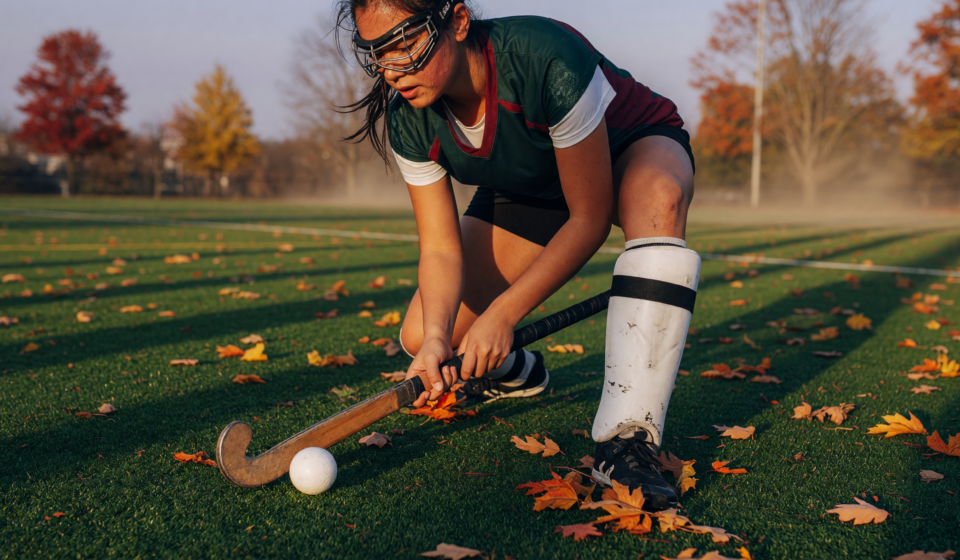
Shin guards are the workhorses of the kit. A field hockey guard is built differently from a soccer shin guard—it is generally longer, wraps further around the calf and ankle, and uses a harder outer shell to spread the force of a direct ball strike. The goal is simple: turn a sharp, localized impact into a dull, distributed one that the plastic and foam absorb instead of your tibia. Under NFHS uniform rules, shin guards must be visible, so tucking them entirely under a sock is not the intent; they are meant to be worn and seen.
When you compare guards, look past the color and pattern and focus on coverage and construction. A guard that stops an inch short at the ankle leaves one of the most painful and injury-prone spots exposed. Foam-only sleeves may feel comfortable but do little against a hard-struck ball, which is the exact threat field hockey presents.
- Hard outer shell: A rigid plate spreads impact rather than letting it concentrate on the bone.
- Full-length coverage: Protection should run from just below the knee to the top of the foot.
- Ankle wrap: Side and ankle coverage guards a vulnerable, bony area.
- Secure retention: Straps or a snug sleeve keep the guard from rotating out of place mid-game.
👉 Shop field hockey shin guards on Amazon (Ad — as an Amazon Associate, we earn from qualifying purchases.)
Eyewear and the ASTM F2713 Standard
If you choose to wear eye protection—or your league requires it—the specification to know is ASTM F2713, the standard specification for eye protectors for field hockey. Goggles built to this standard are designed around the unique threat of a small, hard ball, and a defining feature is a vertical bar positioned to protect the frontal cheekbone area. That vertical bar is what separates a legal field hockey goggle from a lacrosse goggle, which is built to a different ASTM standard, F3077, and is not interchangeable for field hockey play under NFHS rules.
Certification labeling matters as much as the design. Compliant goggles carry a permanent ASTM F2713 marking so officials can confirm they meet the standard at a glance. If a pair is unlabeled, or if it is actually a lacrosse or general sports goggle, it may be turned away at inspection—an avoidable headache on game day. It is also worth being honest about the limits of the standard: even certified goggles are engineered to reduce risk from indirect and glancing contact, not to guarantee immunity from every possible direct hit. Eye protection is one layer in a broader safety approach, not a force field.
Check the stamp, not the sport. A goggle sold for “lacrosse and field hockey” is not automatically legal for field hockey. Look for a permanent ASTM F2713 marking and the vertical front bar before you buy, and confirm your state association’s current requirement.
👉 Shop ASTM F2713 field hockey goggles on Amazon (Ad — as an Amazon Associate, we earn from qualifying purchases.)
Mouthguards, Gloves, and the Goalkeeper Exception
Field hockey protection extends beyond shins and eyes, and the rules treat goalkeepers as a special case for good reason—they stand in the line of fire on nearly every shot. Under NFHS rules, goalkeepers must wear a tooth and mouth protector that covers both the biting surfaces and the front of the teeth, and it has to be a visible color other than white or clear so officials can verify it is in place. Goalkeepers also wear dedicated hand protection with defined size limits, along with full head, chest, and leg padding that field players do not use.
Field players have more latitude. Many choose to wear a mouthguard even where it is not required, and lightweight gloves are common for grip and abrasion protection on cold, wet mornings. None of this is about piling on gear for its own sake—it is about matching the protection to the role and the conditions.
- Goalkeeper mouthguard: Required, must cover bite and front tooth surfaces, and be a non-white, non-clear color.
- Goalkeeper gloves: Dedicated hand protectors with size limits set by the rules.
- Field-player mouthguards: Often optional but widely recommended for dental protection.
- Gloves for field players: A practical choice for grip and warmth in fall weather.
👉 Shop field hockey mouthguard on Amazon (Ad — as an Amazon Associate, we earn from qualifying purchases.)
Fit and Sizing: Where Protection Succeeds or Fails
The best-rated gear in the world does nothing if it does not fit. A shin guard that slides around the leg exposes the very bone it is meant to shield, and a goggle that pinches or slips will be pushed up onto the forehead by the second half. Sizing is not a formality; it is the difference between equipment that works and equipment that just rides along for the game.
For shin guards, the hard shell should cover the length of the shin without digging into the ankle bone or crowding the back of the knee. For goggles, the frame should sit level, stay put when the player jogs and shakes their head, and leave no painful pressure points on the nose or temples. Young athletes grow fast, so a guard or goggle that fit last spring may not fit at fall tryouts—check before the first practice, not after the first bruise.
- Shin length: Coverage from below the knee to the top of the foot, with no gap at the ankle.
- Stable fit: Guards and goggles should not rotate or slide during quick movement.
- No pressure points: Comfortable contact means the athlete keeps the gear on and positioned correctly.
- Reassess each season: Growth and wear can quietly turn last year’s fit into this year’s gap.
Care, Replacement, and Cold-Weather Considerations
Protective gear wears out, and a cracked shell or a scratched, hazy goggle is a warning sign rather than a cosmetic quirk. A shin guard that has taken repeated hard hits can develop stress fractures in the plastic that reduce how well it spreads force. Goggles can loosen at the hinges or cloud enough to compromise vision, which creates its own hazard on a fast field. Inspect gear at the start of the season and periodically through it, and retire anything that is visibly damaged.
Cold weather adds a few practical wrinkles. Some plastics feel stiffer in low temperatures, straps can lose elasticity over time, and fogged lenses are a real nuisance on chilly mornings. Storing gear at room temperature rather than in a freezing car trunk, keeping straps clean, and letting goggles acclimate before play all help. Simple habits keep your field hockey protection performing the way it did on the day you bought it.
- Inspect regularly: Look for cracks, loose straps, and clouded or scratched lenses.
- Retire damaged gear: Compromised shells and hinges no longer offer full protection.
- Store smart: Room temperature preserves plastics and elastic better than a cold trunk.
- Manage fog: Let goggles adjust to conditions and keep lenses clean for clear sight lines.
The Bottom Line
Field hockey rewards players who can commit fully to a loose ball, and that confidence is far easier to find when you trust your gear. Start with well-built, full-coverage shin guards that meet your league’s expectations, and if you or your association call for eye protection, buy goggles that carry a genuine ASTM F2713 marking with the vertical front bar—not a lacrosse look-alike. Confirm your state’s current rules before the opener, fit everything to the actual athlete who will wear it, and inspect it as the fall wears on. None of this is complicated, and none of it should slow anyone down. Do it once at the start of the season, and you can spend the rest of the fall thinking about the game instead of the bruises.
Disclaimer: This article is for general educational purposes only and does not constitute safety, medical, or legal advice. Equipment rules vary by state association, league, and level of play and change over time. Always confirm current requirements with your coach, athletic director, or state association, and follow manufacturer instructions for fit, use, and replacement of any protective equipment.
Sources: National Federation of State High School Associations (NFHS) field hockey rules and 2020 eyewear rule change; ASTM International Standard Specification F2713 (Eye Protectors for Field Hockey) and F3077 (lacrosse eye protectors); National Operating Committee on Standards for Athletic Equipment (NOCSAE); American Optometric Association (AOA) and Prevent Blindness eye-safety guidance.