Fall Road Trip Safety: Packing for Sudden Weather and Long Drives
You leave the driveway on a crisp, sunny October morning with a full tank and a playlist queued up, and by the time you reach the mountains three hours later the temperature has dropped fifteen degrees, a wall of fog has settled into the valley, and the low afternoon sun is glaring straight through your windshield. That swing is the signature of autumn travel: one trip can carry you through warm sun, cold rain, early darkness, and a road carpeted in wet leaves. A fall road trip rewards you with some of the best scenery of the year, but the season also stacks up hazards that summer never throws at you.
This guide covers how to pack and prepare so those swings never catch you off guard. We will walk through the vehicle-readiness checks that matter most before you go, the emergency kit that agencies like Ready.gov and the American Red Cross recommend, how to handle sudden weather and low-visibility driving, why fatigue management on long drives is a safety issue and not just a comfort one, and the seasonal extras worth stashing in the trunk. The goal is simple: keep the trip about the leaves and the coffee stops, not about standing on a cold shoulder waiting for a tow.
Start With the Vehicle, Not the Suitcase
The most important safety gear on any road trip is the car itself. Fall is the transition into cold-weather driving, and a few checks before you leave prevent the majority of roadside breakdowns. The reason is physics as much as maintenance: as temperatures fall, so does tire pressure, roughly one PSI for every ten-degree drop, which means a tire that read fine in September can be underinflated by the first cold snap. Underinflated tires handle worse, wear faster, and are more prone to failure at highway speed.
- Tires and tread: Check pressure against the number on the driver-door jamb, not the sidewall, and confirm tread depth. AAA and NHTSA point to the penny test as a quick gauge; if the tread does not reach past the top of Lincoln’s head, the tire is worn out.
- Battery: Cold weather is hard on batteries that were already weakened by summer heat. If yours is a few years old, have it load-tested before a long trip.
- Lights: With daylight hours shrinking fast in autumn, headlights, brake lights, and turn signals do more work. Walk around the car and confirm every bulb works.
- Wipers and washer fluid: Fall means rain, frost, and road grime. Replace streaky blades and top off washer fluid with a formula rated for freezing temperatures.
- Fluids and belts: Coolant, oil, and belts all take on more strain as the mercury drops. A basic service visit is cheap insurance before a multi-state drive.
👉 Shop tire pressure gauge and portable inflator on Amazon (Ad — as an Amazon Associate, we earn from qualifying purchases.)
Build a Car Emergency Kit for the Season
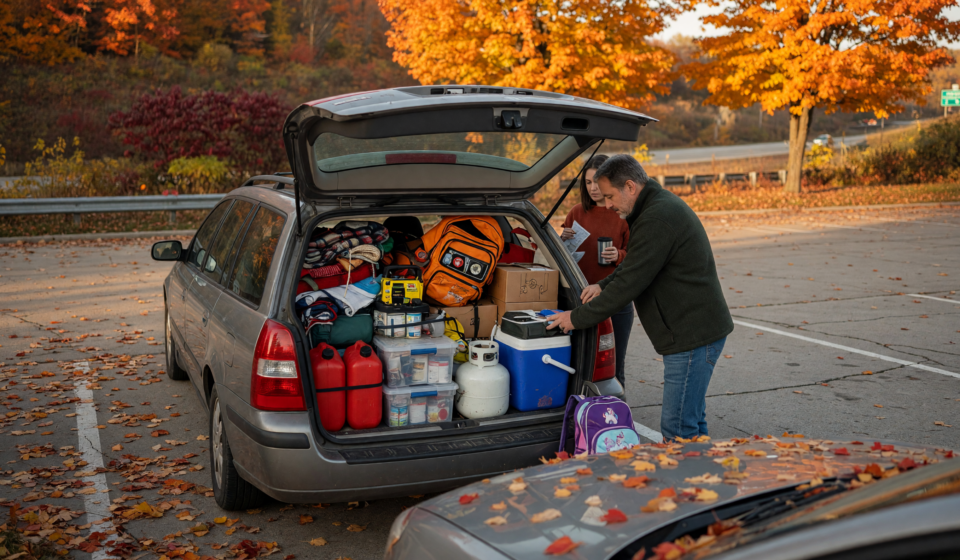
Ready.gov and the American Red Cross both recommend keeping a stocked emergency kit in every vehicle, and fall is the time to refresh it for colder conditions. The logic is straightforward: if you break down or get stranded on a rural highway after dark, help can be an hour away, and the temperature can be near freezing. Your kit bridges that gap. Start with the federal baseline and build from there.
- Jumper cables or a jump pack: Ready.gov lists jumper cables as a core item; a self-contained lithium jump starter means you do not need a second car.
- Flares or a reflective triangle: Making yourself visible on a dark shoulder is one of the highest-value things in the kit.
- Flashlight and spare batteries: A headlamp frees both hands if you need to change a tire in the dark.
- First aid kit: The Red Cross recommends a stocked, in-date first aid kit in every car.
- Warm layers and a blanket: Ready.gov specifically calls for a blanket; add hats, gloves, and an emergency mylar blanket for cold nights.
- Water and non-perishable snacks: Enough to keep everyone in the car steady if you are stuck for several hours.
- Phone charger and a backup battery: A dead phone turns a minor delay into a real problem.
👉 Shop prebuilt car emergency roadside kit on Amazon (Ad — as an Amazon Associate, we earn from qualifying purchases.)
Pack for Sudden Weather Swings
Autumn weather does not read your itinerary. A route that climbs in elevation or crosses a few hundred miles of latitude can move you from shirtsleeves to sleet in a single afternoon, and the National Weather Service routinely warns that the first frosts and freezes of the season arrive earlier at higher elevations. The fix is to pack in layers and assume the forecast at your destination is only part of the story.
- Dress in layers: A base layer, an insulating mid-layer, and a waterproof shell adapt to almost anything the day throws at you without overpacking.
- Rain protection: A packable rain jacket and a small towel handle the difference between a quick fuel stop and arriving soaked.
- Cold-weather extras: Even if the forecast looks mild, a hat and gloves weigh nothing and matter enormously if you are stopped on a shoulder.
- An ice scraper: Ready.gov lists it as a car-kit staple. Early-season frost is easy to underestimate until you are scraping a windshield with a credit card at dawn.
Check before you climb. Before any route that gains significant elevation, check the National Weather Service point forecast for the high country, not just your start and end cities. Mountain passes can hold snow and ice weeks before the valleys do, and conditions there change fast.
Master Low-Visibility and Slick-Road Driving
Two hazards define fall driving, and both come down to traction and sight distance. AAA warns that wet leaves can be as slick as ice, because a layer of decomposing leaves holds water and hides the pavement markings, potholes, and painted lines underneath. At the same time, the season’s low sun angle produces intense glare at sunrise and sunset, exactly when many people are commuting or wrapping up a day of driving.
- Slow down on leaves and in rain: Reduce speed and increase following distance. Braking and cornering both take longer than they look on a leaf-covered road.
- Use low beams in fog: High beams reflect off fog and reduce your vision. Low beams and, where equipped, fog lights keep the light on the road.
- Fight sun glare: Keep the inside of your windshield clean, keep sunglasses in the car, and use the visor. A dirty windshield scatters low light and makes glare far worse.
- Watch for deer at dawn and dusk: AAA notes that fall is peak season for deer-vehicle collisions. If a collision is unavoidable, brake firmly and stay in your lane rather than swerving into oncoming traffic.
- Give headlights time: Turn them on early in the afternoon as light fades. Being seen matters as much as seeing.
Manage Fatigue on Long Drives
Drowsy driving is one of the most underrated risks on any long trip, and NHTSA treats it as a serious impairment on par with other dangerous driving behaviors. Fall makes it worse: earlier darkness and the end of daylight saving time disrupt sleep rhythms, and long stretches of quiet interstate lull tired drivers into a dangerous glassy-eyed state. The warning signs are familiar and worth respecting.
- Know the signals: Frequent yawning, drifting from your lane, missing exits, and heavy eyelids all mean it is time to stop, not push through.
- Plan real breaks: A common rule of thumb is to stop roughly every two hours or 100 miles to stretch, hydrate, and reset your focus.
- Share the driving: If you have a second licensed driver, trade off before either of you is exhausted rather than after.
- Do not rely on tricks: Coffee and cold air buy minutes, not hours. NHTSA is clear that the only real fix for drowsiness is sleep.
- Time your start: Avoid launching a long drive when you would normally be asleep, and be extra cautious in the mid-afternoon and pre-dawn lulls.
👉 Shop LED headlamp and rechargeable flashlight on Amazon (Ad — as an Amazon Associate, we earn from qualifying purchases.)
Seasonal Extras Worth the Trunk Space
Beyond the core kit, a handful of fall-specific items earn their place in the trunk. These are the things you rarely need but are grateful for when you do, especially if your route runs through rural areas or higher elevations where the first winter weather can arrive early.
- Traction aid: Ready.gov recommends a bag of cat litter or sand to give tires grip if you get stuck on a slick or muddy shoulder.
- Small folding shovel: Useful for clearing snow or mud from around a stuck tire in early-season storms.
- Paper map or offline maps: Fall foliage routes often run through areas with spotty cell coverage. Download offline maps before you lose signal, and keep a paper backup.
- Reflective vest: If you have to step out on a shoulder in low light, a high-visibility vest makes you dramatically easier to see.
- Multipurpose tool and duct tape: Small field repairs can get you to the next town when a shop is miles away.
Plan the Route Around Daylight and Weather
Good planning removes hazards before you ever hit them. With daylight shrinking through the fall and standard time returning in early November, the same 400-mile drive that finished in daylight in August can end in full darkness by late October. Build your itinerary around that reality rather than fighting it on the road.
- Front-load the miles: Start early and aim to do the longest stretches in daylight, when visibility and reaction time are best.
- Check the forecast the morning of: Autumn systems move quickly. Look at the National Weather Service forecast and any advisories for every region you will cross.
- Keep the tank above half: Ready.gov advises keeping fuel topped up in case of detours, closures, or long waits, which are more likely when weather turns.
- Tell someone your plan: Share your route and expected arrival with a friend or family member so someone knows to check in if you go quiet.
The Bottom Line
Fall is arguably the best season to be on the road, but it asks more of you than a summer cruise does. The through-line of every tip here is simple: prepare for the swing. Service the car, stock a real emergency kit, pack layers for weather you cannot see coming, respect wet leaves and low sun, and treat fatigue as the safety issue it is. Do that, and a sudden drop in temperature or a fog bank in the valley becomes a story you tell later instead of a roadside emergency. Load the trunk with intention, give yourself daylight and margin, and let the trip be about the leaves.
Disclaimer: This article is provided for general educational purposes only and does not constitute professional, mechanical, medical, or safety advice. Vehicle conditions, road conditions, and weather vary widely; always follow your vehicle owner’s manual, local laws, and the guidance of qualified professionals and official agencies. Check current conditions and advisories before you travel.
Sources: National Highway Traffic Safety Administration (NHTSA) — drowsy driving and winter/seasonal driving guidance; Ready.gov (FEMA) — Car Safety and emergency supply kit recommendations; American Automobile Association (AAA) — fall driving safety tips; American Red Cross — car emergency kit guidance; National Weather Service (NWS) — seasonal weather and forecast guidance.