Outdoor Workout Safety: Sun Timing, Grip and Cooling Recovery
There is a particular kind of afternoon that feels perfect for a run and is actually working against you. The sky is bright, the pavement is radiating heat you can feel through your shoes, and your shadow has shrunk to a puddle at your feet. That short shadow is the sun’s quiet warning: it is directly overhead, ultraviolet radiation is near its daily peak, and the same conditions that make the light feel glorious are stacking the deck for sunburn, dehydration, and heat illness. Outdoor workout safety is less about toughing it out and more about reading those signals before they read you.
This guide walks through the three things that quietly decide whether an outdoor session leaves you stronger or sidelined: sun timing, grip, and cooling recovery. We will cover how to schedule around peak ultraviolet exposure using the EPA UV Index and the National Weather Service, what the FDA sunscreen label is really telling you, why traction underfoot and in your hands prevents the falls that end training blocks early, and how to hydrate and cool down using the same “water, rest, shade” logic that OSHA and NIOSH give outdoor workers. None of it is complicated. All of it is easy to skip when the weather looks inviting.
Time the Sun: Why the Midday Window Is the Danger Zone
The strength of ultraviolet radiation is not constant across the day. According to the U.S. Environmental Protection Agency, UV exposure is strongest from late morning through mid-afternoon, when the sun sits highest and its rays travel the shortest path through the atmosphere. The EPA’s “shadow rule” turns this into something you can check without any app at all: when your shadow is shorter than you are tall, UV levels are high and you should treat the sun with respect. A long shadow in the early morning or evening means gentler light and a safer window for hard efforts.
Practically, that gives outdoor athletes two friendly windows on hot, clear days:
- Early morning: Lower UV, cooler air, and firmer footing before pavement and trail surfaces bake all day.
- Evening: UV drops as the sun lowers, though built-up ground heat can linger, so hydration still matters.
- Midday, if you must: Shorten the session, seek shaded routes, and lean harder on sunscreen, a hat, and covered skin.
Read the UV Index and HeatRisk Before You Head Out
The EPA UV Index is a simple forecast scale that runs from low to extreme, and it is worth a ten-second glance before you lace up. In the EPA’s guidance, low readings call for minimal protection, moderate to high readings mean you should seek shade around midday and cover up with sunscreen, protective clothing, a wide-brimmed hat, and sunglasses, and very high to extreme readings call for extra caution and shade during those peak hours. The higher the number, the faster unprotected skin can burn, which shortens how long you can safely stay out.
Heat is a separate hazard from UV, and it has its own forecast tools. The National Weather Service publishes HeatRisk, a color-coded map that flags days when heat is likely to affect health, and the OSHA-NIOSH Heat Safety Tool app estimates the heat index for your location along with reminders for hydration and rest breaks. Checking both the UV Index and a heat forecast before a session is the outdoor-training equivalent of a pre-flight check: quick, boring, and occasionally the thing that saves your day.
Quick check. Before an outdoor workout, glance at three things: the EPA UV Index for your ZIP code, the NWS HeatRisk level, and your own shadow. If the index is high, HeatRisk is elevated, and your shadow is short, move the hard effort to the edges of the day.
Sunscreen and Cover-Up: What the FDA Label Actually Tells You
Sunscreen is the most misused piece of gear in any athlete’s bag, mostly because people trust the number on the front and ignore the instructions on the back. The U.S. Food and Drug Administration recommends choosing a broad-spectrum product, which protects against both UVA and UVB rays, with an SPF of 15 or higher used regularly and as directed. SPF mainly reflects UVB protection, so “broad spectrum” is the word that guarantees you are also covered against the UVA rays tied to longer-term skin damage.
For anyone who sweats, the fine print matters even more:
- Reapply every two hours: The FDA advises reapplying at least that often, and more frequently when you are sweating heavily or swimming.
- Know your water-resistance rating: Products labeled water resistant must state whether they hold up for 40 or 80 minutes of swimming or sweating. There is no “waterproof” sunscreen.
- Apply generously and early: Thin coats underperform their SPF, so put it on before you head out, not after you are already flushed.
- Cover what you can: A wide-brimmed hat, sunglasses, and light protective clothing do work sunscreen cannot, which is why NIOSH lists them for outdoor workers.
👉 Shop broad-spectrum sweat-resistant sport sunscreen on Amazon (Ad — as an Amazon Associate, we earn from qualifying purchases.)
Grip: Traction Underfoot and in Your Hands
Grip rarely makes the highlight reel, but it quietly decides how many sessions you actually complete. A slip on wet grass, loose gravel, or a sweat-slick bar does not just interrupt a workout; it is one of the most common ways recreational athletes pick up sprains, strains, and worse. Traction is the difference between planting a foot with confidence and hoping the ground cooperates.
Footwear is where grip starts. Outsole traction is measurable, and ASTM International maintains standardized slip-resistance test methods for footwear precisely because friction is not a marketing guess. In plain terms, an aggressive lugged outsole bites into trail and grass, while a flatter, stickier rubber suits dry pavement and gym floors. Matching the shoe to the surface, and retiring shoes once the tread has worn smooth, does more for stability than any single strength exercise.
👉 Shop trail and cross-training shoes with grippy outsoles on Amazon (Ad — as an Amazon Associate, we earn from qualifying purchases.)
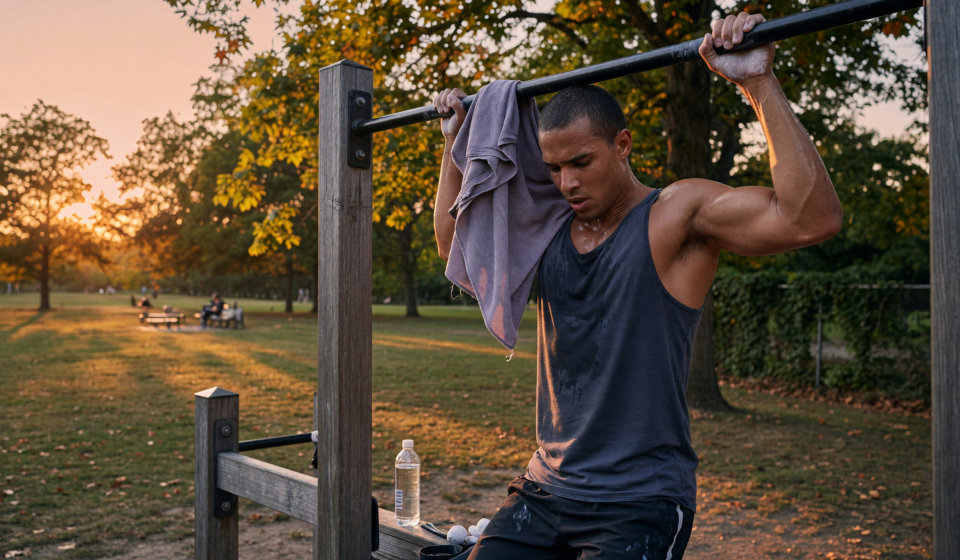
Hand grip deserves the same attention, especially in heat when sweat turns a pull-up bar or kettlebell handle into a liability. Chalk, grip-focused gloves, and clean, dry equipment all reduce the odds of a hand slipping mid-rep. The goal is not to muscle through a slick grip but to remove the slickness so your strength actually transfers to the movement.
Hydration and Heat: Water, Rest, Shade
OSHA’s heat-illness prevention message for outdoor workers boils down to three words that apply just as well to athletes: water, rest, shade. The body cools itself mainly by sweating, and sweating only works if you replace the fluid you lose. Wait until you feel thirsty and you are already behind, because thirst tends to lag behind actual fluid loss during hard effort in the heat.
- Drink on a schedule: Sip regularly through a session rather than gulping once at the end, mirroring the steady-hydration approach OSHA and NIOSH recommend.
- Take real breaks: Short rests in the shade let your core temperature settle before it climbs into dangerous territory.
- Mind heavy sweat: Long or intense efforts in heat cost you electrolytes as well as water, so plan replacement accordingly.
- Carry your own supply: A route with no water fountain is a route where you carry water, full stop.
👉 Shop insulated hydration pack or bottle on Amazon (Ad — as an Amazon Associate, we earn from qualifying purchases.)
Know the Warning Signs of Heat Illness
Heat illness sits on a spectrum, and the earlier you catch it, the less dangerous it is. Heat cramps and heat exhaustion are the body waving a flag: heavy sweating, muscle cramps, weakness, dizziness, nausea, headache, and clammy skin are all signals to stop, get into shade, and cool down. The right response at this stage is simple and usually enough.
Heat stroke is the emergency end of that spectrum. Confusion, slurred speech, fainting, or a body that has stopped sweating and turned hot are signs that the body’s cooling system has failed. This is a call-911 situation, not a walk-it-off situation. Knowing the difference between “I need to cool down now” and “this person needs emergency care” is one of the most valuable pieces of outdoor knowledge any athlete or training partner can carry.
Cooling Recovery: Cool First, Then Everything Else
Recovery from heat is not just about feeling better; done right, it is a safety measure. For genuine exertional heat stroke, sports-medicine experts including the Korey Stringer Institute emphasize rapid, aggressive cooling, and cold-water immersion is the most effective field method for pulling core temperature down quickly. The guiding principle taught to athletic trainers is “cool first, transport second,” because minutes of high core temperature are what cause harm. That is emergency care, and it belongs alongside a call to 911, not instead of one.
For ordinary post-workout recovery on a hot day, the same physics work in gentler forms. Getting into shade, loosening or removing hot clothing, and applying cool water, a cold, damp towel, or a cooling pack to the skin all help shed heat faster than simply standing around. Pair that with steady rehydration and you give your body the fastest path back to baseline.
👉 Shop cooling towel or reusable cold pack on Amazon (Ad — as an Amazon Associate, we earn from qualifying purchases.)
Build Up Gradually: Let Your Body Acclimatize
One of the most overlooked safeguards is time. NIOSH and OSHA stress heat acclimatization for workers new to hot conditions, and the same holds for athletes: the body adapts to training in heat over a span of days to a couple of weeks, sweating more efficiently and managing core temperature better as it goes. The people most at risk are often the fittest ones who assume conditioning transfers instantly to a heat wave or a new climate.
The takeaway is to ramp intensity and duration in the heat gradually rather than launching into your hardest session on the first blazing day of summer. Early-season heat, the first hot day after a cool stretch, and travel to a hotter place all deserve a lighter, shorter start while your body catches up.
The Bottom Line
Training outside is one of the best things you can do for your body, and it rewards a little planning far more than a lot of grit. Check your shadow and the UV Index, aim your hardest efforts at the cooler edges of the day, wear broad-spectrum sunscreen the way the FDA label describes, put real traction under your feet and in your hands, and treat water, rest, and shade as equipment rather than luxuries. Learn the warning signs of heat illness, know that cooling comes first in an emergency, and give your body time to adapt to the heat. Do those things and the sun becomes a training partner instead of an opponent, session after session, all summer long.
Disclaimer: This article is for general educational purposes only and is not medical advice. Individual heat tolerance, skin sensitivity, and health conditions vary. Consult a qualified healthcare professional before beginning or changing an exercise program, and seek emergency care immediately if you suspect heat stroke.
Sources: U.S. Environmental Protection Agency (UV Index Scale and sun-safety guidance); U.S. Food and Drug Administration (sunscreen labeling and use); Occupational Safety and Health Administration (Heat – Water. Rest. Shade.); National Institute for Occupational Safety and Health, CDC (heat stress and sun-exposure guidance); National Weather Service (HeatRisk); ASTM International (footwear slip-resistance test methods); Korey Stringer Institute, University of Connecticut (exertional heat stroke and cold-water immersion).