
Off-Season Dryland Training Safety for Skiers and Snowboarders
Ask any orthopedic surgeon who works with the U.S. ski community and they will tell you the same uncomfortable truth: a lot of the knee injuries that end up on the operating table in January were set in motion long before the first snowfall. An athlete who spent the summer sitting still asks a cold, deconditioned body to absorb the loads of a mogul field on day one, and the tissue simply is not ready. That gap between what your legs can do in July and what the mountain demands in December is exactly where off-season preparation earns its keep.
This guide walks through dryland training safety for skiers and snowboarders from the ground up. We will cover how to build a smart dynamic warm-up, how to progress strength training without overreaching, how to land plyometrics in a way that protects your knees, and how to think about recovery, hydration, and the gear that actually belongs in your gym bag. The goal is not to turn you into a physiologist. It is to help you train hard in the off-season and still arrive at the trailhead healthy, strong, and ready to enjoy the season you have been waiting for.
Why Dryland Training Safety Matters
Dryland training is any conditioning you do off the snow: strength work, jumps, agility drills, mobility, and cardio. Done well, it is one of the best insurance policies a winter athlete has. Done carelessly, it becomes its own source of injury. The whole point of dryland training safety is to make sure the work you do to get ready for the season does not sideline you before it starts. Skiing and snowboarding place unusual demands on the knee, hip, and core, and the anterior cruciate ligament (ACL) in particular is a known vulnerability for alpine athletes, so the way you prepare those structures matters.
The encouraging news is that structured, progressive conditioning is widely recommended by sports medicine bodies as a way to reduce injury risk and improve performance. The American College of Sports Medicine (ACSM) and the National Strength and Conditioning Association (NSCA) both publish guidance built on the same core idea: prepare the body gradually, respect technique, and let capacity catch up to ambition before you chase intensity.
Warm Up the Way the Evidence Suggests
A warm-up is not a formality you rush through to feel virtuous. Its job is to raise your core temperature, get blood into the muscles, and rehearse the movement patterns you are about to load. Current evidence favors a dynamic warm-up over long bouts of static stretching before training. Static holds have their place, but doing them cold, right before explosive work, can briefly blunt power output without offering much protection. Movement-based preparation gets you readier for what comes next.
- Raise the temperature first: Five to ten minutes of easy cardio (bike, brisk walk, light jog) before anything explosive.
- Move through full ranges: Leg swings, walking lunges, hip openers, and bodyweight squats to wake up the joints you will use.
- Rehearse the pattern: A few light, controlled reps of the day’s main lift or jump before you add load or height.
- Save static stretching for after: Long holds are better suited to your cool-down, when they can help you relax and recover.
Build Strength Before You Chase Speed
Strength is the foundation everything else sits on. A body that can squat, hinge, and brace under control has the raw capacity to absorb the forces of a hard turn or an awkward landing. But strength has to be built in order, and the single most common dryland mistake is adding load or volume faster than the body can adapt. Connective tissue like tendons and ligaments strengthens more slowly than muscle, so your legs may feel ready for more weeks before your joints truly are.
ACSM’s resistance training guidance for healthy adults centers on training the major muscle groups a couple of times per week, using a weight you can control through a full range of motion, and progressing gradually over time. For winter athletes that means prioritizing the posterior chain, quadriceps, and core, and treating each jump in load as something you earn rather than something you assume.
- Master the movement first: Own the bodyweight version of a squat, hinge, lunge, and single-leg balance before you load it.
- Progress in small steps: Add modest load or a rep or two at a time rather than big leaps week to week.
- Train both legs alone: Single-leg work exposes and fixes side-to-side imbalances that skiing will otherwise punish.
- Keep a rep in reserve: Stopping a set before technique breaks down is where safe strength is actually built.
👉 Shop stable flat-soled cross-training shoes for lifting and dryland work on Amazon (Ad — as an Amazon Associate, we earn from qualifying purchases.)
Land Your Plyometrics Without Wrecking Your Knees
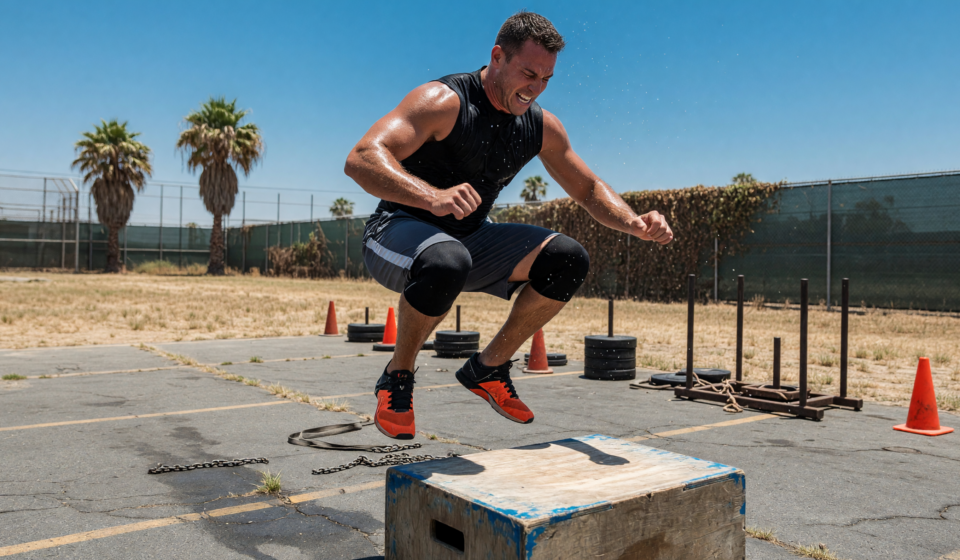
Plyometrics, box jumps, bounds, and hops, teach your body to produce and absorb force quickly, which is exactly what skiing and riding demand. They are also where dryland athletes get hurt most often, because the landing is where all the load lives. The NSCA’s guidance on plyometric training emphasizes building an adequate strength base first, keeping volume conservative, landing on a forgiving surface, and treating every rep as a technique rep rather than a max-effort one.
- Earn the right to jump: Build a base of controlled strength before adding true plyometrics to the mix.
- Land soft and aligned: Absorb through the hips and knees with knees tracking over the toes, never caving inward.
- Step down, don’t jump down: Stepping off a box protects the ankle and Achilles far better than repeated drop landings.
- Keep volume honest: Quality contacts on fresh legs beat a high rep count on tired ones; fatigue is where form fails.
- Use a forgiving surface: A rubber gym floor or a proper mat beats concrete for every landing you take.
Landing rule of thumb. If you cannot land quietly and under control, the drill is too hard, too high, or you are too fatigued to keep doing it. A loud, stiff landing with the knees drifting inward is the body telling you to scale back, not push through.
Protect the Knee: ACL-Smart Movement
The ACL is a small ligament with an outsized influence on a skier’s season. It is most vulnerable during awkward landings, sudden deceleration, and moments when the knee collapses inward while the foot is planted, precisely the situations that dryland training can rehearse safely at low speed. Neuromuscular training programs that teach the body to land, cut, and decelerate with better mechanics are among the most studied tools for reducing knee injury risk in athletes.
- Train deceleration on purpose: Learning to stop and change direction under control is as valuable as learning to explode.
- Fix the inward knee: Cue the knee to track over the second toe on every squat, lunge, and landing.
- Balance the hamstrings and quads: Strong hamstrings help stabilize the knee and take strain off the ACL.
- Build single-leg control: Most real-world knee injuries happen on one leg, so train balance and strength that way too.
👉 Shop balance trainer or foam balance pad for single-leg stability work on Amazon (Ad — as an Amazon Associate, we earn from qualifying purchases.)
Gear That Earns a Spot in Your Bag
Dryland training does not require a warehouse of equipment, but a few well-chosen items make the work safer and more consistent. The priority is anything that improves your footing, cushions your landings, or helps you recover between sessions. Cheap, unstable, or worn-out gear is a false economy when a rolled ankle can cost you the first month of the season.
- Supportive footwear: A flat, stable trainer gives you a secure base for lifts and lateral work; running shoes with soft, high heels are the wrong tool here.
- A quality mat or platform: A dense exercise mat or a sturdy plyo box with a non-slip top protects joints and keeps landings predictable.
- Mobility tools: A foam roller and a lacrosse ball help you manage tight tissue and keep moving well between sessions.
- Hydration you will actually use: An insulated bottle within reach makes it easier to keep drinking through a summer session.
👉 Shop foam roller and mobility recovery tools on Amazon (Ad — as an Amazon Associate, we earn from qualifying purchases.)
Recovery, Hydration, and Knowing When to Stop
Adaptation happens during recovery, not during the workout itself. Summer heat adds a wrinkle skiers are not used to thinking about: training outdoors or in a warm garage gym can push you toward dehydration and heat stress faster than winter conditioning ever does. The CDC and public health agencies consistently flag heat illness as a preventable risk, and the basics, drinking regularly, training during cooler hours, and backing off when you feel off, go a long way.
- Respect rest days: Schedule easy days and full rest so tissue can rebuild stronger than before.
- Hydrate before you’re thirsty: Thirst lags behind need, especially in summer heat; sip throughout the session.
- Sleep is a training tool: Consistent sleep does more for recovery than any supplement on the shelf.
- Learn the warning signs: Sharp joint pain, dizziness, or nausea are stop signals, not something to train through.
👉 Shop insulated hydration bottle for hot-weather training on Amazon (Ad — as an Amazon Associate, we earn from qualifying purchases.)
The Bottom Line
The off-season is where good seasons are quietly built. If you warm up with intention, build strength before you chase speed, land your jumps with control, protect your knees with smart movement, and give your body the recovery it needs, you show up in December ready to ski and ride the way you want to, not nursing an injury you gave yourself in July. None of this requires heroics. It requires patience, honest technique, and a willingness to scale back on the days your body asks you to. Treat dryland season as part of the sport rather than a chore, and the mountain will feel a whole lot friendlier when the snow finally flies.
Disclaimer: This article is for general educational purposes only and is not medical, training, or professional advice. It is not a substitute for guidance from a qualified physician, physical therapist, or certified strength and conditioning professional. Consult an appropriate professional before beginning any new exercise program, especially if you have a history of injury or a medical condition. Follow all manufacturer instructions and applicable safety guidance for any equipment you use.
Sources: American College of Sports Medicine (ACSM) resistance training and physical activity guidance; National Strength and Conditioning Association (NSCA) plyometric training guidelines; peer-reviewed literature on dynamic warm-up versus static stretching for performance and injury prevention; sports medicine literature on ACL injury prevention and neuromuscular training in alpine athletes; U.S. Centers for Disease Control and Prevention (CDC) heat illness prevention guidance.