Summer Training Gear for Martial Arts: Breathable Guards and Hand Wraps
Step into a dojo, boxing gym, or garage mat room in August and you feel it before the first round even starts: the air is thick, the vinyl smells warm, and your rash guard is damp before you have thrown a single strike. Summer is when training tests your conditioning and your equipment at the same time, and the right martial arts summer gear can be the difference between a focused, safe session and a sweaty, slippery scramble. Padding that traps heat, wraps that soak through, and mouthguards that never fully dry out do not just feel miserable, they quietly chip away at your safety and your consistency.
This guide walks through how to build a warm-weather kit that actually breathes. We will cover breathable guards for your shins, head, and body, cooler and better-fitting hand wraps, smart mouthguard care, and the sweat-and-hygiene realities that get worse in the heat. Along the way we will lean on US organizations and standards that shape this space, including ASTM International for equipment practices, the American Academy of Pediatric Dentistry (AAPD) on mouth protection, and the National Athletic Trainers’ Association (NATA) and OSHA on heat. The goal is simple: help you train hard through the hottest months without cooking yourself or wrecking your gear.
Why Summer Changes the Equation
Martial arts gear is designed to manage impact, but in summer it also has to manage heat and moisture, and most of it was never built to do both well at once. Foam and synthetic leather are excellent insulators, which is great for protecting joints and knuckles and terrible for shedding body heat. When a piece of equipment covers a large surface area, like headgear or a chest protector, it can meaningfully raise how hot you feel by blocking the sweat evaporation your body relies on to cool down.
On top of that, sweat is not a neutral bystander. It saturates padding, softens grip, and turns warm foam into an ideal environment for odor-causing and potentially harmful microbes. So summer gear choices come down to a few connected problems:
- Heat retention: Bulky, sealed padding limits evaporation, the body’s main cooling tool in a hot room.
- Moisture load: Heavy sweating soaks wraps, liners, and foam, adding weight and reducing grip and control.
- Hygiene risk: Warm, damp gear is friendly territory for bacteria and fungi that thrive in contact sports.
- Fit drift: Sweat-swollen hands and slick straps can change how securely equipment sits during a session.
Breathable Guards: What “Ventilated” Really Means
Not all “breathable” gear breathes. Marketing loves the word, so it helps to know what actually moves air and moisture. On shin guards, look for perforated backing panels, mesh or moisture-wicking liners against the skin, and lower-profile foams that protect without wrapping your whole calf in a heat sleeve. Instep guards with open channels dry faster than fully enclosed pockets. For headgear, open-face designs with vented crowns and mesh ear areas let heat escape from one of your body’s most sensitive zones, while a fully padded, closed cheek design will always run hotter.
Body protectors and chest guards are the biggest heat traps of all because they cover so much core surface area. In summer, a lighter guard with ventilation channels and a wicking backing is often the smarter pick for drilling and light sparring, as long as it still delivers the coverage your discipline and intensity demand. The tradeoff is real: more ventilation usually means slightly less bulk, so match the guard to the contact level you actually train at rather than the heaviest thing on the wall.
- Perforated foam: Small vent holes in the backing let heat and moisture escape instead of pooling against skin.
- Wicking liners: Mesh or technical fabric pulls sweat off the body so it can evaporate rather than sit.
- Low-profile coverage: Right-sized protection beats maximum bulk when the room is already hot.
- Quick-dry construction: Open channels and removable liners dry faster between sessions and smell better for it.
👉 Shop ventilated/breathable shin guards and headgear on Amazon (Ad — as an Amazon Associate, we earn from qualifying purchases.)
Hand Wraps in the Heat: Support Without the Swelter
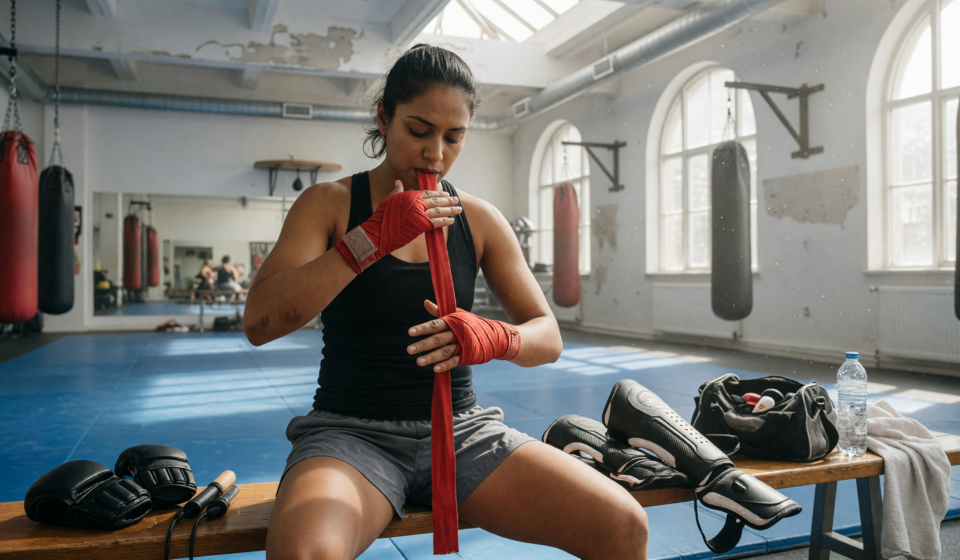
Hand wraps are the unsung hero of striking arts. They are not padding; their job is to hold the small bones of the hand together, support the wrist, and cushion the knuckles so the force of a strike is spread instead of concentrated. Wrap well and you protect a joint that is notoriously easy to injure. Wrap poorly and no glove will save you. In summer, wraps face a second job: managing a river of sweat without turning into a soggy, loose mess mid-session.
There are two broad families. Traditional cotton wraps are breathable and absorbent, which helps in the heat, though they can bunch if you rush the wrap. Semi-elastic “Mexican-style” wraps stretch to hug the hand and tend to stay snug as your hands swell and sweat, which many fighters prefer for hot-weather training. Lengths commonly run from around 120 inches for smaller hands up to roughly 180 inches for larger hands or a thicker wrap, and for competition many gyms move to gauze and athletic tape under supervision. Whatever you choose, own more than one pair so a wrap is always clean and dry.
- Cotton wraps: Breathable and absorbent, a good match for soaking summer sweat if you wrap carefully.
- Semi-elastic wraps: Stretch to stay snug on swelling, sweaty hands and resist loosening during long rounds.
- Length matters: Roughly 120 to 180 inches depending on hand size and how much coverage you want.
- Rotate and wash: Multiple pairs let you train on a clean, dry wrap every session and dry them fully between uses.
👉 Shop cotton and semi-elastic hand wraps on Amazon (Ad — as an Amazon Associate, we earn from qualifying purchases.)
Mouthguards and Warm-Weather Care
A mouthguard is one of the cheapest pieces of protection you own and one of the most important, cushioning teeth and jaw against exactly the kind of contact martial arts delivers. The American Academy of Pediatric Dentistry has long promoted properly fitted mouth protectors to reduce orofacial injuries in sports, and ASTM International has published practice guidance covering the care and use of athletic mouth protectors. The through-line from both is fit and upkeep: a guard that seats well and stays clean does its job, while a warped or grimy one does not.
Summer adds a wrinkle. Boil-and-bite guards are made of heat-sensitive thermoplastic, so leaving one in a hot car or a bag baking in the sun can soften and deform it, ruining the custom fit you worked to create. Heat and moisture also mean a mouthguard that goes back in a sealed bag damp will grow a film fast. Rinse it after every session, let it dry, and store it in a ventilated case, not a sweaty glove.
Heat warning. A mouthguard is thermoplastic by design. A closed car in summer can reach temperatures high enough to soften and warp it, so store guards in a ventilated case and keep them out of direct sun and hot bags.
Fighting the Funk: Sweat, Bacteria, and Skin
Contact sports that combine close skin contact, shared mats, and heavy sweat are a known setting for skin infections, and summer heat only accelerates the growth of the organisms involved. Sports medicine sources, including guidance highlighted by Nationwide Children’s Hospital, point to a familiar trio in grappling and striking arts: bacterial infections such as staph and MRSA, fungal infections like ringworm (tinea), and viral herpes gladiatorum. Warm, damp gear and mats give these a foothold, which is why hygiene is genuine safety equipment, not an afterthought.
The defenses are unglamorous but effective. Moisture-wicking, antimicrobial-treated base layers and rash guards keep skin drier and add a barrier on shared surfaces. Gear that dries fully between sessions is far less hospitable to microbes than equipment stuffed damp into a closed bag. And the oldest advice still holds: shower promptly after training, wash your training clothes every session, and do not ignore a suspicious patch of skin.
- Wicking base layers: Antimicrobial rash guards keep skin drier and add a barrier against shared mats.
- Dry it out: Air gear fully between sessions instead of sealing it damp in a gym bag.
- Wash and shower: Clean training clothes every session and a prompt post-training shower cut infection risk.
- Check your skin: Cover or stay off the mat with any open sore or unexplained rash until it is evaluated.
👉 Shop antimicrobial rash guards and gear-drying/deodorizing products on Amazon (Ad — as an Amazon Associate, we earn from qualifying purchases.)
Hydration and Heat Illness: The Real Risk
No amount of breathable gear cancels out a dangerously hot training environment. Exertional heat illness is a serious, well-documented risk in strenuous activity, and the National Athletic Trainers’ Association, through its position statements and inter-association task force work, treats prevention as a core part of athlete safety. OSHA offers parallel guidance for heat in indoor and outdoor work settings, and a stuffy, poorly cooled gym in July is functionally a hot indoor environment. The common thread is recognizing the spectrum, from heat cramps and heat exhaustion up to life-threatening exertional heat stroke, and acting early.
Practically, that means hydrating before, during, and after training rather than waiting until you are parched, giving your body time to acclimatize to hot conditions over days rather than pushing all-out on the first sweltering day, and building in rest and cool-down breaks. Learn the warning signs, dizziness, nausea, confusion, and a sudden drop in sweating, and stop immediately if they appear. Gear that breathes helps you shed heat, but hydration, acclimatization, and honest self-monitoring are what actually keep heat illness at bay.
- Hydrate on a schedule: Drink before, during, and after training instead of waiting for thirst.
- Acclimatize gradually: Ease into hot-weather intensity over several days rather than all at once.
- Build in breaks: Rest and cool down between hard rounds when the room is hot.
- Know the signs: Dizziness, nausea, confusion, or stopping sweating are red flags to stop and cool down now.
Fit, Sizing, and When to Replace
Breathable gear only protects you if it stays put. Summer sweat makes straps slick and can swell your hands and feet, so recheck the fit of shin guards and headgear once you are warm, not just when you first strap in. A guard that slides mid-round leaves gaps exactly where you need coverage. Wraps should feel snug with your fingers relaxed and not cut off circulation when you make a fist.
Heat and moisture also age equipment faster. Foam that has compressed flat, liners that stay smelly no matter how you wash them, and mouthguards that no longer seat cleanly are all telling you it is time to replace them. Protective gear is a consumable, and pretending a broken-down guard still protects you is how small problems become injuries.
- Recheck when warm: Sweat and swelling change fit, so adjust straps after you have heated up.
- Wraps snug, not tight: Secure with relaxed fingers, no numbness or tingling when you close your fist.
- Watch for breakdown: Flattened foam, permanent odor, and a poor mouthguard seat mean it is time to replace.
👉 Shop replacement mouthguards and ventilated protective sets on Amazon (Ad — as an Amazon Associate, we earn from qualifying purchases.)
The Bottom Line
Summer training rewards fighters who plan for the heat instead of fighting through it. Choose guards that genuinely ventilate, pick hand wraps that support your wrists and knuckles without turning into a wet rag, care for your mouthguard like the thermoplastic tool it is, and treat hygiene and hydration as safety gear in their own right. None of this is expensive or complicated, but together it keeps you sharp, healthy, and on the mat through the hottest weeks of the year. Build the kit once, maintain it honestly, and let the weather be the only thing you have to sweat.
Disclaimer: This article is for general educational purposes only and is not medical, dental, or safety advice. Protective equipment reduces but does not eliminate the risk of injury or illness. Follow the fitting, care, and usage instructions from your gear manufacturer and your instructor, and consult a qualified medical or dental professional for guidance specific to your situation, including any concerns about heat illness or skin infection.
Sources: ASTM International (Standard Practice for Care and Use of Athletic Mouth Protectors, F697); American Academy of Pediatric Dentistry (Policy on Prevention of Sports-Related Orofacial Injuries); National Athletic Trainers’ Association (Exertional Heat Illness position statement and Inter-Association Task Force materials); Occupational Safety and Health Administration (Heat Exposure guidance); Nationwide Children’s Hospital (Wrestling and Skin Conditions).