The Ultimate Travel First-Aid Kit and Health Packing List
The moment a blister opens up two miles into a hike, or a stomach bug hits in a town where you cannot read the pharmacy signs, you learn the same lesson every seasoned traveler already knows: the help you need is the help you brought with you. A well-built travel first aid kit is not about expecting disaster. It is about turning small, common problems into minor inconveniences instead of trip-ending crises, so you can spend your energy on the reason you left home in the first place.
This guide walks you through everything worth packing, organized the way you would actually assemble it. We cover why a dedicated kit earns its space, how to pack and document prescription medicines, the over-the-counter staples that solve most on-the-road ailments, the wound-care basics, and the destination-specific add-ons for bugs, sun, water, and altitude. We finish with the paperwork that matters, how to decide between buying a kit and building your own, and how to keep the whole thing ready for the next departure. The recommendations lean on guidance from the CDC’s Travelers’ Health program and the American Red Cross.
Why a Travel Kit Is Worth the Space
It is tempting to assume you can buy whatever you need wherever you land. Sometimes that is true. Often it is not. Pharmacies keep local hours, stock unfamiliar brands, and may require a conversation you are not equipped to have in the local language. In remote or rural areas, the nearest well-supplied store can be hours away. Even in a major city, hunting for antihistamines at 2 a.m. with a swelling allergic reaction is not the memory you want.
A compact kit collapses all of that uncertainty into a single zippered pouch you already control. The CDC recommends assembling a travel health kit sized to your destination, trip length, and planned activities, so you have familiar remedies on hand before you need them. The kit does not have to be large. It has to be thoughtful, and it has to travel with you rather than getting buried in checked luggage you cannot reach mid-flight.
👉 Shop compact travel first-aid kit on Amazon (Ad — as an Amazon Associate, we earn from qualifying purchases.)
Prescription Medicines: How to Pack and Document Them
Prescription medications are the one category you cannot improvise on the road, so they deserve the most care. The CDC’s core advice is straightforward: pack enough of each medication to cover your entire trip, plus a little extra in case of delays, and keep everything in your carry-on rather than checked baggage where it could be lost or exposed to temperature extremes.
- Original, labeled containers: Keep medicines in the pharmacy-labeled bottles they came in. This helps at security checkpoints and at borders, where officials may need to verify what you are carrying.
- Copies of your prescriptions: Carry a copy of each prescription, ideally noting the generic drug name, which is often more recognizable internationally than a brand name.
- A letter for controlled substances: For controlled medications, the CDC advises carrying a letter from your prescribing clinician on office letterhead explaining what you take and why.
- Extra supply and a backup plan: Pack more than the exact number of doses, and keep a second stash separate from your main kit so a lost bag does not leave you without anything.
- Essential medical devices: Do not forget glasses, contact lenses and solution, inhalers, an EpiPen if prescribed, and any diabetes supplies, along with their documentation.
One more step people skip: check the rules at your destination. Some medications that are routine in the United States are restricted or banned elsewhere. A quick look at the destination country’s regulations before you fly can save you a serious problem at customs.
👉 Shop travel medication organizer on Amazon (Ad — as an Amazon Associate, we earn from qualifying purchases.)
The Over-the-Counter Medicine List
Over-the-counter medicines handle the vast majority of travel ailments, from the queasy bus ride to the sleepless first night in a new time zone. You do not need a pharmacy’s worth of options. You need a short list of proven staples, packed in travel sizes to save room. The CDC’s suggested lineup includes:
- Pain and fever relief: Acetaminophen or ibuprofen covers headaches, minor injuries, and fevers.
- Diarrhea medicine: An anti-diarrheal such as loperamide, and an option like bismuth subsalicylate, for the most common travel illness of all.
- Motion sickness medicine: Useful for winding mountain roads, small boats, and turbulent flights.
- Antihistamines: For allergic reactions, insect bites, and, in some formulations, help with sleep.
- Decongestant and cough drops: Cabin pressure, dry air, and new environments have a way of triggering congestion.
- Antacid and mild laxative: Unfamiliar food and disrupted routines affect digestion in both directions.
Traveling with children changes the math. Pack pediatric formulations dosed by weight rather than assuming you can split an adult tablet, and confirm anything new with your child’s provider before departure.
First-Aid and Wound-Care Basics
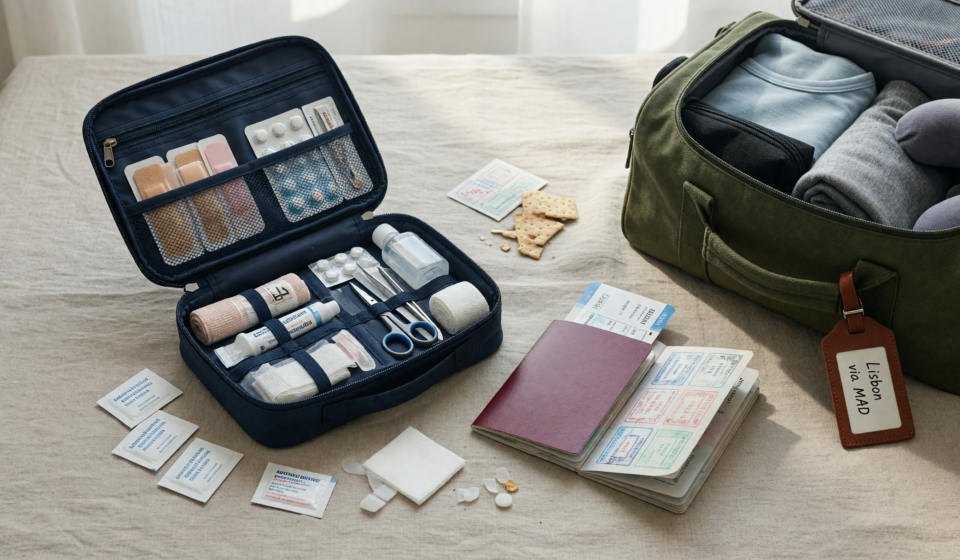
This is the heart of any first-aid kit and the part most people underpack. Scrapes, blisters, and small cuts are the daily reality of active travel, and treating them promptly keeps a minor wound from becoming an infected one far from care. The American Red Cross and CDC both recommend a straightforward set of supplies:
- Adhesive bandages in assorted sizes: Plus blister-specific cushions for anyone doing serious walking.
- Gauze pads and adhesive tape: For wounds too large for a standard bandage.
- Antiseptic wipes and antibiotic ointment: To clean and protect broken skin.
- An elastic wrap bandage: For sprained ankles, wrists, and knees.
- Tweezers and a digital thermometer: For splinters, ticks, and confirming a fever.
- Disposable gloves and hand sanitizer: The CDC advises hand sanitizer with at least 60 percent alcohol for when soap and water are not available.
- Aloe gel and hydrocortisone cream: For burns, rashes, and itchy bites.
One practical flying note: sharp items like scissors and anything over the liquid limit belong in checked baggage or in TSA-compliant sizes. Build your carry-on kit accordingly so nothing gets confiscated at the checkpoint.
Pack the boring stuff. The items that feel unglamorous at home, blister cushions, an elastic wrap, a thermometer, are exactly the ones you will be grateful for on day three of a trip. They weigh almost nothing and solve the problems that actually happen.
Destination-Specific Add-Ons: Bugs, Sun, Water, and Altitude
Here is where a generic kit becomes your kit. The base stays the same; what you add depends on where you are going and what you plan to do. The CDC’s destination guidance points to a handful of categories worth considering:
- Insect protection: An EPA-registered repellent with an active ingredient like DEET or picaridin, essential anywhere mosquitoes or ticks carry disease. Permethrin-treated clothing adds another layer for high-risk areas.
- Sun protection: Broad-spectrum sunscreen with UVA and UVB coverage at SPF 15 or higher, plus lip balm with SPF. Sunburn is easy to underestimate at altitude, near water, and close to the equator.
- Safe water: For remote destinations where tap water is not reliably safe, pack water purification tablets or a portable filter so you always have a way to make water drinkable.
- Altitude and motion: If you are heading high, talk to your provider about altitude sickness medication before you leave. Keep motion sickness remedies handy for the journey itself.
Match the add-ons to reality. A city break in a temperate climate needs very little beyond the basics. A jungle trek, a diving trip, or a high-altitude expedition each calls for its own considerations, and specialized commercial kits exist for exactly those scenarios.
👉 Shop insect repellent and sunscreen on Amazon (Ad — as an Amazon Associate, we earn from qualifying purchases.)
👉 Shop water filter or purification tablets on Amazon (Ad — as an Amazon Associate, we earn from qualifying purchases.)
Documents, Insurance, and Emergency Info
Paperwork is not glamorous, but it is part of your health kit, and it can matter more than any bandage in a real emergency. The CDC recommends carrying the documentation that lets a stranger help you when you cannot help yourself.
- Copies of prescriptions and a medication list: Including generic names and dosages, kept separately from the medicines themselves.
- Health insurance information: Confirm whether your policy covers you abroad, and consider travel health insurance plus medical evacuation coverage for remote or international trips.
- Vaccination records: Where relevant, such as proof of yellow fever vaccination, which some countries require for entry.
- An emergency contact card: With street addresses, phone numbers, and email for your clinician back home, your emergency contacts, and the nearest embassy or consulate.
- Copies of your passport and travel documents: Stored both on paper and securely on your phone.
Note any serious allergies or conditions somewhere a first responder would find them. A medical ID bracelet or a card in your wallet does the talking when you cannot.
Buying a Kit vs. Building Your Own
Both approaches work; the right one depends on your time, your trip, and how particular you are. A pre-made kit is fast, compact, and thoughtfully organized, which is a genuine advantage when you would otherwise never get around to assembling one. Commercial kits also exist for specialized needs like adventure travel, marine trips, and expeditions.
Building your own gives you control. You choose the brands you trust, size the quantities to your trip, and add the specific items a store-bought kit leaves out, your prescriptions, your preferred allergy medicine, the blister care that actually fits your feet. Many experienced travelers do both: start with a quality commercial kit as the base, then customize it. Whichever route you take, the goal is the same, a kit you understand and can use under stress.
Keeping It Trip-Ready
A kit is only as good as its contents on the day you open it. Medicines expire, ointments dry out, and supplies get used and never replaced. Build a simple maintenance habit so your kit is always ready to grab.
- Check expiration dates: Review the whole kit before every major trip and swap out anything expired or close to it.
- Restock after each trip: Replace whatever you used while you still remember what is missing.
- Refresh prescriptions early: Refill well before departure so you are never scrambling, and account for any delays.
- Store it smart: Keep the kit somewhere cool and dry between trips, and keep a running checklist inside so repacking takes minutes.
The Bottom Line
A good travel first aid kit is one of the highest-return items you will ever pack: small, light, and inexpensive, yet capable of turning a ruined day into a footnote. Start with prescription medicines packed and documented the way the CDC advises, layer in the over-the-counter staples and wound-care basics, then tailor the destination-specific add-ons to where you are actually going. Keep your documents in order, decide whether to buy or build, and keep the kit maintained between trips. Do that, and you will travel with the quiet confidence that comes from being ready for the small stuff, so you are free to enjoy the big stuff.
Disclaimer: This article is for general educational purposes only and is not medical advice. It does not replace guidance from a qualified healthcare professional. Before you travel, consult a travel-health provider about your specific medications, vaccinations, and health needs, and check your destination’s rules on medications and any entry requirements.
Sources: CDC Travelers’ Health (Pack Smart; Travel Health Kits, CDC Yellow Book); American Red Cross (first aid and emergency preparedness guidance).